



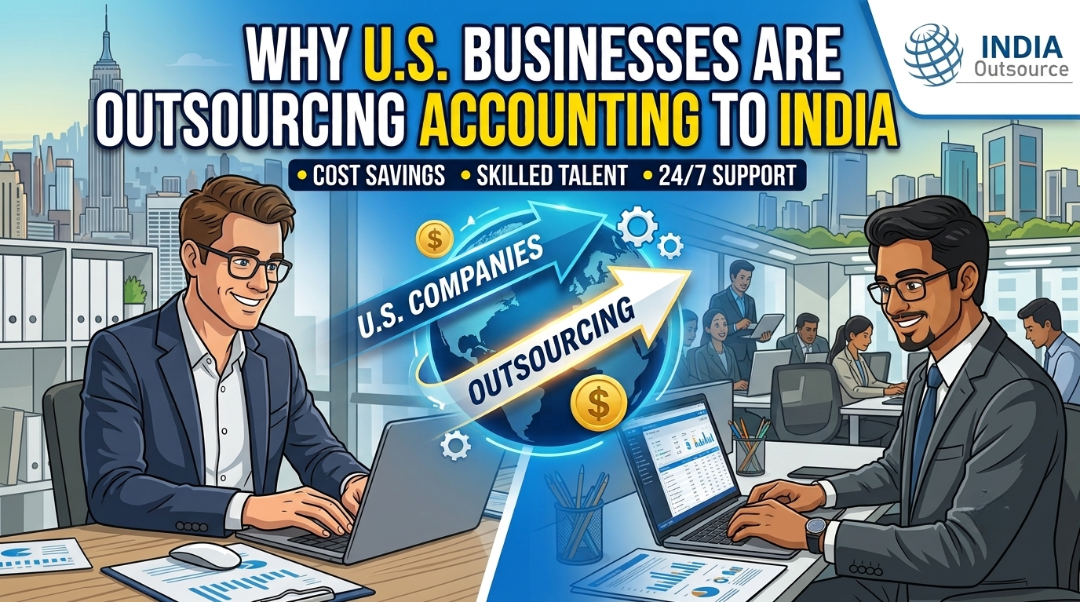
Accounting is not the back office job any longer. It plays a vital role in business expansion, financial management, adherence to regulations, and decision-making.
However, keeping an in-house accountant has become more and more costly and difficult for a lot of businesses in the United States. Companies are questioning the conventional accounting model due to a number of factors that are driving them to reconsider, such as rising wages, the inability to find qualified accountants, heavier workloads, shorter reporting deadlines, and a need for specialized skill sets.
This is where outsourcing accounting services in India has become strategic alternative.
India offers US businesses access to a large pool of accounting professionals, experience with US accounting practices and software, flexible staffing models, and potentially significant cost efficiencies. Recent industry research continues to identify talent availability, technology, scalability, and cost reduction as major drivers behind accounting outsourcing to India.
For many companies, the question is no longer simply:
“Can we outsource accounting?”
It has become:
“How can we build a smarter accounting operation by combining our US team with global accounting talent?”
In this guide, we will explore why US businesses are outsourcing accounting to India, which services they outsource, the benefits and risks involved, how the process works, and how to choose the right outsourcing partner.
What Is Accounting Outsourcing to India?
Accounting outsourcing involves outsourcing the duties of accounting and financial related tasks to external expert team.
A US company can instead work with an accounting outsourcing provider in India, rather than hiring, training, managing, and retaining every accounting employee.
Depending on the company’s requirements, outsourced accounting teams can support:
- Bookkeeping
- Accounts payable
- Accounts receivable
- Bank reconciliation
- General ledger maintenance
- Payroll support
- Financial reporting
- Month-end closing
- Tax preparation support
- Audit support
- Accounts reconciliation
- Financial data entry
- Management reporting
- Controller support
- CFO support
- Accounting cleanup
- QuickBooks management
- Xero accounting
- NetSuite accounting
- Sage accounting
- Financial analysis
Modern cloud accounting software offers a much simpler way for international collaboration as accounting teams can access and use shared financial systems, digital documents, automated workflows, and real-time reporting tools.
Why Are US Businesses Outsourcing Accounting to India?
There isn’t one single reason.
For most businesses, it’s a result of cost squeeze, talent shortage, scale, technology uptake, and the need to make the most of their internal resources.
Here are the major reasons.
1. Significant Cost Savings
One of the biggest reasons companies outsource accounting to India is cost efficiency.
Maintaining an in-house accounting department involves much more than employee salaries.
A US business may need to pay for:
- Salaries
- Payroll taxes
- Health benefits
- Paid leave
- Recruitment
- Training
- Office space
- Hardware
- Software
- Employee benefits
- Management overhead
- Employee replacement costs
Outsourcing converts many of these fixed costs into a more flexible operating expense.
Industry providers commonly report potential savings in the 40%–60% range, although actual savings vary significantly based on the work’s complexity, staffing model, service level, and provider.
The important point is that businesses shouldn’t evaluate outsourcing purely by hourly rates.
The better question is:
“What is my total cost of delivering this accounting function internally versus outsourcing it?”
When recruitment, benefits, technology, management, and infrastructure are included, the economics can become considerably more attractive.
2. Access to a Large Accounting Talent Pool
Finding experienced accounting professionals in the US can be difficult, particularly for businesses competing for experienced bookkeepers, accountants, controllers, and specialized finance professionals.
India has developed a substantial professional services ecosystem supporting global companies.
Indian accounting professionals can have experience with:
- US GAAP
- IFRS
- Bookkeeping
- Financial reporting
- Tax support
- Audit preparation
- Accounts payable
- Accounts receivable
- Payroll processes
- Cloud accounting
- Financial analysis
Industry research published in 2026 identifies access to skilled talent as one of the central reasons US firms are considering accounting outsourcing to India.
This allows US companies to expand their accounting capacity without relying exclusively on local recruitment.
3. The US Accounting Talent Shortage
The accounting profession in the United States is facing long-term workforce challenges.
For businesses and CPA firms, this creates a difficult situation:
More work + fewer available professionals + higher hiring costs = pressure on accounting teams.
Accounting outsourcing provides another way to address this capacity problem.
Rather than waiting months to find the perfect candidate for every accounting position, companies can access an established offshore team and begin delegating appropriate processes.
This is especially valuable during:
- Tax season
- Month-end close
- Year-end close
- Audit season
- Business expansion
- M&A activity
- New client onboarding
- Rapid growth periods
The result is a more flexible approach to workforce management.
4. Scalability Without Constant Hiring
Business workloads don’t remain constant.
A company may have relatively manageable accounting requirements for most of the year but experience significant increases during tax season, audits, financial close, or rapid growth.
Hiring permanent employees for every temporary workload spike isn’t always financially efficient.
Outsourcing allows companies to scale accounting capacity based on demand.
For example:
Small workload:
A business may use one dedicated offshore bookkeeper.
Growing business:
It may add accounts payable and accounts receivable support.
Larger operation:
It may build a dedicated offshore accounting team.
Peak season:
Additional resources can be added temporarily.
This flexibility is one of the major advantages of outsourced accounting.
5. Focus on Core Business Activities
Accounting is essential, but not every accounting task needs to be performed by the business owner or senior management.
Business owners often spend valuable time dealing with:
- Transaction categorization
- Invoice processing
- Bank reconciliation
- Accounts receivable
- Accounts payable
- Expense management
- Routine reporting
These activities can consume significant management time.
By outsourcing repetitive accounting tasks, internal leadership can focus more heavily on:
- Business development
- Sales
- Customer relationships
- Product development
- Strategy
- Expansion
- Hiring
- Innovation
In other words:
Outsourcing isn’t simply about reducing accounting costs. It’s about reallocating valuable human attention.
6. Expertise in Popular Accounting Software
Cloud accounting has transformed how companies collaborate with external accounting teams.
Many outsourcing providers work with platforms such as:
- QuickBooks
- QuickBooks Online
- Xero
- NetSuite
- Sage
- Zoho Books
- Microsoft Excel
- Bill.com
- Other cloud-based finance platforms
This means an outsourced team doesn’t necessarily need to operate in a separate accounting environment.
Instead, the provider can work within the company’s existing technology stack.
This creates a more integrated workflow between the US management team and the offshore accounting team.
7. Time-Zone Advantages
The time difference between the US and India can be turned into an operational advantage.
A US company can assign accounting work at the end of its business day.
The US team can shutdown while the offshore team can continue to work on them.
On the next morning when the US team gets to work, the tasks that have been completed may be available for review.
This model can be particularly useful for:
- Reconciliations
- Bookkeeping
- Data processing
- Reporting
- Invoice processing
- Accounting cleanup
- Month-end preparation
But, advantages of time zones should not be taken for granted. Clear deadlines, overlapping working hours, effective communication and good workflow management are key.
8. Improved Accounting Turnaround Time
Outsourcing can add on to the existing accounting team without overloading them.
For instance, an individual inside an accounting firm can specialize in:
- Financial analysis
- Management reporting
- Review
- Decision support
While the offshore team handles:
- Transaction processing
- Reconciliations
- Accounts payable
- Accounts receivable
- Data preparation
This division of responsibilities can improve workflow efficiency.
Instead of one employee doing everything, accounting work is divided according to specialization.
9. Support During Tax and Audit Seasons
Seasonal workload is one of the biggest challenges for accounting firms and businesses.
During busy periods, companies may suddenly need additional resources for:
- Tax preparation support
- Audit documentation
- Account reconciliation
- Client bookkeeping
- Financial statement preparation
- Data gathering
- Workpaper preparation
An outsourced accounting team can provide additional capacity without requiring the company to permanently expand its internal workforce.
For US CPA firms in particular, this can make outsourcing a useful capacity-management strategy.
10. Access to Specialized Accounting Skills
Outsourcing isn’t limited to basic bookkeeping.
Depending on the provider, businesses can access specialists for:
- Financial reporting
- Controller services
- Tax preparation support
- Payroll accounting
- Audit support
- Accounts payable
- Accounts receivable
- Management accounting
- Financial analysis
- CFO support
This allows a company to build a finance function around specific expertise rather than hiring one employee who must perform every accounting responsibility.
11. Better Operational Efficiency
A well-designed outsourcing arrangement can improve accounting processes through:
- Standard operating procedures
- Defined workflows
- Automated approvals
- Digital documentation
- Cloud accounting
- Task management
- Review processes
- Quality controls
- Performance metrics
The goal should not be simply to move accounting work from one country to another.
The real objective should be:
Build a more efficient accounting operation.
12. Data-Driven Financial Reporting
Accurate bookkeeping is the foundation of good financial decision-making.
When books are updated consistently, management can gain better visibility into:
- Revenue
- Expenses
- Cash flow
- Accounts receivable
- Accounts payable
- Profitability
- Liabilities
- Financial trends
An outsourced accounting team can assist in keeping financial information up-to-date for timely reporting.
This can enable business owners and financial leaders to make decisions on the basis of the latest information instead of the old spreadsheets.
What Accounting Services Can US Businesses Outsource to India?
Almost every repetitive or process-driven accounting activity can potentially be outsourced, subject to the company’s regulatory, contractual, and professional requirements.
Common outsourced accounting services include:
Bookkeeping
- Transaction recording
- Account categorization
- Bank reconciliation
- Credit card reconciliation
- General ledger maintenance
- Journal entries
- Accounting cleanup
Accounts Payable
- Invoice processing
- Vendor management
- Payment preparation
- Expense verification
- AP reconciliation
Accounts Receivable
- Customer invoicing
- Payment tracking
- Receivables reconciliation
- Aging reports
- Collections support
Payroll Accounting Support
- Payroll data preparation
- Payroll reconciliation
- Payroll journal entries
- Employee expense accounting
Financial Reporting
- Profit and loss statements
- Balance sheets
- Cash-flow reporting
- Management reports
- Financial dashboards
Tax Support
Outsourced teams may also provide tax-related preparation and administrative support, depending on their qualifications, the engagement structure, and applicable US professional requirements.
Audit Support
Offshore teams can assist with:
- Workpaper preparation
- Documentation
- Reconciliations
- Supporting schedules
- Data gathering
- Audit request management
Accounting Outsourcing vs. Hiring In-House
| Factor | In-House Accounting | Outsourced Accounting to India |
| Hiring | Local recruitment required | Access to offshore talent |
| Cost structure | Salary + benefits + overhead | Flexible service cost |
| Scalability | Hiring required | Easier to scale |
| Talent availability | Can be limited | Larger global talent pool |
| Technology | Company-managed | Provider-supported or shared |
| Seasonal capacity | Requires temporary/permanent hiring | Flexible staffing |
| Management | Direct employee management | Vendor/team management |
| Time-zone coverage | Primarily local | Potential extended coverage |
| Specialized skills | May require additional hires | Can access specialists |
| Long-term flexibility | Lower | Higher |
This will vary depending on the size and complexity of the business, the level of security the business requires, how much control the business desires to have, and its budget.
Some companies will find a hybrid approach to be the optimal solution.
Why India Instead of Other Outsourcing Destinations?
India has become a major destination for global business-process and professional services for several reasons.
These include:
- Large professional talent pool
- Strong English communication
- Established outsourcing ecosystem
- Experience supporting international businesses
- Accounting and finance education
- Technology infrastructure
- Familiarity with global accounting software
- Competitive operating costs
- Flexible staffing models
Industry guides published in 2026 continue to highlight India’s combination of accounting talent, technology capability, communication, and cost efficiency as key reasons for its popularity among US businesses.
Is Outsourcing Accounting to India Safe?
This is one of the most important questions US business owners should ask.
Financial data is highly sensitive.
A reputable outsourcing relationship should therefore include strong controls around:
- Data access
- User permissions
- Password security
- Multi-factor authentication
- Confidentiality
- Secure file sharing
- Employee background checks
- Data retention
- Backup procedures
- Incident response
- Vendor access
- Employee training
Companies should also evaluate relevant security certifications and contractual protections.
Avoid choosing providers just based on the criteria of low price.
The right provider has to allow for security, control, accuracy, accountability in the process.
How Much Does It Cost to Outsource Accounting to India?
There is no universal price.
The cost depends on:
- Type of accounting work
- Number of transactions
- Business size
- Number of accounts
- Software used
- Required expertise
- Reporting requirements
- Service hours
- Dedicated vs. shared resources
- Tax-season workload
- Complexity of the engagement
Industry sources commonly cite substantial savings compared with equivalent US staffing, with many providers reporting roughly 40%–60% overall savings in appropriate engagements. Actual results can vary significantly.
Therefore, businesses should compare total cost of ownership, not simply hourly rates.
What Does the Accounting Outsourcing Process Look Like?
In order for outsourcing to be successful, it must have a framework that guides the process.
Step 1: Identify Accounting Tasks
The first step is to make a record of the functions performed by the accounting team.
Separate tasks into:
- Strategic
- Routine
- Repetitive
- Specialized
- Compliance-sensitive
This can help to make a decision regarding what functions to keep in-house and what can be outsourced.
Step 2: Define Your Requirements
Determine:
- Required staffing
- Software
- Working hours
- Reporting requirements
- Communication expectations
- Service-level agreements
- Review procedures
Step 3: Select an Outsourcing Provider
Evaluate potential providers based on:
- Experience
- Accounting expertise
- US client experience
- US GAAP knowledge
- Security controls
- Technology
- Communication
- References
- Pricing
- Scalability
Step 4: Establish Processes
Create:
- SOPs
- Checklists
- Approval workflows
- Escalation procedures
- Reporting schedules
- Quality-control processes
Step 5: Start With a Pilot
Rather than outsourcing everything at once, it is advisable to start with one defined process.
For example:
Phase 1: Bank reconciliation
Phase 2: Bookkeeping
Phase 3: Accounts payable
Phase 4: Financial reporting
Phase 5: Additional finance support
This reduces transition risk and allows both teams to refine the workflow.
How to Choose the Best Accounting Outsourcing Company in India
Selecting a good partner is crucial for successful outsourcing.
Here are the most important factors to evaluate.
1. US Accounting Experience
Ask whether the provider regularly supports US companies and understands US accounting requirements.
2. Qualified Professionals
Understand who will actually perform the work.
Don’t evaluate only the sales team.
Ask about:
- Qualifications
- Experience
- Training
- Team structure
- Supervisory review
3. Technology Expertise
Confirm experience with the accounting platforms your business uses.
4. Security
Ask for evidence of:
- Security controls
- Access management
- Data protection
- Employee security training
- Relevant certifications
5. Communication
Communication problems can quickly undermine an outsourcing relationship.
Look for:
- Dedicated points of contact
- Clear escalation processes
- Regular meetings
- Defined response times
- Transparent reporting
6. Quality Control
Ask how the provider reviews accounting work before delivery.
7. Scalability
Your provider should be able to grow with your business.
8. Transparent Pricing
Be careful about any hidden costs in fees and select only those vendors whose pricing is clear.
Avoid providers whose pricing structure is unclear.
Common Concerns About Outsourcing Accounting to India
Outsourcing has many benefits, but it is also risky.
Here are some common concerns.
Data Security
All financial information should be protected with the help of the necessary technical, organizational, and legal approaches.
Communication
Different timing may cause communication issues due to poor design of the working process.
Quality
Not every provider has the same standards.
It is necessary to check their quality and make sure that there are clear quality control processes in place.
Loss of Control
Companies sometimes worry that outsourcing means giving up control.
In reality, a well-structured arrangement can preserve management oversight through:
- Access controls
- Review procedures
- Approval requirements
- Dashboards
- SLAs
- Performance reports
Compliance
Outsourcing does not mean that the company is relieved of its obligations in respect of legal responsibilities.
Businesses need to clearly define responsibilities in terms of outsourcing and consult with the experienced professionals from America if they are faced with legal, tax, and regulatory obligations.
Who Should Outsource Accounting to India?
Accounting outsourcing can be particularly attractive for:
Small Businesses
Companies that need professional accounting support without building a large internal finance department.
Startups
Growing businesses that want to control overhead while establishing strong financial processes.
E-commerce Businesses
Companies dealing with high transaction volumes, multiple payment platforms, and complex reconciliations.
CPA Firms
Accounting firms that need additional capacity during tax season or want to increase client capacity without proportionally increasing US headcount.
Real Estate Companies
Companies handling various properties together with contractors, tenants, and finances.
Professional Services Firms
Companies requiring proper bookkeeping, invoicing, expenses recording, and reporting.
Growing Mid-Market Companies
Businesses that need a larger finance function but aren’t ready to build every role internally.
.
Why Accounting Outsourcing Is Becoming a Strategic Decision
The major misconception regarding outsourcing is that it is concerned merely with labor cost reduction.
Modern accounting outsourcing is much broader.
It can help businesses:
Reducing expenditures → attracting professional staff → Increasing capacity → Improving processes → Faster development → Focusing on growth
Thus, outsourcing is an operating model that is much more than just a way of cutting costs.
The opportunity for a developing US Companiesto increase its accounting capacity without any long-lasting recruitment is a true competitive advantage.
Conclusion: Is Outsourcing Accounting to India Right for Your Business?
The accounting landscape is changing.
US businesses are under pressure to control costs, find qualified professionals, increase efficiency, and deliver accurate financial information faster.
Outsourcing accounting to India can address several of these challenges at the same time.
The biggest benefits can include:
- Lower operating costs
- Access to skilled accounting talent
- Flexible staffing
- Scalable finance operations
- Extended working-hour coverage
- Technology expertise
- Faster processing
- Support during busy seasons
- More time for strategic activities
Nevertheless, effective outsourcing is not simply about opting for the low-cost option.
It is primarily focused on selecting the correct provider, utilizing the appropriate processes, employing the best technology, and putting the right monitoring techniques and controls in place.
Once properly applied, outsourcing of accounting functions can change finance from a place of costly hiring to a scalable and positive business unit meant for facilitating growth.
Ready to Build a Smarter Accounting Team?
Contact Us Today
FAQs
1. Why are US businesses outsourcing accounting to India?
US businesses are outsourcing accounting to India primarily to access skilled accounting professionals, improve operational flexibility, manage costs, scale finance operations, and handle growing accounting workloads. Industry sources also identify technology, communication, and scalability as important factors.
2. Is accounting outsourcing to India cheaper than hiring in the US?
It can be significantly less expensive, particularly when total employment costs are considered. Industry providers commonly report savings of approximately 40%–60%, but actual savings depend on the type and complexity of services outsourced.
3. Can Indian accountants work with US GAAP?
Yes. Many Indian accounting professionals and outsourcing firms have experience with US GAAP and US accounting software. However, businesses should verify the specific qualifications and experience of the team assigned to their account.
4. Can I outsource QuickBooks bookkeeping to India?
Yes. QuickBooks is commonly used by accounting outsourcing providers supporting US businesses. You should first check the practical experience of the provider concerning the exact version of QuickBooks you intend to use and implement access control procedures.
5. Is outsourcing bookkeeping to India safe?
Yes, provided that the business makes sure to pick a reputable provider and guarantee access and vendor management, confidentiality and security.
6. Can small businesses outsource accounting to India?
Yes. Small businesses are often good candidates because outsourcing can provide access to professional accounting support without the expense of building a large internal finance department.
7. Can CPA firms outsource accounting work to India?
Yes. CPA firms often delegate some part of their non-core operations to offshore teams, such as bookkeeping, accounting, tax assistance, reconciliation, and other business back-office functions, if they comply with professional and legal provisions.
8. How do I start outsourcing accounting to India?
Begin your outsourcing process with determining your routine accounting tasks, analyzing what you need, looking for appropriate service providers, checking their security level and references, and developing the process.