



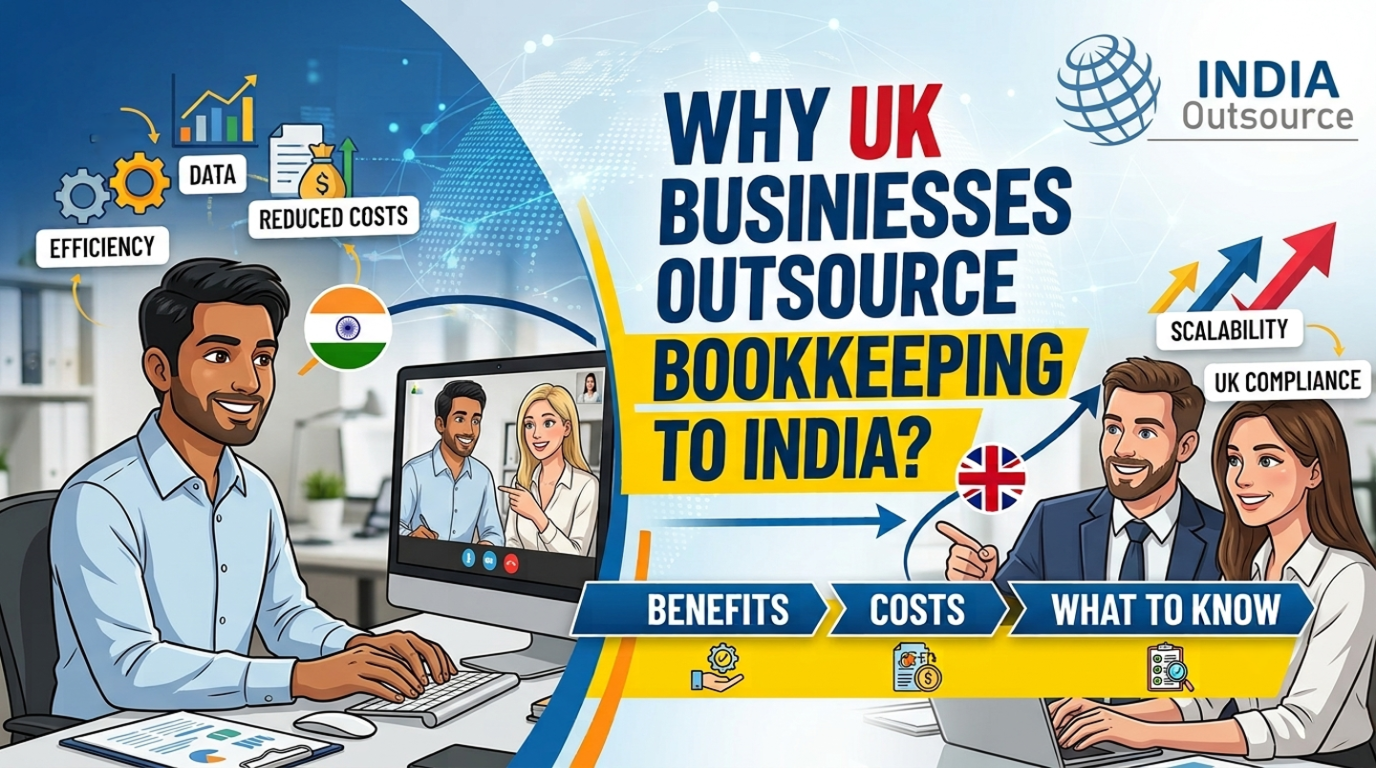
Bookkeeping is an essential part of the financial framework of every successful business, but for many businesses in the UK, keeping it in-house is becoming increasingly expensive, time consuming and difficult to scale. Cities have embraced this change, which includes a rapid rise in employment expenses, compliance demands, and a lack of qualified finance personnel, among other factors. Businesses are seeking a smarter approach to managing their accounts without sacrificing accuracy, and cities have taken to this change.
That is why outsource bookkeeping to India has grown more popular among businesses in the UK.
India is known for having a large workforce of accounting professionals, low operating costs, and technology-driven bookkeeping services, which are experienced to support international clients. Outsourcing bookkeeping can offer cost savings, efficiency, expertise and time to concentrate on business growth for UK companies.
However, does outsourcing your bookkeeping to India make sense for your business?
In this guide, we explore the reasons why businesses in the UK outsource their bookkeeping tasks to India, the benefits, challenges, costs, technology, and finally, how to select the right outsourcing partner.
What Is Bookkeeping Outsourcing?
Bookkeeping outsourcing refers to hiring a service provider outside of your company for manage some or all of your accounting and bookkeeping duties.
Rather than having an in-house bookkeeper employed full-time, a UK company can hire experts based in India to perform several tasks, such as:
- Recording sales and purchase transactions
- Bank and credit card reconciliations
- Accounts payable and receivable
- Invoice processing
- Expense management
- Payroll support
- General ledger maintenance
- Financial data entry
- Management accounts preparation
- Month-end bookkeeping
- VAT bookkeeping support
- Financial reporting
The UK business continues to make financial decisions and the outsourced team manages the day to day and operational bookkeeping.
Why UK Businesses Outsource Bookkeeping to India
UK companies have different reasons to choose India for bookkeeping services. This has to do with different aspects of business including reduced costs, specialized skills, scalability, technology, and efficiency.
Let’s look at the biggest reasons.
1. Significant Cost Savings
The ability to cut down on overheads is one of the main reasons why businesses employ outsourced bookkeepers from India.
There is so much more to the hire of an in-house bookkeeper in the UK than just wages. Employers may also have to consider:
- Recruitment costs
- Employer National Insurance
- Pension contributions
- Employee benefits
- Office space
- Equipment
- Software
- Training
- Sick leave and holidays
- HR and administrative expenses
By outsourcing, businesses can eliminate a number of these fixed costs and instead have a more predictable service expense.
UK businesses could also find reliable bookkeeping services at a much lower price in India, as operational and employment expenses may be reduced.
The result?
Maintaining business bookkeeping support can allow businesses to focus their resources on sales, marketing, technology, customer service, and growth.
2. Access to a Large Pool of Skilled Accounting Professionals
There is a significant number of accountants, bookkeepers, accounting graduates and finance professionals in India.
This provides UK enterprises with experts who have experience in the following areas:
- Bookkeeping
- Accounting
- Financial reporting
- Payroll processing
- VAT support
- Accounts payable
- Accounts receivable
- Reconciliation
- Management reporting
- Cloud accounting software
In times when finding local finance talent has proven difficult for businesses, outsourcing can bring in a larger pool of talent.
A specialist outsourcing firm can recruit the right team for the company in a matter of weeks or months, while a hiring process that is typically lengthy could take months.
3. Lower Recruitment and Training Burden
Hiring an experienced bookkeeper is a time consuming process.
One has to post an advertisement, go through applications, interview, do background checks, make an offer, bring him/her on board and train him/her on their internal processes.
After the recruitment process, employee turnover can be a challenge.
Outsourcing shifts a great deal of the responsibility for recruitment and workforce management to the service provider.
A trustworthy outsourcing result may hire, educate, oversee and administer bookkeepers for their clients.
This enables business owners and managers in the UK to focus on running their business, rather than recruitment.
4. Focus on Core Business Activities
While bookkeeping is very important, it may not be the most productive use of a business owner’s time.
As an entrepreneur you should pay attention to the things that will really help you grow such as:
- Winning new customers
- Improving products and services
- Building partnerships
- Managing employees
- Developing marketing strategies
- Expanding into new markets
By outsourcing basic accounting, in-house teams are freed up for more valuable activities.
Rather than spending hours each week pursuing invoices, recording transactions, and reconciling accounts, those running their businesses can now concentrate on growing their companies.
5. Access to Modern Accounting Technology
A lot of bookkeeping outsourcing companies are implementing cloud-based bookkeeping and business management software.
They can involve the use of platforms like:
- Xero
- QuickBooks Online
- Sage
- Microsoft Excel
- Other cloud accounting and financial management systems
Cloud technology enables UK businesses and their outsourced teams to collaborate remotely.
Financial data can be accessed safely, transactions can be processed effectively and reports can be shared without everyone needing to be in the same physical office.
6. Flexible and Scalable Bookkeeping Support
Business needs change.
Bookkeeping for a small business may only need a few hours of bookkeeping per week during the initial stages. The more the product grows, the more transactions are required, more reporting is needed and the more complex the work of the finances becomes.
Outsourcing can provide greater flexibility than maintaining a fixed internal team.
For example, a business may outsource:
- Basic bookkeeping initially
- VAT bookkeeping as it grows
- Payroll support later
- Management accounts as reporting requirements increase
- Additional accounting support during busy periods
This means that outsourced bookkeeping is a valuable option for startups, small to medium businesses, ecommerce companies, professional service providers, property businesses and businesses that are growing in the United Kingdom.
7. Extended Working Hours and Time-Zone Advantages
Time differences between the UK and India can be an advantage for operations.
With proper management, an Indian bookkeeping group can engage in monetary obligations away from the regular work hours in the UK.
This opens the opportunity for a “follow-the-sun” workflow.
For example, the volume of bookkeeping work that can be handed over in the UK during the day can be processed by an Indian team during their working hours, providing work done by the Indian team available to the UK team the next morning.
This will help in decreasing turnaround times and keep the businesses more continuous in the workflow.
8. Faster Turnaround for Routine Tasks
Bookkeeping professionals out of your company may be specialists in financial procedure driven tasks.
They have clear procedures and staffing to effectively manage the following high volume activities:
- Invoice entry
- Bank reconciliation
- Expense categorisation
- Accounts receivable updates
- Accounts payable processing
- Data verification
A good outsourcing deal can therefore assist companies to stay with a more consistent bookkeeping schedule.
9. Better Business Continuity
So what do you do when your sole in-house bookkeeper leaves on holiday, falls ill or just decides to leave the company?
When a critical employee leaves a small business, there can be negative consequences.
There could be several team members at the outsourcing company that are familiar with the client’s processes.
This provides further operational resilience that if one person is responsible it is not enough.
A good provider should also have documentation of processes, backup procedures, quality monitoring and the necessary data-security measures in place.
10. Improved Financial Visibility
Proper and timely bookkeeping provides business owners with more insight into their financial situation.
With consistent bookkeeping, businesses can more easily track:
- Revenue
- Expenses
- Cash flow
- Outstanding invoices
- Supplier payments
- Profitability
- Financial trends
This data can help inform decision making.
With the help of more up-to-date financial data, business owners can make decisions that are more informed and effective than what they could do with outdated spreadsheets or incomplete records.
11. Support for UK Accounting and VAT Processes
There are accounting and tax requirements specific to businesses in the UK.
It’s crucial to select an outsourcing bookkeeping service that has experience in handling UK companies.
A good provider can facilitate activities relating to:
- VAT records
- VAT-related bookkeeping
- UK chart of accounts
- Bank reconciliations
- Management accounts
- Year-end preparation
- Accounts payable and receivable
But, companies should differentiate between bookkeeping support and regulated tax or statutory accounting services. For some duties, it may be necessary to hire someone with a UK qualification in accountancy or taxation regardless of their location.
12. Outsourcing Can Be More Efficient Than Hiring In-House
Why use outsourcing is not just about the lower cost.
It’s actually about securing the right mix of people, processes, technology, supervision, and scaling without having to build it all in-house.
For a lot of SMEs, a full blown finance department may not be the best financial choice.
Outsourcing enables companies to make use of specialty resources without incurring excessive costs related to a full-sized internal team.
How Much Does It Cost to Outsource Bookkeeping to India?
The price of outsourced bookkeeping services depends on various aspects.
These can include:
- Number of transactions
- Number of bank accounts
- Business size
- Complexity of bookkeeping
- Number of employees
- Payroll requirements
- VAT requirements
- Accounting software
- Reporting requirements
- The hours needed for the task.
- Experience in accounting and financial matters.
- The location and reputation of the service provider.
Some providers have hourly rates, others provide monthly packages, or even a dedicated-team model.
Not all the cheapest is the best.
UK companies need to consider all aspects of the value provided, such as accuracy, delivery time, communication, data security, software knowledge, quality control, and scalability.
In-House Bookkeeping vs Outsourcing to India
|
Factor |
In-House Bookkeeping | Outsourced Bookkeeping to India |
| Recruitment | Business handles recruitment | Provider handles staffing |
| Employment costs | Generally higher | Potentially lower |
| Scalability | Can be slower | Usually more flexible |
| Training | Internal responsibility | Provider-led |
| Staff absence | Can disrupt operations | Team-based models may reduce disruption |
| Technology | Business-funded | Often provided by outsourcing partner |
| Talent pool | Local recruitment market | Access to broader talent pool |
| Management | Internal management required | Provider manages team |
| Flexibility | Depends on employee capacity | Can scale resources as needed |
The right choice will depend on the size and complexity of the business, internal capabilities and long term plans.
What Bookkeeping Tasks Can UK Businesses Outsource to India?
Depending on the provider and the company’s needs, almost any sort of bookkeeping tasks can be out sourced.
Common outsourced services include:
Accounts Payable
- Supplier invoice processing
- Invoice verification
- Payment scheduling support
- Vendor statement reconciliation
Accounts Receivable
- Customer invoice processing
- Payment allocation
- Outstanding invoice tracking
- Receivables reporting
Bank Reconciliation
An outsourced bookkeeper can verify the matching of transactions with banking statements and pinpoint any mismatches that need to be resolved.
Expense Management
Expense categorisation, receipt processing, receipt reconciliation and expense bookkeeping can be outsourced by businesses.
Payroll Support
Some providers will also provide administrative help and payroll processing, but UK businesses need to make sure they are aware of the relevant payroll requirements in the UK.
Management Accounts
Periodic financial reports which facilitate the understanding of business performance can be outsourced to businesses.
Month-End Bookkeeping
A team of people can help you close your monthly books, reconcile, review ledgers, and prepare reports.
Is Outsourcing Bookkeeping to India Safe?
Security is one of the primary concerns for enterprises in UK when they are considering offshore bookkeeping.
A bookkeeping services provider can deal with extremely sensitive data such as monetary transactions, supplier details, client details, and payroll details.
So, companies need to do proper due diligence before choosing a provider.
Look for:
- Strong access controls
- Secure data transfer
- Role-based permissions
- Confidentiality agreements
- Data backup procedures
- Employee security training
- Documented processes
- Appropriate data-protection practices
- Business continuity plans
- Clear client data ownership policies
UK companies should also be mindful of the requirements of relevant data protection legislation, and have appropriate documentation of their outsourcing contracts.
Do not hire an outsourcing company on a cheap price basis. Data security, reliability, transparency, and accountability are equally important.
How to Choose the Right Bookkeeping Outsourcing Company in India
The selection of the appropriate service provider is crucial to ensuring that the outsourcing relationship is a success rather than a costly blunder.
Consider the following factors.
1. UK Bookkeeping Experience
Inquire if the provider has experience dealing with UK businesses and is aware of the workflows in accounting for UK businesses.
2. Qualified and Experienced Staff
Discover who will be responsible for your accounts and their training and experience.
3. Accounting Software Expertise
Ensure that the provider has experience with the accounting software that your business uses.
4. Quality Control
Inquire if bookkeeping is checked prior to delivery.
The process can be strong as well as have several levels of checks, not solely on one bookkeeper.
5. Communication
Time-zone benefits only come in play when communication is effective.
Establish:
- Primary points of contact
- Response-time expectations
- Meeting schedules
- Escalation procedures
- Reporting frequency
6. Data Security
Ask how the provider protects client information and controls employee access to sensitive financial data.
7. Transparent Pricing
Do not have confused pricing systems.
The contract should make it clear what’s covered, what’s not, and how extra work is charged.
8. Scalability
Select a partner that will be able to assist you as you increase your transaction volume and bookkeeping needs.
Common Concerns About Outsourcing Bookkeeping to India
Although outsourcing has its benefits, UK companies are reluctant to do it due to common issues.
“Will communication be difficult?”
Not necessarily.
Several companies in India provide outsourcing services. They work together with UK clients by means of regular e-mail and video conferences, project management systems and instant messaging.
The secret is to set up processes from the outset.
“Will the quality be good?”
Quality is dependent upon the provider.
An expert outsourcing firm should possess well-trained employees, procedures documented, reconciliation plans, supervision and quality checks.
“Will I lose control of my finances?”
Commissioning a bookkeeping service doesn’t imply you lose control of your finances.
You can keep the approval rights, review reports, control access to the bank and take all strategic financial decisions while the outsourced team does the agreed bookkeeping work.
“Is India only suitable for large companies?”
No.
Bookkeeping outsourcing can be especially beneficial for SMEs as they are not likely to have the resources or budget to sustain a large finance department.
The Future of Bookkeeping Outsourcing for UK Businesses
Bookkeeping is evolving in the digital field.
The landscape of financial data processing is transforming with cloud accounting, automation, AI, payment integration, and digital document management. Cloud accounting, automation, AI, payment integration, and digital document management are reshaping financial data processing.
This signifies that the way forward in outsourcing bookkeeping services is probably going to be more than in pulling a few data figures.
More and more, outsourcing providers are placed to assist businesses in the following areas:
- Automated transaction processing
- Digital invoice workflows
- Real-time reporting
- Cloud accounting
- Financial dashboards
- Process automation
- Data analysis
- Virtual finance support
In the UK, this is a chance to make the finance department more effective while not adding to the staff size.
Is Outsourcing Bookkeeping to India Right for Your UK Business?
Outsourcing may be a good option if your business:
- Is there excessive time being spent on day to day bookkeeping?
- Wants to reduce finance-related operating costs
- Has difficulty recruiting bookkeeping staff
- Needs flexible accounting support
- Is experiencing rapid growth
- Wants access to specialist bookkeeping talent
- Uses cloud accounting software
- Needs support during busy periods
- Wants its internal team to focus on higher-value activities
However, outsourcing is not automatically the right answer for every business.
Other companies, such as those that have very complicated financial arrangements, that need internal-control frameworks or have a strong desire to have fully internal finance teams may opt for a different option.
The answer lies in understanding your needs and choosing an operating model that meets the cost, control, quality, security and scale.
Conclusion: Why UK Businesses Outsource Bookkeeping to India
It’s more than about cost-cutting when it comes to outsourcing bookkeeping to India.
It’s a strategic solution for many UK businesses to gain access to talent, enhance efficiency and scale their finance function, alleviate administrative burden, and enable internal staff to concentrate on growth.
A UK business can develop a bookkeeping process that’s efficient, technologically advanced, scalable and cost-effective with the right outsourcing partner.
The most crucial is selecting a provider who is aware with UK businesses, has robust quality management, can keep private financial data, has effective communication, and is scalable enough to grow with your business.
Ready to Reduce Your Bookkeeping Workload?
Get in touch today to discuss your bookkeeping requirements
Contact Us Today
FAQs
1. Why do UK businesses outsource bookkeeping to India?
Businesses opt to outsource bookkeeping to India to cut down on expenses, get expert bookkeeping professionals, optimize operations and avail flexible bookkeeping services without the burden of hiring an extensive accounting team.
2. Is it safe to outsource bookkeeping to India?
Yes, it is safe to outsource bookkeeping as long as one has a reliable bookkeeping firm with robust data-security measures, confidentiality protocols, limited access, secure systems and data-protection policies.
3. How much can UK businesses save by outsourcing bookkeeping to India?
The possible savings will vary based on company size, volume of transactions, the complexity of bookkeeping, and the services needed. Outsourcing can have lower recruitment costs, salary, office maintenance, training costs, and other operational costs than hiring an in-house team.
4. What bookkeeping tasks can UK businesses outsource to India?
Tasks can be outsourced to the UK business including bank reconciliation, accounts payable, accounts receivable, invoice processing, expense management, transaction recording, VAT bookkeeping support, payroll support and management accounts preparation.
5. Is outsourcing bookkeeping to India cheaper than hiring a UK bookkeeper?
Outsourcing often can be more affordable; businesses may not have to incur several expenses for employing an in-house bookkeeper. Actual savings will vary based on the services and provider chosen.
6. Can Indian bookkeepers work with UK accounting software?
Yes. Nowadays, numerous Indian bookkeeping professionals are working with advanced cloud-based accounting platforms such as Xero, QuickBooks Online, and Sage. Businesses must ensure that their service provider has relevant knowledge about the software before making a commitment.
7. Can small UK businesses outsource bookkeeping to India?
Yes. Outsourced bookkeeping comes in handy for UK new companies and small and medium enterprises that require professional bookkeeping services but have not enough tasks to hire a full-time bookkeeper and thus justify the employment.
8. How does outsourcing bookkeeping improve business efficiency?
Outsourcing standard bookkeeping tasks helps business owners and employees devote less attention to bookkeeping activities and more to customers, sales, strategy, and business development.
9. How do I choose the best bookkeeping outsourcing company in India?
You should choose a provider that has a proven record of providing bookkeeping services in the UK, has experienced staff members, possesses knowledge of bookkeeping tools and has implemented good control measures to provide high-quality services.
10. Why is India a popular destination for bookkeeping outsourcing?
India has a vast pool of accounting and finance professionals, competitive operating costs, English language skills, experience of dealing with international clients, and availability of modern accounting technology.
11. Can outsourced bookkeepers support UK VAT bookkeeping?
Yes, there are many providers that provide bookkeeping assistance with keeping records and transactions related to VAT. But businesses should check the provider’s specific experience with UK VAT and the requirement for a UK qualified tax expert to carry out specific tax tasks.
12. Does outsourcing bookkeeping mean losing control of my finances?
No. A well-designed outsourcing contract enables the business to maintain its control of financial approvals, bank access, reporting requirements and decision-making while the outsourced team is responsible for tasks that have been agreed.