



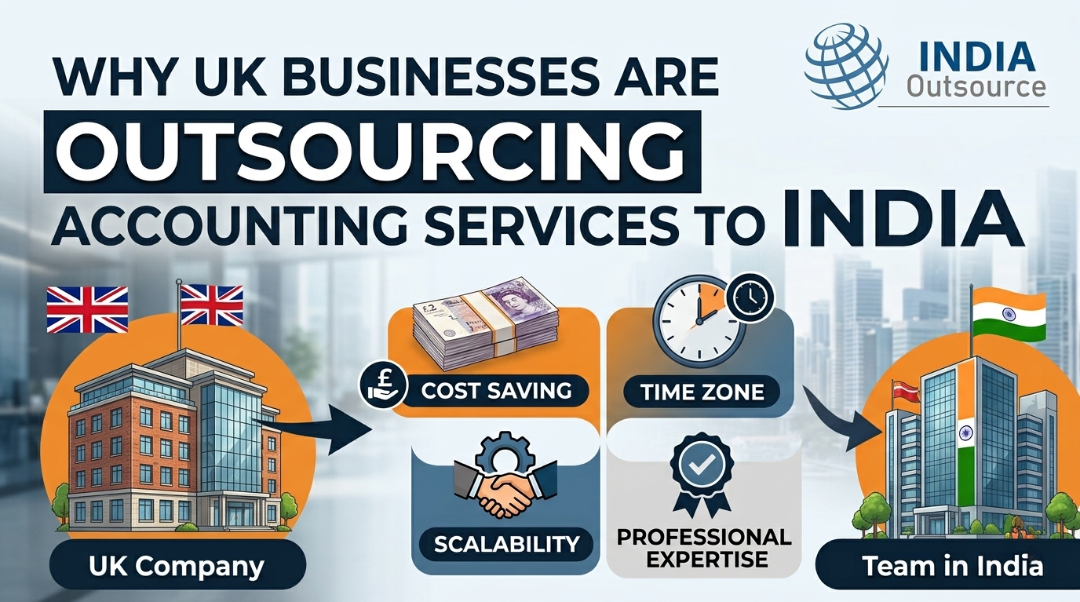
Accounting is always an important part of a business, but the role of finance has evolved at a fast pace.
From cutting operating expenses to hiring skilled staff, keeping accurate financial records, adapting to increasingly complex laws and regulations, using cloud accounting technology and generating timely financial information to aid decision making, the pressure UK businesses are facing is immense. Meanwhile, accounting firms are facing a talent shortage and are placing increased demands on their clients.
This mix is sparking more and more small businesses and accountancy firms in the UK to re-think the provision of routine and specialist accounting work.
Outsourcing accounting to India is one solution that is becoming increasingly popular.
India has evolved into one of the world’s leading destinations for professional-services and outsourcing, boasting a large pool of accounting and finance professionals, English proficiency, a robust technology eco-system and experience working with international organizations.
Importantly, it’s no longer just a strategy for lowering labor expenses. Today, outsourcing accounting work is as much a business of access to talent, scalability, technology, productivity, business continuity and enabling in-house staff to focus on more value added tasks in the UK.
The ICAEW research, which marks the first step in the creation of an accountancy sector outsourcing/offshoring benchmark, reveals just how embedded outsourcing and offshoring has become in the accountancy profession. Half of the some of the smaller companies surveyed had outsourced or offshored at least one service line, typically accountancy, tax, audit and payroll. India was mentioned as one of the successful countries owing to the availability of qualified professionals and the scaling capability of the service centres.
Then, what is the reason for businesses from the UK to outsource accounting services to India?
Let’s explore the major reasons.
What Is Accounting Outsourcing to India?
Accounting outsourcing involves outsourcing a set of accounting, bookkeeping, finance, tax-support, payroll or similar processes to an external specialist provider.
If the provider is based in India, this outsourcing is generally termed as offshore accounting outsourcing.
A business in the UK doesn’t necessarily move all of their finance functions abroad. Rather, it can off-shoren particular processes but preserve strategic monetary regulate in the UK.
For example, a UK company could keep its finance director, accountant or senior management team in the United Kingdom, while an Indian outsourcing team manages:
- Bookkeeping
- Accounts payable
- Accounts receivable
- Bank reconciliation
- Credit control support
- Payroll processing
- VAT preparation
- Management accounts
- Financial reporting
- Year-end accounts preparation
- Tax return preparation support
- Audit preparation and documentation
- Data entry and transaction processing
- Invoice processing
- Expense management
- Financial data reconciliation
- Cash-flow reporting
- Month-end procedures
- Accounting software administration
According to HMRC bookkeeping is the recording of vital primary business records such as money received and paid, sales ledgers and purchase ledgers. These records can then be used to create accounts and tax calculations.
This lends itself to bookkeeping and other accounting activities to be particularly appropriate for structured outsourcing arrangements.
10 Major Reasons UK Businesses Are Outsourcing Accounting Services to India
1. Lower Accounting and Operational Costs
Cost efficiency is one of the most apparent motivations for outsourcing accounting tasks to India.
Having a full complement of finance staff is significantly more than salary. Businesses might also have to take into account:
- Recruitment costs
- Employer National Insurance
- Pension contributions
- Employee benefits
- Office space
- Equipment
- Software
- Training
- Recruitment agency fees
- Staff turnover
- Sick leave
- Holiday cover
- Professional development
- Management overhead
Some of these fixed costs can be shifted to become a more flexible service cost through outsourcing.
India’s geography and the professional demographics of the workforce gives outsourcing providers an edge in providing accounting support service at reduced overall operating expense when compared with employing comparable extra resources at the UK.
But cost reducing is not the only motive for outsourcing.
The better the business case when there are cost savings plus capacity, technology, specialist knowledge and workflow efficiencies.
The real financial advantage
The objective should not be:
How do you find the cheapest accountant?
It should be:
What steps can be taken to ensure reliable accounting capacity at an economic cost, and yet achieve quality and control?
This is the key point to consider in choosing an outsourcing provider.
2. Access to a Large Pool of Skilled Accounting Professionals
Talent availability is one of the other significant factors that come to make India an appealing outsourcing destination.
Hiring and retaining top talent in the accounting profession is an ongoing challenge in the UK. ICAEW research actually indicates that talent-related concerns are a large problem in the mid-tier accountancy firms, as recruitment and retention of qualified staff is one of the main concerns.
India can provide a significant number of financial and accounting experts, such as those with experience in:
- Bookkeeping
- Financial accounting
- Management accounting
- Tax support
- Audit support
- Payroll
- Accounts preparation
- Financial analysis
- Cloud accounting
- Finance operations
This can help a UK business to recruit people to fit their requirements without being limited to the local recruitment market.
This is especially beneficial for growing Business.
A company could be able to hire an accounting specialist offshore from the UK relatively quickly by using a known outsourcing provider instead of taking months to find a new specialist.
3. Strong Familiarity With UK Accounting Practices
Many people think that a team of accountants in India is not suitable to be part of a UK business due to the presence of the team in India.
The truth is that many outsourcing providers have a specific training of their teams to enable them to operate within the UK’s accounting frameworks, tax process, software and business practices.
Depending on the provider and engagement, teams may have experience with:
- UK GAAP
- FRS 102
- FRS 105
- VAT
- HMRC processes
- Making Tax Digital
- UK payroll
- Companies House-related processes
- UK year-end accounts
- UK bookkeeping procedures
- UK accounting software
ICAEW’s research highlights that effective offshore arrangements can include offshore staff integration with UK staff and processes and the training of offshore teams in UK GAAP.
This does not imply that people have to be good at geography in order to be good at accounting.
It’s the ability to prove their UK expertise that’s the key here.
4. Scalability Without Constant Recruitment
Business requirements are not everlasting.
A company might require:
- One bookkeeping resource today
- There were two finance professionals next year
- Additional support during year-end
- Increased payroll capacity through acquiring employees
- Temporary assistance during a busy tax period
- A focused staff with a very rapid growth.
It is cost and time intensive to hire person on a permanent basis for each change.
Outsourcing provides a potentially more flexible model.
Business can opt for various options like:
Dedicated resource
The accountant or accounting team is assigned to a single client.
Shared service model
Several clients share the provider’s resources.
Project-based outsourcing
Specific work is contracted out for a specific amount of time or specific project.
Fully managed accounting
The provider carries out an agreed accounting task from the processing of transactions to the production of reporting.
The scalability factor is one of the reasons why outsourcing can be particularly appealing to startups, SMEs and expanding accounts firms.
5. Ability to Focus on Core Business Activities
There is a vital need for finance administration, but not all financial activities need to be the responsibility of senior management in the UK.
Business owners and directors tend to waste a lot of time on:
- Invoice processing
- Bank reconciliation
- Expense records
- Bookkeeping queries
- Data entry
- Payment processing
- Payroll administration
- Month-end preparation
All these activities take time that could be better spent on:
- Business development
- Customer relationships
- Sales
- Strategic planning
- Product development
- Market expansion
- Leadership
- Investment decisions
Outsourcing helps businesses to distinguish transactional accounting from strategic financial management.
The goal here isn’t to replace the finance function.
It is to give internal professionals more time to be more productive in work activities where they have added value to the business.
6. Better Access to Accounting Technology
Today, outsourcing accounting is tightly linked to the cloud and automation.
A good outsourcing partner can potentially collaborate with platforms like:
- Xero
- QuickBooks
- Sage
- IRIS
- TaxCalc
- Microsoft Excel
- Cloud payroll platforms
- Document management systems
- Workflow automation tools
- Reporting and business intelligence platforms
Technologies can make it possible for UK companies and teams in the offshore to work together without having to be in the exact same workplace.
Authorised users can also access financial information and workflows from various locations from Cloud Accounting.
In this new way of working, outsourcing is not merely:
UK company → emails spreadsheet → India team → spreadsheet returned.
An operation can, instead, look like a mature operation:
Cloud accounting platform → automated workflow → offshore processing → quality review → UK management approval → real-time reporting.
The latter is a much more complicated model.
7. Faster Turnaround and Greater Capacity
When a UK team becomes overloaded, so do accounting deadlines.
The end of month, quarter, year, VAT deadlines, Payroll deadlines and tax periods can be very stressful.
An offshore team can add to the processing capacity without the need for the UK business to substantially increase its permanent staff.
Teams can function with:
- Defined service-level agreements
- Standard operating procedures
- Task management systems
- Automated reminders
- Quality-control checks
- Escalation procedures
- Dedicated account managers
But some companies get an advantage due to the time zone difference as well.
Anything done by an Indian team outside office hours may be reviewed when UK team starts work the following morning.
This can be a helpful follow-the-sun workflow, as long as there’s proper communication, deadlines, and the provider’s team structure.
8. Improved Business Continuity
Resilience is another benefit of outsourcing.
An employee can put a small internal finance team at risk when he or she:
- Resigns
- Takes annual leave
- Becomes ill
- Goes on parental leave
- Retires
- Changes roles
- Becomes unavailable during a critical deadline
An appropriately managed outsourcing provider will have several trained employees and documented procedures.
This lessens the reliance on an individual person.
But, there is no guarantee that outsourcing equates to resilience in the business. They should enquire from providers about:
- Backup staffing
- Disaster recovery
- Business continuity plans
- Data backups
- Access controls
- Staff replacement procedures
- Disaster recovery testing
- Service-level commitments
The aim is to establish a process that documents key financial processes, rather than relying on one person to know them.
9. Support During UK Accounting Staff Shortages
As a company grows, they start to need accounting staff and the challenge of hiring them becomes a strategic problem in many companies in the UK.
Some esearch reveals that talent issues can have direct impact on outsourcing and offshoring. Of the mid-tier companies surveyed, half had already outsourced and/or offshored at least one service line. This makes an important difference:
This makes an important difference:
Outsourcing doesn’t always mean that UK accountants are being replaced.
It can mean augmenting the existing UK team.
For example:
A practice in the UK can have five accountants but require seven during peak periods.
The firm might be able to get an offshore accounting team to prepare and process the defined work, and UK accountants to work on the client facing and review tasks.
This can help the UK team to manage a greater number of clients while reducing the number of staff at a similar rate.
10. Greater Focus on High-Value Accounting and Advisory Services
Money may not be the ultimate motivator for outsourcing.
It could be developing capacity for more expensive services.
An accountancy practice which mainly does bookkeeping and routine accounts work has limited capacity to:
- Business advisory
- Management reporting
- Tax planning
- Forecasting
- Cash-flow advisory
- Strategic finance
- Virtual CFO services
- Client consultations
- Business growth planning
Outsourcing appropriate processing work can give UK accountants the opportunity to focus their time on advisory services.
That opens up a possibility to shift the business model from:
“We sell accounting hours.”
to:
“We sell financial expertise and business insight.”
Especially as everyday office tasks are increasingly automated.
What Accounting Services Can UK Businesses Outsource to India?
Not all processes have to be done in-house.
Typical tasks which are outsourced to an accountant are:
- Daily transaction recording
- Bank reconciliation
- Sales ledger
- Purchase ledger
- General ledger maintenance
- Expense processing
- Journal entries
Accounts Payable
- Supplier invoice processing
- Invoice verification
- Purchase order matching
- Payment preparation
- Supplier statement reconciliation
Accounts Receivable
- Customer invoicing
- Payment allocation
- Debtor reporting
- Credit-control support
- Receivables reconciliation
- Payroll processing
- Payroll data preparation
- Employee records
- Payroll reconciliations
- Payroll reporting
VAT and Tax Support
- VAT data preparation
- VAT return support
- Tax schedules
- Tax computation support
- Supporting documentation
- Monthly management accounts
- Profit and loss statements
- Balance sheet preparation
- Cash-flow reports
- Budget-versus-actual reporting
Year-End Accounts
- Working-paper preparation
- Reconciliations
- Supporting schedules
- Draft accounts preparation
- Audit documentation
Responsibility for the work should always be clearly defined and agreed in contract and re-evaluated against the UK regulatory and professional requirements.
How Much Can UK Businesses Save by Outsourcing Accounting to India?
It will depend on the business largely.
There is no company-wide percentage that will be saved by all businesses.
Actual economics depend on:
- Number of transactions
- Complexity of accounting
- Number of employees
- Required qualifications
- Service scope
- Software
- Quality-control requirements
- Provider location
- Dedicated versus shared resources
- Working hours
- Internal management requirements
- Data-security requirements
- Contract structure
The responsible outsourcing analysis should therefore not only take the price of outsourcing in India and the price of the employee in the UK into consideration, but should include the total cost of ownership.
Total cost of ownership should include:
In-house model
Salary + benefits + employer costs + recruitment + software + office + training + management + employee turnover
versus
Outsourced model
Provider fee + onboarding + software/access costs + management/review time + transition costs + compliance/security requirements
It is a much more realistic estimate of potential savings when the difference between the two is calculated.
Is Outsourcing Accounting to India Safe?
One of the most crucial questions to ask UK businesses is about security.
Accounting staff have access to confidential data such as:
- Bank details
- Customer information
- Supplier information
- Payroll information
- Financial statements
- Tax records
- Business performance data
- Employee information
So, security should be considered a selection value, not an afterthought.
When evaluating an outsourcing provider, businesses should evaluate them on their:
- Data-protection policies
- Access controls
- Encryption
- Employee confidentiality agreements
- Security certifications
- Backup systems
- Disaster recovery
- Incident-response procedures
- Data-processing agreements
- Subcontractor arrangements
- Staff training
If the business uses data from the UK, the business should also take into account the UK data protection requirements that apply and the legal basis and safeguards for international data transfers.
A provider that states that they are “secure” is not sufficient. Ask for evidence.
What About UK Compliance When Accounting Is Outsourced?
The legal obligations of the business don’t necessarily go with the outsourcing job.
This is one of the most important points for UK businesses.
A company should clearly understand:
What is being outsourced?
Who performs the work?
Who reviews it?
Who approves it?
Who remains legally responsible?
Outsourcing arrangements are covered by HMRC guidance which highlights the need for the HMRC to see if a third party is competent, qualified and controlled when outsourced functions impact tax accounting.
Thus, it is important that UK companies have adequate control, even if the accounting process is outsourced to overseas locations.
A good outsourcing model typically has the following characteristics:
- Defined responsibilities
- Written procedures
- Clear approval authority
- Quality-control reviews
- Access controls
- Performance monitoring
- Regular communication
- Contractual protections
- Data-protection arrangements
- Escalation procedures
Challenges of Outsourcing Accounting Services to India
Outsourcing has significant benefits, but it is not risk-free.
Businesses should understand the potential challenges before making a decision.
Communication Issues
Communication, differences in work or expectations can cause issues.
Solution:
Use:
- Written SOPs
- Clear deadlines
- Defined escalation procedures
- Regular meetings
- Task-management systems
- Dedicated account managers
Quality-Control Problems
It is the wrong approach of outsourcing to produce errors, not to prevent them.
Solution:
Introduce a multi-level review process.
For example:
Processor → Senior reviewer → UK accountant/manager → Client approval
The level of review should be appropriate to the complexity and risk of the work.
Data Security Risks
Financial data is highly sensitive.
Solution:
Check security certifications, access controls, encryption, confidentiality agreements, data-processing arrangements and disaster-recovery procedures before signing a contract.
Lack of UK-Specific Knowledge
All the accounting experts in India do not know the accounting standards in the UK.
Solution:
Ensure provider has UK experience and specifically request:
- UK GAAP
- FRS 102
- FRS 105
- VAT
- HMRC
- Making Tax Digital
- UK payroll
- Companies House
- UK accounting software
Hidden Costs
If a seemingly inexpensive provider turns out to be expensive, it may be because of extra fees for such things as:
- Training
- Software
- Urgent work
- Rework
- Management
- Extra reports
- Additional resources
Solution:
Ask a detailed pricing structure before signing.
How to Choose the Right Accounting Outsourcing Company in India
Choosing the best outsourcing partner is vital rather than picking the cheapest option.
Use the following evaluation criteria.
1. UK Accounting Experience
Ask:
- How many UK clients do you serve?
- Which UK accounting standards do you support?
- What types of UK businesses do you work with?
- Do your employees have UK accounting experience?
2. Qualifications and Training
Ask about:
- Accounting qualifications
- Staff experience
- UK-specific training
- Continuing professional development
- Senior-level supervision
3. Technology
Check whether the provider can work with your existing technology stack.
For example:
- Xero
- QuickBooks
- Sage
- IRIS
- Microsoft 365
- Payroll platforms
- Practice-management systems
4. Data Security
Ask for evidence rather than promises.
Consider:
- ISO certifications
- GDPR processes
- Access controls
- Encryption
- Backup
- Disaster recovery
- Security audits
5. Quality-Control Procedures
Ask:
Who reviews the work before it gets to us?
It is important that a provider can be transparent about its review process.
6. Scalability
Inquire about the provider’s ability to expand its capacity as your business expands.
Any outsourcing partner you choose should be able to easily adjust their workload while keeping you from having to redesign the whole engagement.
7. Communication
Determine:
- Who your account manager is
- How frequently you meet
- What communication platform is used
- How urgent issues are escalated
- How performance is reported
A Practical Step-by-Step Process for Outsourcing Accounting to India
1: Identify What to Outsource
Begin with repetitive and process oriented jobs.
For example:
Bookkeeping → Reconciliations → Accounts preparation → Management reporting
Do not outsource everything immediately.
2: Document Your Existing Process
Create SOPs covering:
- Who performs each task
- What software is used
- What information is required
- Deadlines
- Review procedures
- Approval requirements
- Exceptions
3: Select Potential Providers
Compare providers based on:
- UK experience
- Expertise
- Cost
- Security
- Technology
- Scalability
- Communication
- Reviews and references
4: Conduct Due Diligence
Request:
- Company information
- References
- Security documentation
- Sample reports
- Staff qualifications
- Service-level agreements
- Business-continuity information
5: Start With a Pilot
Do not move all of the accounting work at once—start with a clear process.
For example:
Monthly bookkeeping for selected entities
Measure:
- Accuracy
- Turnaround
- Communication
- Cost
- Review time
- Error rates
6: Build Quality Controls
Establish:
- KPIs
- Review procedures
- Deadlines
- Escalation routes
- Monthly performance reports
7: Gradually Expand
Once the provider demonstrates consistent performance, additional functions can be outsourced.
UK Accounting Outsourcing vs Hiring In-House
| Factor | In-House Accounting Team | Outsourced Accounting to India |
| Recruitment | Required | Provider handles recruitment |
| Cost structure | Mostly fixed | Potentially more flexible |
| Scalability | Slower | Usually easier to scale |
| Talent pool | UK-focused | Access to broader international talent |
| Management | Direct | Managed through provider |
| Technology | Business-funded | Often provider-supported |
| Business continuity | Depends on internal staff | Can benefit from shared resources |
| Strategic focus | Can be limited by routine work | Can free UK team for higher-value work |
| UK expertise | Direct | Must be verified |
| Control | High direct control | Requires governance framework |
| Data security | Internal responsibility | Shared contractual/operational responsibility |
The right choice depends on the company’s size, complexity, risk profile and strategic objectives.
Why India Rather Than Other Outsourcing Destinations?
India’s appeal is not based on one factor.
It has several benefits:
Large talent pool
India has a large workforce of finance, accounting, tech and business service professionals.
English-language capability
Accounting communication with UK clients requires a good command of English.
Established outsourcing ecosystem
India has decades of experience in providing international business-process and professional services.
Technology expertise
The country’s out-sourcing industry has grown up hand-in-hand with the cloud, automation and digital transformation.
UK familiarity
There are many Indian providers which have established their own accounting units and practices in the United Kingdom.
Scalability
The larger service providers may be able to increase resources that are easier than the smaller out sourcing markets.
The Role of AI and Automation in UK-India Accounting Outsourcing
The next generation of accounting outsourcing will not be based solely on human labour.
AI and automation are transforming the business of accounting.
Automation can increasingly assist with:
- Invoice extraction
- Transaction categorisation
- Bank reconciliation
- Data matching
- Anomaly detection
- Report generation
- Workflow management
- Document processing
It’s not that accountants are no longer needed.
Rather, the division of work is evolving.
Traditional model
Human → data entry → reconciliation → report
Emerging model
Automation → processing → exception detection → accountant review → business insight
This merely provides an opportunity for businesses in the UK to merge:
UK strategic oversight + Indian accounting expertise + cloud technology + automation.
The research indicates that the role of the accountant is increasingly one of judgement, interpretation and ethical oversight in the face of changes in technology with respect to the duties involved in routine work.
Is Accounting Outsourcing to India Right for Every UK Business?
No.
Not all the time outsourcing is the best option for all organisations.
It might not be as well suited in the following cases:
- Accounting processes are extremely specialised
- The business requires constant physical interaction
- Data restrictions create specific operational limitations
- Internal processes are undocumented
- Management cannot dedicate time to oversight
- The provider does not have relevant experience in the UK
Likewise, businesses need to be careful regarding handing out sensitive or strategic jobs without proper governance.
Selective outsourcing is typically the best option.
Delegate processes to external experts when they can provide value but where internal expertise is important ensure strategic control.
Conclusion: Outsourcing Is Becoming a Strategic Finance Decision
For businesses in the UK the question is not so much:
“Should we outsource accounting?”
The more important question is:
“Which accounting activities should remain in-house, which should be automated, and which should be delivered by a specialist offshore team?”
India’s vast pool of skilled professionals, robust infrastructure for outsourcing, technological capabilities, and experience in handling international enterprises makes it an important outsourcing destination for accountants.
The advantages that UK businesses can gain from are nothing new.
A well-designed outsourcing partnership can provide:
- Access to skilled accounting talent
- Flexible capacity
- Cost efficiency
- Faster processing
- Business continuity
- Technology support
- UK accounting expertise
- Scalable finance operations
- Reduced administrative burden
- More time for strategic activities
However, successful outsourcing requires more than choosing a low-cost provider.
The winning model is based on quality, security, communication, UK expertise, technology, governance and measurable performance.
When those elements are properly designed, outsourcing accounting services to India can become more than a cost-saving exercise—it can become a powerful component of a modern, scalable and technology-enabled finance function.
Ready to Make Your Accounting Function More Efficient?
Contact Us Today
FAQs | Outsourcing Accounting Services to India
1. Why do UK businesses outsource accounting services to India?
The main reasons why businesses outsource accounting to the UK to India are to gain access to skilled accounting professionals, manage operating costs, expand the capacity, enhance scalability, avail technology support, and give time to the internal team for higher value tasks.
2. Is outsourcing accounting to India cheaper than hiring in the UK?
It may be, but saving is dependent on the service scope, provider, staffing model, complexity and internal management requirements. When comparing salaries, companies must take into account the cost of ownership.
3. Can Indian accountants handle UK accounting standards?
Yes, there are lots of specialist outsourcing companies that instruct teams to operate by UK accounting requirements and processes. But when choosing a provider for business, it is important to check the provider’s actual experience in the United Kingdom, and not take it for granted that all the Indian accounting professionals will have experience in the UK.
4. Can bookkeeping be outsourced to India?
Yes. One of the most usual outsourced accounting processes is bookkeeping. It can allow for transaction processing, sales and purchase ledgers, bank recon and other financial record maintenance. HMRC defines bookkeeping as keeping the main accounts of the business and records that are essential for calculating taxes and accounts.
5. Is offshore accounting secure?
It may be secure if the provider has the necessary technical, contractual and organisational controls in place. There are few things businesses need to do, such as perform due diligence with regard to data protection, access controls, data encryption, security certifications, employee confidentiality, backups, and disaster recovery.
6. Will outsourcing eliminate the need for UK accountants?
Not necessarily. Outsourcing is often employed as an aid for UK accountants, and not as a replacement. There’s room to have an offshore team process the day-to-day stuff, while UK folk focus on review, client relationships, judgement and advisory services.
7. What accounting software can be used with an Indian outsourcing team?
This will vary based on the provider, but most of the teams working with cloud accounting and practice-management systems like Xero, QuickBooks, Sage or other accounting systems.
8. How quickly can a UK business start outsourcing accounting work?
This will vary depending on the complexity of the business and the provider. A small bookkeeping task can typically be converted quicker than a big multi-entity financial operation. It is generally better to implement a structured induction and pilot programme before transferring on a full scale.