



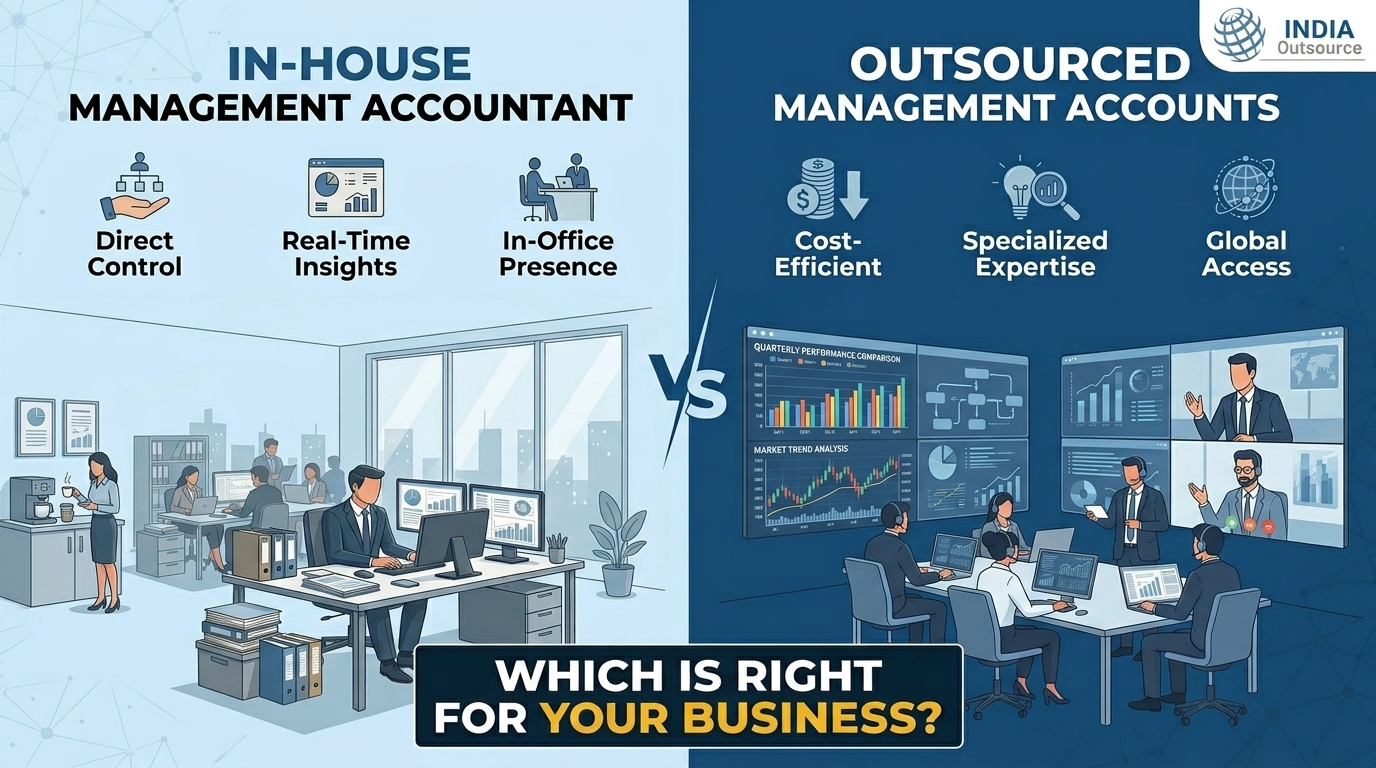
In-house management accounting or outsourced management accounts? Many businesses are faced with the question of whether or not they should hire a full-time finance professional, but when financial reporting becomes too critical to be handled via spreadsheets, it still may not be commercially viable.
Management accounts are more than just monthly reports of income and expenditure. When done correctly, they provide business owners with a line of sight as to profitability, cash flow, cost, budgets, financial performance and future decision making.
The challenge is deciding how that financial insight should be delivered.
If you have an internal management accountant that only works in your company? Or, should you use a seasoned accounting firm that offers specialist support when you require it, for management accounts?
Both methods are good. The right choice depends on the size and complexity of your business, budget, the need to report and future plans for expansion.
In this guide, we compare in-house management accountants vs outsourced management accounts, looking at the pros, cons, flexibility, expertise and scalability, as well as cost.
What Are Management Accounts?
Management accounts are regular financial reports that are created for the business owner and management team to be able to understand how the business is doing.
Management accounts are prepared to help internal decision making processes that would not be required by external bodies such as the statutory bodies.
Common management accounts are:
- Profit and loss statements
- Balance sheet reports
- Cash flow reports
- Budget vs actual analysis
- Revenue and gross profit analysis
- Department or project profitability
- Key performance indicators (KPIs)
- Cost analysis
- Debtor and creditor analysis
- Financial forecasts
- Management commentary and recommendations
Can be different from business to business. Some companies are based on a monthly management account, others might need weekly or quarterly reports.
The true benefit is translating financial data into information management they can utilize.
What Is an In-House Management Accountant?
An in-house management accountant is a member of your organisation who is responsible for management accounting and financial reporting.
Their responsibilities may include:
- Preparing monthly management accounts
- Analysing financial performance
- Preparing budgets and forecasts
- Monitoring business costs
- Investigating variances
- Producing financial reports for directors
- Supporting strategic decision-making
- Working with department managers
- Improving financial controls
- Providing ongoing financial analysis
In-house Management Accountant can gain an in-depth knowledge of your operations, customers, products and internal processes as they are in the business.
Advantages of an In-House Management Accountant
1. Dedicated Financial Support
An in-house management accountant has their attention to your business while they’re at work.
This can help to establish a regular reporting system and easy communication with operational teams.
2. Deep Understanding of Your Business
An employee can acquire extensive knowledge of:
- Your revenue streams
- Cost structure
- Customers
- Suppliers
- Internal processes
- Financial systems
- Business objectives
This can make it very specific to your organisation to do a financial analysis.
3. Immediate Access
An internal accountant is on hand should management require a report or wish to discuss a financial matter.
For enterprises that have complicated or evolving financial needs, this can be quite beneficial.
4. Greater Internal Integration
An in-house accountant can collaborate with:
- Directors
- Operations teams
- Sales teams
- HR
- Procurement
- Finance staff
This can assist to align financial reporting with business activities.
Disadvantages of an In-House Management Accountant
While the advantages are there, having a management accountant is a larger job commitment.
Higher Employment Costs
But, the cost of an employee isn’t just their pay.
Other factors to take into account for a business are:
- Employer taxes
- Pension contributions
- Employee benefits
- Recruitment costs
- Training
- Software and technology
- Office costs
- Equipment
- Holiday and sickness cover
These extra expenses can be prohibitive for smaller companies to afford employing a full-time finance person.
Recruitment Can Take Time
It can take time to find an experienced management accountant who has the technical skills and understanding of the commercial aspects.
You may also have to pay recruitment fees and induction costs.
Limited Skill Coverage
Not all employees will have expertise in all aspects of finance.
For instance, your management accountant might have top-flight reporting skills, but lack experience in:
- Tax planning
- Financial systems
- Payroll
- Corporate finance
- Business restructuring
- Specialist forecasting
- Financial strategy
There may be additional external support that will be needed.
Risk of Key-Person Dependency
If one person is involved in a major part of your management accounting, you could experience disruption if that person is unable to work or leaves.
What Are Outsourced Management Accounts?
Outsourced management accounts are when an external accountant, accounting firm or finance provider prepares and analyses your management accounts.
Depending on the provider, the service may include:
- Monthly management accounts
- Profit and loss reporting
- Balance sheet analysis
- Cash flow reporting
- Budgeting and forecasting
- KPI reporting
- Variance analysis
- Financial commentary
- Management meetings
- Financial planning support
Your business can tap into external expertise in management accounting, as needed, rather than hiring a full time management accountant.
Advantages of Outsourcing Management Accounts
1. Access to Specialist Expertise
A long-standing accounting company could have staff who are knowledgeable in a variety of business models and industries.
This can provide your enterprise with more financial information than can be offered by any one individual.
2. Potentially Lower Fixed Costs
Commissioning can lower the need for a complete time finance employee and the corresponding price of the employment.
Instead, businesses have the option of selecting a service that fits their reporting needs and service level needs.
This can be a very appealing option for:
- Start-ups
- SMEs
- Growing businesses
- Owner-managed companies
- Businesses without a large finance department
3. Flexible and Scalable Support
Your accounting requirements may change as your business grows.
An outsourced provider may be able to scale back or expand the level of support as your requirements change – you can go from simple monthly management accounts to more sophisticated forecasting, reporting and financial analysis.
4. Wider Financial Knowledge
An external accounting team might have experience working with a number of businesses.
This can give access to a variety of reporting techniques, financial procedures and strategies to business analysis.
5. Reduced Recruitment Pressure
By outsourcing, you don’t have to hire, train and keep on staff a full-time management accountant.
It can also help to alleviate the worry around annual leave, sickness absence and employee turnover that can impact on financial reporting.
Disadvantages of Outsourcing Management Accounts
Not all organisations are the same and outsourcing is not necessarily the solution.
Less Day-to-Day Presence
An external accountant does not work in your business on a day-to-day basis, like an employee does.
This may be a factor for companies that require regular monetary transactions.
Potential Communication Delays
Answers and/or further reports may need to be communicated via an external team depending on the provider/service arrangement.
A well-defined service agreement and communication will help to mitigate this.
Less Immediate Internal Knowledge
It takes an outsourced accountant time to learn about your business.
The quality of the relationship is thus partly dependent on the effectiveness of the communication of information, processes and business objectives.
In-House vs Outsourced Management Accounts: Key Differences
| Factor | In-House Management Accountant | Outsourced Management Accounts |
| Employment | Direct employee | External provider |
| Availability | Usually dedicated to your business | Based on agreed service |
| Cost structure | Salary + employment overheads | Service/retainer fees |
| Expertise | Primarily individual skillset | Potentially broader team expertise |
| Recruitment | Required | Not normally required |
| Scalability | Requires hiring or restructuring | Can often scale with requirements |
| Business knowledge | Deepens over time | Developed through the client relationship |
| Flexibility | Dependent on employee capacity | Can often adjust service levels |
| Key-person risk | Potentially higher | May be distributed across a team |
| Strategic support | Depends on employee’s expertise | May provide access to wider specialists |
How Much Do Management Accounts Cost?
There is no single price of management accounting as costs will vary due to such factors as:
- Business turnover
- Number of transactions
- Number of entities
- Complexity of accounts
- Reporting frequency
- Number of departments
- Payroll requirements
- Accounting software
- Forecasting requirements
- Level of financial analysis
- Industry
- Number of bank accounts
- VAT and tax requirements
Typically, an in-house solution will be an employment-based cost plus any related overheads.
An outsourced solution typically comes with a fixed monthly charge, project fee or a customized service agreement.
Businesses should not just look at the headline price – they should look at the cost of the financial capability they need.
Which Option Is More Flexible?
Businesses that are growing in size can find flexibility as crucial.
The defined capacity is used by an in-house employee. An increase in financial reporting needs can lead to the need for additional personnel or working hours in the business.
Businesses can extend the range of services that they provide without hiring another worker with outsourcing.
For example, a business might initially require:
Monthly management accounts → budgeting → cash-flow forecasting → KPI reporting → strategic finance support
An outsourced provider may be able to expand its service as these requirements develop.
Which Option Provides Better Financial Expertise?
This is heavily reliant on the employee or out sourcing company.
A special in-house management accountant can be of great commercial value.
Likewise, an excellent outsourced accounting service will offer access to a number of specialists, instead of just one finance professional.
Businesses should not only consider if someone can produce management accounts, but also if they can produce them when comparing providers.
Consider whether they can also:
- Explain what the numbers mean
- Identify financial trends
- Highlight potential problems
- Analyse margins
- Explain cash-flow movements
- Prepare useful forecasts
- Support budgeting
- Identify cost pressures
- Communicate clearly with directors
The goal should be not only reports of financial information, but also actionable financial insight.
When Should You Hire an In-House Management Accountant?
An in-house management accountant may be appropriate when:
- Your company has extensive and regular accounting needs.
- Finance is highly embedded in the company’s operations.
- There must be an internal person available throughout the working day.
- Your reporting needs are multi-layered and highly customised to your business.
- You have sufficient workload to justify a full-time position.
- You would like to expand your internal finance team.
- Your business needs a lot of financial analysis within itself.
At this stage, an in-house finance team might well form an integral part of the company’s infrastructure in larger companies.
When Should You Outsource Management Accounts?
Outsourcing may be appropriate when:
- You don’t need a management accountant for your business full-time.
- You prefer to have access to financial professionals who are experienced.
- You are trying to control fixed overheads.
- Your business is growing quickly.
- You need monthly management accounts but not constant finance support.
- Forecasting or financial analysis must be done in conjunction with reporting.
- You don’t wish to handle recruitment and employee management.
- You want flexible access to financial expertise.
Outsourcing may be an option for many small and medium-sized businesses that wish to develop their financial reporting capabilities without forming a full financial team immediately.
Can You Combine In-House and Outsourced Accounting?
Absolutely.
The advantages of both models can be achieved with a hybrid finance model.
For instance, an internal finance administrator or bookkeeper may be responsible for the day-to-day administration of the finances, and an external management accountant may be available for the following:
- Monthly management accounts
- Financial analysis
- Forecasting
- Budgeting
- KPI reporting
- Management meetings
- Strategic financial support
This may be especially beneficial for a company that requires better financial accounting but hasn’t yet reached the point of hiring a full-time senior management accountant.
What Should You Look for in an Outsourced Management Accounts Provider?
There’s more to selecting an outsourced accounting partner than just the monthly costs.
Look for a provider that offers:
Accurate Reporting
Your management accounts require solid underlying financial information.
Clear Financial Commentary
Report numbers showing change, but explaining the reason for the change.
Commercial Understanding
Your accountant needs to know how you really make money.
Timely Reporting
Management accounts are most useful when they get to the decision makers when the information is pertinent.
Forecasting Support
Good financial reporting should not be about looking back, it should be about looking forward.
Transparent Pricing
Know exactly what is covered within the service and what might be extra expenses.
Strong Communication
Your accountant should be able to make financial information understandable to business owners and directors who don’t have a financial background.
Scalable Services
As your business expands, you may find yourself in need of different financial needs, and you want to know if the provider can meet your needs beyond management accounts.
Conclusion: In-House Management Accountant vs Outsourced Management Accounts
The decision isn’t simply about employing someone versus hiring an accounting firm.
It’s all about the financial requirements for your business.
An in-house management accountant may also offer in-house assistance and a thorough understanding of the organisation. Outsourced management accounts can offer flexibility, specialist expertise and may help to reduce fixed overheads.
If a business requires a finance professional on a day-to-day basis, then an in-house hire can be part of a long-term finance plan.
Outsourcing can offer a more flexible solution for businesses requiring consistent monthly reporting, financial expertise and guidance without the responsibility of a full-time employee.
Get Professional Management Accounts Without the Cost of a Full-Time Hire
Looking for a way to make your financial information more effective for your business?
Get in touch today
FAQs
1. What is the difference between an in-house management accountant and outsourced management accounts?
In-house management accountant – a person who works directly for your company. Outsourced management accounts are produced by an external accountant or accountancy company in a mutually agreed management contract.
2. Are outsourced management accounts cheaper than hiring an accountant?
They can be, at least in part where a business does not need to have an accountant on staff full-time. The costs are dependent on the complexity, and the level of services needed.
3. What do outsourced management accounts include?
They may have a variety of components depending on the provider, including monthly profit and loss reports, balance sheets, cash-flow reporting, budgeting, forecasting, KPI analysis, variance analysis, and management commentary.
4. Are management accounts useful for small businesses?
Yes. Small businesses can be more profitable thanks to the management accounts, and they can also see how their finances are performing and how costs are going, which can help them make better business decisions.
5. How often should management accounts be prepared?
Most companies are producing management accounts every month though it will vary according to the size, complexity and needs of the business.
6. Can I outsource management accounts while keeping bookkeeping in-house?
Yes. A business may maintain its bookkeeping and day-to-day finance in-house and may outsource management accounting and financial analysis and forecasting.
7. Is an outsourced management accountant suitable for a growing business?
It can be. For financial expertise, outsourcing can offer the answers you need, without a need for the business to expand its financial support.