



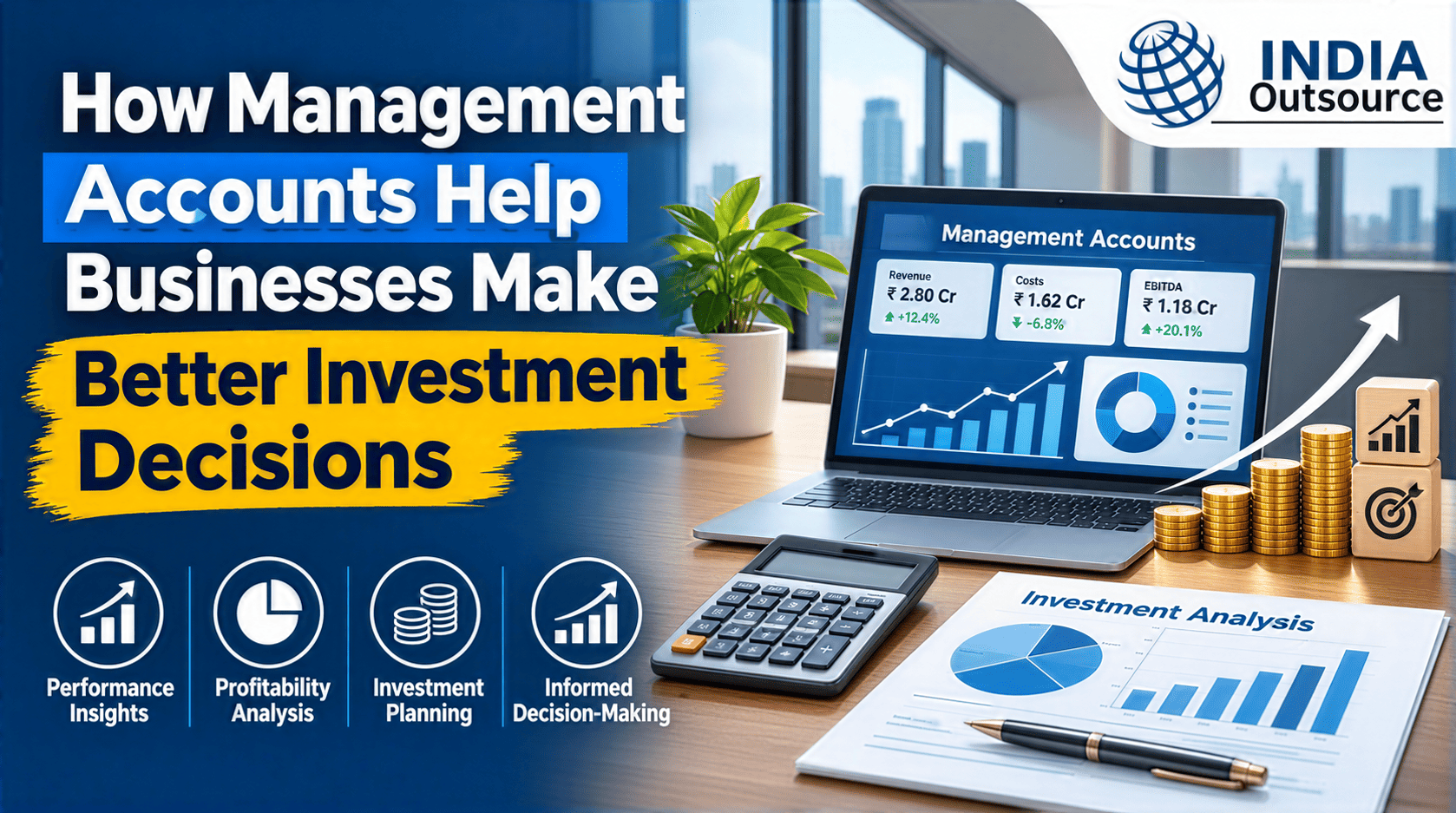
Good investment decisions can lead to good business growth. Investment can involve equipment, market expansion, staff recruitment and technology – all financial decisions which require sound and current data to inform choices.
Too frequently though, people base investment decisions on old financial data, misconceptions and/or poor quality accounting. As such, businesses may then make unwise investment decisions and face issues relating to cash flow and profitability.
Management accounts give companies current financial information which enables them to analyse business finances, and then evaluate and manage investment in a way which minimises risk. Compared to annual financial accounts, management accounts are produced more regularly and so can therefore be used to effectively steer businesses at key times.
Quick Answer: How Do Management Accounts Improve Investment Decisions?
Management accounts enable businesses to analyse and understand their financial profitability, cash flow, expenditure and overall financial performance. Businesses can therefore investigate and analyse options for investment, recognise financial risks and analyse likely investment returns. Good quality management accounts can thus be used to recognise beneficial investment choices and avoid unproductive expenditure. Resources can then be deployed in ways which match a company’s financial aims.
Table of Contents
- What Are Management Accounts?
- Key Components of Management Accounts
- How Management Accounts Help Businesses Make Better Investment Decisions
- Management Accounts vs Annual Financial Accounts
- Practical Example of Management Accounts in Investment Planning
- Benefits of Outsourcing Management Accounts
- Frequently Asked Questions
- Conclusion
What Are Management Accounts?
Management accounts are prepared to enable business owners, managers and stakeholders to analyse and assess a company’s financial position and make well-informed business decisions.
Generally these are prepared monthly and/or quarterly dependent on a company’s needs.
Whilst financial accounts are mainly produced for external dissemination and legal compliance, management accounts are utilised for assessing and managing a business’s financial affairs and for guiding strategy development.
They can help to ascertain both a company’s financial status and whether it is financially able to pursue new investment prospects.
Key Components of Management Accounts
Commonly, the following reports will form part of a company’s management accounts:
| Financial Report | Purpose |
| Profit and Loss Statement | Analyse financial profitability |
| Balance Sheet | Detail a company’s assets, liabilities and financial position |
| Cash Flow Statement | Tracks cash inflows and outflows |
| Budget Variance Report | Contrast a business’ performance with its budget |
| Financial Forecasts | Analyse likely future financial performance |
| KPI Reports | Monitors key business performance indicators |
| Debtor and Creditor Reports | Tracks outstanding payments and obligations |
This information is highly useful for business financial analysis and to underpin investment choices.
How Management Accounts Help Businesses Make Better Investment Decisions
1. Provide Up-to-Date Financial Visibility
Understanding of a company’s financial situation is key for making good investment choices.
Management accounts can be used to analyse a business’ income, expenditure and profitability.
Furthermore, they can show an entity’s financial status so that it can then be established whether a company is financially able to make new investments without negatively affecting existing business functions.
2. Improve Cash Flow Management
Whilst companies can have good levels of profitability, cash flow problems can still occur.
Management accounts can be analysed to establish how much cash a company holds, when it expects to receive and what payments must be made. Companies can then decide whether they can self-finance new investment or whether they need to seek external financial backing.
Furthermore, enhanced cash flow knowledge can assist a business to avoid cash flow problems which may arise after substantial investment has been made.
3. Identify Profitable Investment Opportunities
Investments do not necessarily all bring equivalent financial advantages. Through the use of management accounts, companies can analyse and assess how well individual business functions, goods, services and investment initiatives are performing.
By analysing financial performance and income, for instance, a company can recognise which business areas hold the greatest scope for good growth. It can then deploy resources in these areas.
It may therefore be more financially lucrative for a company to further invest within its currently successful service provision, as opposed to investing in an unknown market.
4. Support Accurate Budgeting and Financial Forecasting
Historical and current financial information can be analysed via management accounts to facilitate the creation of appropriate budgets and financial forecasts. Financial forecasting can then be used to:
- Estimate future income and expenditure
- Calculate likely investment returns
- Ascertain financial needs
- Evaluate future cash flow
- Identify prospective financial risks
Such knowledge can then inform a company about the financial viability of various investment choices.
5. Help Assess Investment Risks
Every business investment carries some degree of risk, management accounts can be used to recognise financial risks. These can include falling profit margins; increasing expenditure; high debt levels; and late client payments.
Companies can analyse these and other risks to analyse the possible impact of different investment options and so recognise how such choices might influence financial robustness. Early recognition of financial risks enables companies to avoid making costly errors in relation to investment.
6. Improve Return on Investment Analysis
It is crucial to assess the likely investment returns which can be achieved from different business options. Businesses can utilise data obtained from their management accounts to calculate expected investment returns, and to analyse likely investment repayment times together with investment expenditure.
Businesses can then contrast anticipated investment returns with subsequent real financial performance. This can therefore enhance business accountability and further inform an entity’s future investment decision making.
7. Enable Better Capital Allocation
Businesses often encounter numerous investment options, and may be financially constrained. Using management accounts means that business leaders can analyse financial data to decide which investments are most appropriate to pursue, having considered business financial performance, likely investment returns and business strategy.
Rather than basing resource deployment on guesswork, entities can deploy resources in those investment choices which are most financially and functionally advantageous.
8. Support Long-Term Business Growth
Businesses will often consider short-term financial profitability, management accounts can encourage a longer term approach to financial development.
By continually analysing financial information, companies can recognise when it is both strategically and financially appropriate to grow, update technology, recruit further staff and/or launch new products. This ensures that investment is in line with a firm’s strategic and financial aims.
Management Accounts vs Annual Financial Accounts
Both management and annual financial accounts are important but differ in function.
| Factor | Management Accounts | Annual Financial Accounts |
| Frequency | Monthly or quarterly | Annually |
| Primary Purpose | Strategic decision-making | Statutory financial reporting |
| Users | Business owners and managers | Shareholders and external stakeholders |
| Financial Focus | Current and future performance | Historical performance |
| Reporting Format | Customised to business needs | Applicable accounting requirements |
| Investment Planning | Supports ongoing decisions | Provides historical financial insights |
Management accounts are especially beneficial for investment as they enable more frequent and adaptable financial analysis.
Practical Example of Management Accounts in Investment Planning
Let us imagine a UK-based business wishing to spend £100,000 on innovative technology to enhance business efficiency.
Members of the company’s management examine the business’ management accounts, so that it can analyse its cash position, its expenditure and the likely cost reductions and income which can be realised. Financial analysis shows that if the new technology were purchased right away, the company would experience short-term cash flow issues. The company thus chooses to progressively deploy this new technology. In this way it is able to continue to preserve working capital and still benefit from technological innovation.
Hence, good quality management accounts can be used to both guide and enhance investment decision making as well as minimise financial risks.
Benefits of Outsourcing Management Accounts
Good quality management accounts can only be produced where there is appropriate accountancy knowledge and quality financial data. Furthermore, standardised procedures are required to ensure consistent production of financial information.
If a business does not have a specific finance department, then outsourcing can be a good way to obtain management accounting services.
Outsourcing offers a number of benefits, including:
- Access to expert accountants
- Good quality and timely financial reporting
- Cost-effective in-house accountancy
- Enhanced financial forecasting and budgeting
- Customised management reports
- Greater visibility into business performance
- More time to focus on strategic growth
Accountancy can also be outsourced to India to allow UK businesses and accountants to both benefit from flexible accountancy services and efficiently manage costs.
Conclusion
Alongside relevant business experience and sector knowledge, good decision making regarding investment is underpinned by sound financial data, together with well founded financial forecasts and risk awareness.
Through their provision of these elements, management accounts enable businesses to analyse investment choices. Furthermore, they can facilitate more effective resource management, and also promote good cash flow and long-term business growth.
Businesses can convert financial data into insightful knowledge through the outsourcing of expert management accounting services. They can then confidently and knowledgeably make investment decisions.
Make Smarter Investment Decisions with IndiaOutsource
Contact IndiaOutsource today to convert financial data into smart investment decisions and to foster sustainable business growth.
Contact Us Today
Frequently Asked Questions (FAQs)
1. Why are management accounts important for investment decisions?
Management accounts offer good quality current financial data. They can hence be analysed to analyse a company’s financial profitability, cash position, investment risks and likely returns.
2. How often should businesses prepare management accounts?
Ideally, management accounts should be produced monthly. However, for smaller entities with less complex financial affairs, quarterly reporting may prove appropriate.
3. Can management accounts help improve business profitability?
Yes. Management accounts can highlight superfluous expenditure, lucrative business areas and inefficient business processes. Companies can thereby make decisions to further enhance profitability.
4. Are management accounts useful for small businesses?
Yes. Small businesses can analyse their cash flow, manage expenditure and explore market expansion potential. Hence, management accounts can be utilised to effectively inform business decisions.
5. Can businesses outsource management accounting services?
Yes. Businesses can outsource their management accounting to expert accountants. Such accountants can then routinely analyse and report on a company’s financial information and conduct budgeting, forecasting and performance analysis.