



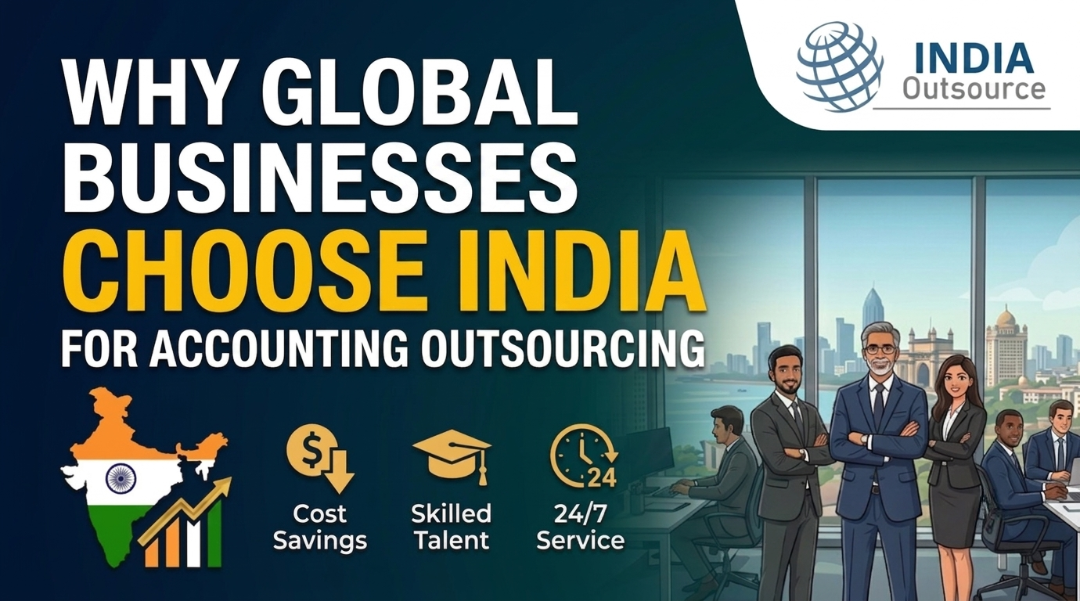
Today’s competitive business landscape is driving companies to look for more efficient, cost-effective, and expert ways to cut costs. While accounting is one of the most important functions of any business, it can be costly, time consuming and resource intensive to keep an in-house accounting team. That’s why accounting outsourcing is becoming a company practice for businesses of all sizes.
India is the top outsourcing destination for accounting outsourcing services. Indian accounting firms are trusted by thousands of businesses across the United States, the United Kingdom, Canada, Australia, New Zealand, Europe, the Middle East and Singapore for payroll, taxation, financial reporting, accounts payable and accounts receivable and compliance services.
India is no longer just selected because of the low prices. The expertise of Indian accounting professionals is a major reason why companies are using their services today: they know how to handle finances better than anyone else; they understand global accounting; they have high-level technology; they are knowledgeable of the regulations governing finances; they have excellent communication skills, and they can provide the best financial service product with the greatest accuracy.
From startups aiming to cut down on operational expenses, offshore accounting services in India for accounting firms, or multinational companies striving for financial efficiency, outsourced accounting services in India can revolutionize your business.
This comprehensive guide explains why global businesses choose India for accounting outsourcing and how this strategic decision creates long-term value.
What is Accounting Outsourcing?
Accounting outsourcing is the process of hiring an external accounting department or group of professionals is hired to manage financial operations rather than having an internal accounting department.
These services may include:
- Bookkeeping
- Financial reporting
- Payroll processing
- Tax preparation
- Accounts payable
- Accounts receivable
- Bank reconciliation
- Budgeting
- Cash flow management
- Financial analysis
- CFO support
- Audit support
- VAT, GST, and sales tax management
You can hire out certain accounting processes or the full accounting division of your business.
Why India Leads the Global Accounting Outsourcing Industry
India’s technology, infrastructure and business friendly operation makes it one of the most trusted outsourcing destinations for finance and accounting functions in the world.
Many of the world’s largest corporations, accounting firms and financial institutions already have finance offices in India.
Key factors include:
- Highly educated workforce
- A vast number of Chartered Accountants are available.
- English-speaking professionals
- Affordable service costs
- Strong IT infrastructure
- Modern accounting software expertise
- International accounting knowledge
- Government support for IT-enabled services
1. Significant Cost Savings
One of the main reasons why businesses outsource their accounting to India is for cost reduction.
The in-house accounting department requires:
- Salaries
- Recruitment expenses
- Employee benefits
- Office infrastructure
- Software licenses
- Training
- Payroll taxes
- Equipment costs
Much of these costs are avoided if you outsource.
By as much as 40% to 70%, depending on the scope of services, businesses can save on accounting costs by using these services.
The savings can be redirected toward:
- Product development
- Marketing
- Expansion
- Customer service
- Innovation
2. Access to Highly Skilled Accounting Professionals
Each year thousands of finance graduates and accounting professionals are produced in India.
Qualifications that are common among professionals include:
- Chartered Accountant (CA)
- CPA
- ACCA
- CMA
- MBA Finance
- M.Com
- CFA
Many accountants in India deal with foreign clients on a regular basis and they understand:
- US GAAP
- IFRS
- UK Accounting Standards
- Australian Accounting Standards
- Canadian Accounting Practices
This facilitates easy collaboration.
3. Expertise in Global Accounting Software
Indian accounting firms are proficient in the leading Cloud Accounting Platforms, which are:
- QuickBooks
- Xero
- Zoho Books
- Sage
- NetSuite
- FreshBooks
- Microsoft Dynamics
- SAP
- Oracle Financials
- Wave Accounting
Many firms also use automation tools that improve accuracy and reduce manual work.
4. Round-the-Clock Productivity
The advantage of time zone differences is huge.
For example:
A company in New York can submit accounting documents at the end of the business day.
While the business sleeps, the Indian accounting team completes the work.
Financial reports are updated and given to the client by the following morning.
This results in almost 24 hours of business.
5. Focus on Core Business Activities
Time for management is valuable and should not be spent on accounting.
Business owners often spend hours:
- Managing invoices
- Reconciling accounts
- Preparing reports
- Handling payroll
- Managing tax documentation
In outsourcing, leadership teams can concentrate on the following:
- Sales
- Customer acquisition
- Business growth
- Strategic planning
- Product innovation
6. Improved Accuracy
All professional accounting firms have a set of procedures, quality control measures, and review steps.
This minimizes:
- Human error
- Duplicate entries
- Incorrect tax calculations
- Missed invoices
- Compliance mistakes
The more accurate it is, the better the financial decision-making is made.
7. Scalability
Business requirements evolve all year round.
Accounting workloads intensify throughout tax time, auditing time, acquisition time or expansion times.
An outsourced accounting firm is capable of increasing resources quickly without requiring companies to hire more employees.
This flexibility enables companies to control growth successfully.
8. Better Compliance
Tax laws are often subject to change.
Indian accountants keep up-to-date with global compliance standards.
Services often include:
- Financial reporting
- Tax filing support
- Payroll compliance
- Audit preparation
- Record management
This decreases legal and financial risks.
9. Advanced Technology
In the modern era, the accounting firms in India use:
- Cloud accounting
- Artificial Intelligence
- Automation
- Optical Character Recognition (OCR)
- Workflow automation
- Dashboard reporting
- Data analytics
- Secure document management
Technology improves speed, accuracy, and transparency.
10. Strong Data Security
Financial information is very confidential.
Good accounting outsourcing companies have:
- Secure cloud infrastructure
- Data encryption
- Multi-factor authentication
- Restricted user access
- Secure VPN connections
- Regular security audits
- Confidentiality agreements
Numerous also adhere to worldwide recognised information security protocols.
Services Global Businesses Commonly Outsource
There are numerous aspects of finance that companies can outsource, such as:
Bookkeeping
Keeping good financial books.
Accounts Payable
Processing and scheduling vendor invoices.
Accounts Receivable
Generating and tracking invoices and collecting payments.
Payroll Processing
Payroll calculations, tax deductions, employee benefits and payroll reporting.
Tax Preparation
Documents to prepare for tax return.
Financial Reporting
Reporting: Monthly, quarterly and annual reports.
Bank Reconciliation
Research of bank statements against accounting books.
CFO Services
Strategic financial planning for growing businesses.
Industries That Benefit from Accounting Outsourcing
A number of sectors benefit from outsourced accounting services such as:
- Healthcare
- E-commerce
- Manufacturing
- Construction
- Information Technology
- SaaS
- Retail
- Hospitality
- Logistics
- Real Estate
- Legal Services
- Nonprofits
- Financial Services
- Professional Services
- Marketing Agencies
Technology Driving Modern Accounting Outsourcing
Outsourced accounting is now a very efficient and collaborative process using technology.
Leading firms use:
- AI-powered bookkeeping
- Automated invoice processing
- Cloud collaboration
- Real-time financial dashboards
- Expense management software
- Secure client portals
- Automated bank feeds
- Business intelligence reporting
Clients can access financial data anytime from anywhere.
Common Challenges and How to Overcome Them
Communication
Select companies that have dedicated account managers and have regular reporting periods.
Data Security
Confirm security policies, confidentiality policies and secure infrastructure.
Time Zone Management
Set overlapping schedule for the meetings and enjoy overnight productivity.
Process Alignment
Establish documented workflow and make it clear who’s responsible.
How to Choose the Right Accounting Outsourcing Partner
When deciding on a provider, consider:
- Industry experience
- Client reviews
- Team qualifications
- Technology expertise
- Data security measures
- Service flexibility
- Pricing transparency
- Communication process
- Response time
- Scalability
- Reporting capabilities
- Confidentiality policies
Request a trial project whenever possible.
Future of Accounting Outsourcing in India
The accounting outsourcing sector in India is still growing at a fast pace.
Emerging trends include:
- AI-assisted accounting
- Robotic Process Automation (RPA)
- Predictive financial analytics
- Cloud-native finance operations
- Virtual CFO services
- Real-time reporting
- ESG reporting support
- Advanced cybersecurity measures
India’s talent, technology, and cost-effectiveness make it well-suited to continue thriving in the era of digital finance.
Conclusion
Combining competitiveness with remarkable professionalism, modern technology, and commitment to standards has made India the preferred country in outsourcing accounts. And businesses that use outsourcing for their accounting services get more than savings. They get a reliable partner who brings improved accuracy, process optimization, compliance and sustainable development.
At a time when companies are looking for more operational flexibility through digitalization, outsourcing their accounting services to India offers a viable way to increase efficiency and competitiveness. Whether your company is a start-up, a small or medium-sized business, or a large corporation, engaging with the right Indian accounting team will allow you to achieve optimal results, make wise financial decisions, and focus on the important: growing your business.
Ready to streamline your accounting processes and reduce operational costs?
Contact Us Today
FAQs
1. Why do companies outsource accounting to India?
Companies outsource accounting to India to reduce operational costs, access experienced accounting professionals, improve accuracy, leverage advanced accounting technologies, and scale financial operations efficiently.
2. Is outsourcing accounting to India secure?
Yes. Reputable firms use encrypted systems, secure cloud platforms, restricted access controls, confidentiality agreements, and robust cybersecurity practices to protect sensitive financial data.
3. What accounting software do Indian firms use?
Indian accounting professionals commonly work with QuickBooks, Xero, Zoho Books, Sage, NetSuite, SAP, Oracle Financials, Microsoft Dynamics, FreshBooks, and other leading cloud accounting platforms.
4. Can small businesses outsource accounting to India?
Absolutely. Small business owners, startups and entrepreneurs can gain benefits from outsourcing as it can offer them expert financial assistance without spending a lot of money to employ a full time workforce.
5. What services can be outsourced?
Outsourcing of bookkeeping, payroll, tax preparation, financial reporting, accounts payable, accounts receivable, bank reconciliation, budgeting, virtual CFO services and other aspects of the business.