
Category Archives: Post

Payroll Outsourcing

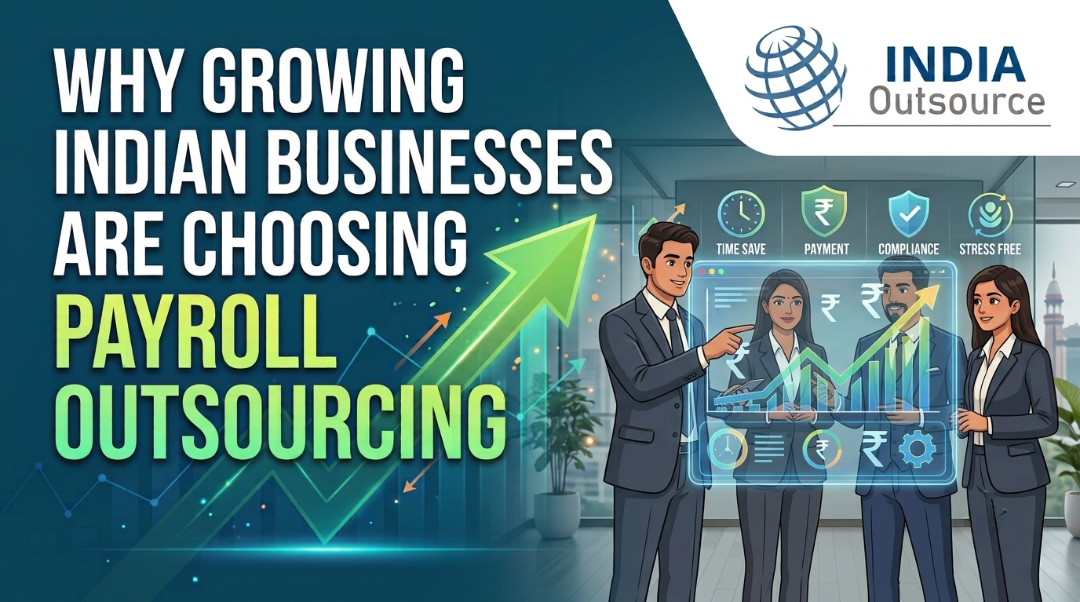
Why Growing Indian Businesses Are Choosing Payroll Outsourcing

Payroll is no longer simply a monthly task for a growing business – it is a process of salary calculation and distribution of payslips. It’s a complicated business role that includes employee information, tax deductions, statutory compliance, payroll computations, reporting, deadlines, and, with more and more complex requirements for the workforce, it’s more complicated.

With businesses growing, payroll outsourcing is moving beyond the realm of convenience and into a strategic approach.

Whether a startup is hiring their first employee or an established company looking to expand into several states, companies are finding that managing payroll in-house can be tedious, time-consuming and fraught with potential pitfalls regarding compliance and errors. According to industry research, India’s Payroll Services market is growing as businesses switch from manual to cloud-based, automated and professionally managed solutions.

For growing companies, the question now is no longer, “Can we do payroll ourselves?”

It is:

But shouldn’t our HR and finance teams be able to focus on other tasks since payroll can be managed by people who are more suited for it?

This is the primary justification for the increasing number of companies from India opting for payroll outsourcing solutions so as to enhance accuracy, strengthen compliance, cut down the administrative load and build a more efficient payroll system.

What Is Payroll Outsourcing?

Payroll outsourcing comprise engaging a third-party payroll service provider in order to handle either some or all of a company’s payroll responsibilities.

Depending on the service model and payroll service provider, outsourced payroll services can include:

  • Employee salary calculations
  • Payroll processing
  • Payslip generation
  • Tax calculations and deductions
  • TDS management
  • Provident Fund (EPF) support
  • Employee State Insurance (ESI) administration
  • Professional Tax management
  • Statutory filings
  • Payroll reports
  • Employee payroll queries
  • Full and final settlements
  • Leave and attendance integration
  • Payroll data management
  • Compliance support
  • Payroll audits and reconciliation

That is, a business outsources all of its payroll operations to a specialist who has the technology, skill and processes to ensure efficient payroll operations.

In India, where dealing with payroll administration can include numerous legal obligations and evolving laws, this is especially useful. For instance, the Income Tax Department announced that the payroll systems should reflect the amendments made by the Income Tax Act, 2025 for TDS deduction on salary from April 2026 onwards.

Why Are Growing Indian Businesses Choosing Payroll Outsourcing?

1. Payroll Becomes More Complex as Businesses Grow

When a company has only 10 or 20 employees, payroll can be a breeze.

But, as the arms grow longer and more numerous, so do the complexities of payroll.

A business may suddenly have:

  • Different salary structures
  • Multiple locations
  • Different employee benefits
  • Variable pay
  • Bonuses and incentives
  • New hires and exits
  • Leave adjustments
  • Reimbursements
  • Different statutory requirements
  • Tax declarations
  • Full and final settlements

The organization that was efficient for a 15-person startup might not be efficient for a 150-person company.

One of the main reasons for businesses to avail payroll outsourcing services in India. Professional providers are designed to manage payroll processes at scale while reducing the dependence on manual calculations and spreadsheets.

2. Compliance Is Becoming Too Important to Ignore

Payroll compliance is one of the strongest reasons companies consider outsourcing.

Indian employers may need to manage several payroll-related statutory obligations, including applicable:

  • EPF
  • ESI
  • Professional Tax
  • TDS
  • Labour-related requirements
  • Statutory records
  • Employee tax documentation
  • Other state- or business-specific requirements

The challenge isn’t simply knowing the rules.

The challenge is consistently applying them correctly and meeting the relevant deadlines.

Tax and payroll laws may evolve and payroll process must adapt. For instance, the Income Tax Department points out that the employers must update their payroll systems keeping pace with the new Income Tax Act, 2025 and revised salary-TDS requirement from April 2026 onwards.

The compliance obligations can quickly become a challenge for rapidly expanding companies without payroll department experts.

With payroll outsourcing, you can still utilize specialist expertise for the payroll procedure without needing to establish an in-house payroll team.

3. Reducing Payroll Errors

Payroll errors can have consequences far beyond correcting a spreadsheet.

An incorrect salary calculation can affect:

  • Employee trust
  • Employee satisfaction
  • Tax deductions
  • Statutory contributions
  • Financial reporting
  • HR workload
  • Management credibility

Staff members and workers demand that their wages be correct and promptly paid.

The professional payroll outsourcing company will generally have standardised processes, payroll software, validation and reconciliation processes, to minimise the risk of errors that could be avoided.

Although outsourcing will not solve all payroll problems, a careful, professional payroll process can help decrease reliance on manual calculations.

4. Saving HR and Finance Teams Valuable Time

When you ask the HR Manager what happens on payroll day, you’ll frequently get answers about spreadsheets, attendance information, employee questions, salary changes, approvals, deductions and the occasional last-minute correction.

Now think about doing that each month and at the same time, recruiting, engaging people, managing performance and developing them.

Payroll can be an ongoing nuisance in your operation.

An internal team may be able to outsource a significant amount of the administrative work with payroll outsourcing.

This frees up more time for your HR and financial team to do more of the things that are more important:

  • Hiring
  • Workforce planning
  • Employee retention
  • Performance management
  • Financial planning
  • Cost optimization
  • Business strategy

Payroll becomes a managed business process rather than a recurring internal bottleneck.

5. Better Cost Efficiency

One of the most attractive benefits of payroll outsourcing is cost efficiency.

Managing payroll internally may require businesses to invest in:

  • Payroll professionals
  • Payroll software
  • Compliance training
  • System maintenance
  • Employee administration
  • Data management
  • Backup resources
  • Compliance expertise

For smaller and growing companies, maintaining all of these capabilities internally may not be financially efficient.

Outsourcing allows companies to access payroll expertise and technology through a service model.

The goal isn’t simply to find the cheapest payroll provider.

The goal is to achieve lower total payroll administration costs while improving accuracy, compliance and scalability.

6. Access to Better Payroll Technology

Modern payroll outsourcing services are increasingly technology-driven.

Cloud-based payroll platforms can automate activities such as:

  • Salary calculations
  • Payroll workflows
  • Payslip generation
  • Attendance integration
  • Leave management
  • Tax calculations
  • Reporting
  • Employee self-service
  • Data storage
  • Payroll analytics

Industry research identifies cloud-based solutions, automation and digital technologies as important drivers of India’s growing payroll services market.

This means businesses don’t necessarily have to build their own sophisticated payroll infrastructure.

Instead, they can leverage a provider’s existing technology and expertise.]

7. Easier Scaling for Growing Companies

Growth creates payroll challenges.

Imagine a company growing from:

20 employees → 50 → 100 → 250 → 500 employees.

The payroll process needs to scale alongside the workforce.

An internal system that worked at 20 employees may require significant investment at 500.

With payroll outsourcing, the provider can often support increasing employee volumes through an established technology and operational framework.

This makes payroll more scalable as the organization expands.

For fast-growing startups and SMEs, this flexibility can be especially valuable. Research into India’s payroll services market indicates that smaller companies are expected to be an increasingly important growth segment as cloud-based systems reduce adoption barriers.

8. Managing Multi-State Payroll Becomes Easier

India’s diverse regulatory environment can create additional payroll complexity when a company operates across multiple states.

A growing company may have employees in:

  • Delhi
  • Maharashtra
  • Karnataka
  • Tamil Nadu
  • Telangana
  • Gujarat
  • West Bengal
  • Uttar Pradesh
  • Other states

Different locations can create different compliance and payroll administration requirements.

When businesses grow beyond their boundaries, payroll outsourcing in India allows them to gain from specialized payroll skills and expertise that can administer multi-location payroll operations.

This can be especially helpful to those businesses that require setting up new offices, factories, retail points, or remote teams across India.

9. Improved Employee Experience

Payroll is an employee experience issue.

Employees don’t necessarily see the internal work behind payroll.

They simply expect:

“My salary should be correct, on time and transparent.”

A professional payroll system can improve employee experience through:

  • Accurate payslips
  • Self-service access
  • Clear salary breakdowns
  • Faster query resolution
  • Tax documentation
  • Consistent payroll processing
  • Easy access to payroll information

As payroll technology becomes more sophisticated, payroll is increasingly being viewed as part of the broader employee experience rather than simply an accounting function.

10. Stronger Data Management and Security

Payroll contains highly sensitive information.

This may include:

  • Employee names
  • Bank details
  • Tax information
  • Salary information
  • Identification data
  • Attendance records
  • Benefits information

Managing this information through disconnected spreadsheets and manual processes can create unnecessary risks.

Professional payroll providers generally use controlled systems, access permissions, standardized workflows and security processes to manage payroll information.

However, businesses should carefully evaluate a provider’s:

  • Data security policies
  • Access controls
  • Encryption practices
  • Backup procedures
  • Audit trails
  • Data retention policies
  • Privacy practices
  • Vendor agreements

Payroll outsourcing should reduce operational risk—not create a new data-security risk.

11. More Accurate Payroll Reporting

Growing businesses need payroll information for more than paying employees.

Management may need payroll data to understand:

  • Total employee costs
  • Department expenses
  • Salary trends
  • Overtime
  • Benefits costs
  • Hiring costs
  • Workforce growth
  • Monthly payroll liabilities

Professional payroll systems can turn payroll information into structured reports that help management make better workforce and financial decisions.

This makes payroll more useful as a source of business intelligence.

12. Easier Audits and Record Management

Payroll records need to be accurate, organized and accessible.

When payroll is managed through manual systems, finding historical information can become difficult.

Professional payroll platforms can centralize payroll records and create standardized reports.

This can make it easier to:

  • Review previous payroll cycles
  • Reconcile payroll
  • Investigate discrepancies
  • Produce reports
  • Maintain employee records
  • Support internal reviews
  • Prepare for audits

For growing companies, this organizational benefit can become increasingly important.

Payroll Outsourcing vs. In-House Payroll

The choice between an in-house payroll solution and outsourcing depends on a number of criteria, including the size of the company, the complexity of work that needs to be done, and the resources available.

Factor In-House Payroll Payroll Outsourcing
Payroll expertise Requires internal specialists Access to external specialists
Technology Business must invest Provider may supply platform
Compliance management Internal responsibility Can be supported by provider
Scalability Requires internal expansion Usually easier to scale
HR workload Higher Lower
Cost structure Salaries + technology + overhead Service-based cost
Employee support Internal team Provider + internal coordination
Multi-location payroll Can become complex Specialized support may help

For very small companies with simple payroll requirements, internal processing may still be practical.

But as workforce size and payroll complexity increase, payroll outsourcing can become a more attractive operating model.

What Does a Payroll Outsourcing Provider Actually Do?

A comprehensive payroll provider may manage the payroll lifecycle from employee data collection through reporting and statutory processes.

A typical monthly cycle can include:

Step 1: Collect Payroll Inputs

The provider receives information such as:

  • Attendance
  • Leave
  • New hires
  • Resignations
  • Salary revisions
  • Incentives
  • Bonuses
  • Reimbursements
  • Deductions

Step 2: Process Payroll

The payroll system calculates:

  • Gross salary
  • Applicable deductions
  • Tax
  • Contributions
  • Net salary

Step 3: Validate Payroll

Payroll data is reviewed for inconsistencies and unusual changes.

Step 4: Generate Payslips

Employees receive detailed salary statements.

Step 5: Process Statutory Requirements

Applicable statutory deductions, payments and filings are managed according to the agreed scope.

Step 6: Generate Reports

Management receives payroll summaries and relevant reports.

Step 7: Maintain Records

Payroll data and documentation are securely maintained for future reference.

Is Payroll Outsourcing Suitable for SMEs?

Absolutely.

In fact, SMEs can potentially benefit significantly because they often don’t have the resources to maintain a large internal payroll team.

A growing SME may have:

  • A small HR team
  • A finance manager
  • No dedicated payroll specialist
  • Increasing employee numbers
  • Multiple compliance requirements

There’s no need to employ many people to handle the payroll. The business can hire a specialized payroll service.

This means that the company will benefit from the expertise of payroll professionals without needing to invest money in creating an entire payroll system.

When Should a Business Consider Payroll Outsourcing?

There is no universal employee-count threshold.

However, outsourcing becomes particularly worth considering when:

  • Payroll takes too much HR time
  • Payroll errors are increasing
  • Employee numbers are growing quickly
  • The company operates in multiple states
  • Compliance requirements are becoming difficult to manage
  • Finance teams are spending too much time on payroll
  • The business is expanding rapidly
  • Payroll is still managed primarily through spreadsheets
  • Employees frequently ask payroll-related questions
  • The company needs better reporting
  • Management wants to reduce administrative overhead

A useful rule is:

If payroll is becoming a business bottleneck, it may be time to outsource it.

How to Choose the Right Payroll Outsourcing Company in India

Choosing the cheapest provider isn’t necessarily the best strategy.

Businesses should evaluate potential payroll partners based on several factors.

  1. Compliance Expertise

Ask how the provider handles applicable:

  • TDS
  • EPF
  • ESI
  • Professional Tax
  • Statutory filings
  • State-specific requirements
  1. Technology

Check whether the platform offers:

  • Cloud access
  • Employee self-service
  • Automated calculations
  • Attendance integration
  • HRMS integration
  • Reporting
  • Secure access
  1. Data Security

Ask about:

  • Data encryption
  • User permissions
  • Backups
  • Audit trails
  • Data privacy
  • Security certifications
  1. Customer Support

Payroll issues are time-sensitive.

Make sure you understand:

  • Response times
  • Support channels
  • Dedicated account management
  • Escalation procedures
  1. Scalability

Your payroll provider should be able to support your growth.

Ask:

“Can this provider handle our workforce if we double or triple our employee count?”

  1. Transparent Pricing

Understand what is included in the quoted price.

Look for potential additional charges for:

  • Implementation
  • Employee onboarding
  • Additional payroll runs
  • Statutory filings
  • Support
  • Integrations
  • Year-end documentation

Common Mistakes Businesses Make When Outsourcing Payroll

Payroll outsourcing can deliver significant benefits, but only when the provider and process are carefully selected.

Choosing purely on price

The cheapest provider may not offer the compliance depth or support your company needs.

Not defining responsibilities

Your contract should clearly explain what the provider handles and what remains your responsibility.

Ignoring data security

Payroll involves sensitive employee information. Security should be evaluated before signing a contract.

Failing to verify compliance capabilities

Ask for specific examples of how the provider manages applicable statutory requirements.

Poor integration with HR systems

Disconnected systems can create duplicate data entry and increase the possibility of errors.

No transition plan

Moving payroll from an internal system to an external provider requires careful data migration, testing and validation.

The Future of Payroll Outsourcing in India

The future of payroll is increasingly digital, automated and data-driven.

Businesses are moving away from manual payroll processes toward:

  • Cloud payroll
  • Automated compliance workflows
  • Employee self-service
  • HRMS integration
  • API-based systems
  • Real-time reporting
  • Data analytics
  • AI-assisted processes

Market research points to continued growth in India’s payroll services sector, driven by automation, cloud adoption, compliance complexity and the increasing needs of smaller businesses.

At the same time, payroll has become more strategic.

Businesses want payroll information to offer solutions to the following questions:

  • How much are we spending on employees?
  • Which departments are growing fastest?
  • What is our workforce cost?
  • Where can we optimize compensation?
  • How quickly can we scale?
  • What will our payroll cost look like next year?

This means the future of payroll outsourcing isn’t simply about processing salaries.

It is about achieving more effective, compliant and smart systems of staff management.

Conclusion: Payroll Outsourcing Is a Growth Strategy

For growing Indian businesses, payroll is becoming too important—and too complex—to treat as a simple back-office activity.

As more employees enter the workplace, companies are also forced to process more payroll information, to fulfill more legal requirements and to meet higher employees’ expectations.

Payroll outsourcing is a sensible decision for overcoming these challenges while making it possible for staffs to concentrate on what is important for the company.

The primary goal of payroll outsourcing is not just saving money.

It is about improving the accuracy, compliance, scalability, technologies and utilization of time.

And when the company is developing, time is a valuable resource.

Ready to Simplify Your Payroll?

Contact a trusted payroll outsourcing provider today

FAQs About Payroll Outsourcing

1. What is payroll outsourcing?

Payroll outsourcing refers to the process of enlisting the services of an outside company to handle payroll tasks such Payroll calculation, payroll accretion, the issuance of payslips, any necessary tax deductions, adherence to relevant laws, and payroll reports.

2. Is payroll outsourcing suitable for small businesses?

Yes. Small and entrepreneurial businesses can benefit from payroll outsourcing, thereby utilizing payroll expertise and systems without employing a hefty payroll department.

3. How does payroll outsourcing reduce costs?

This will result in less need for dedicated payroll personnel, software purchases, manual work processes, and continuous payroll-related education. The savings will differ based on the business size and complexity of payroll management.

4. Is payroll outsourcing safe?

This is possible if the business uses the services of reliable companies that have necessary security measures, access control, data protection methods, and contractual guarantees.

5. Does payroll outsourcing include compliance?

While many full-service providers do offer payroll compliance services, the range does differ between them. Therefore, the businesses should check what statutory calculations, payments, filings, and paperwork are included into the agreement with payroll service provider.

6. Can payroll outsourcing support employees in multiple Indian states?

Yes. There are many providers that do payroll across multiple locations, but the businesses should check whether the provider works in the specific states needed for their workforce.

7. Is payroll outsourcing better than payroll software?

They are not exactly the same.

Payroll software gives your internal team a technology platform to manage payroll.

Payroll outsourcing can transfer much of the operational responsibility to an external specialist.

The right choice depends on how much control, internal expertise and administrative capacity your business wants to maintain.
Outsource Bookkeeping

Why Outsource Your Bookkeeping Instead of Hiring In-House?

Your books are more than just a record of your business’s earnings and spent. Their role is to support your business plan, tax filing, cash flow, budgeting, profitability and business growth.

However, as your business expands, you may find yourself with the same conundrum as any other business owner: should you have an in-house book keeper or outsource your bookkeeping to a professional bookkeeping service?

First off, it may appear that it’s obvious to hire an employee. You have someone who is available and knows your business, is around during the day and is near your staff, both physically and virtually. However, the price of an in-house bookkeeping operation is far greater than salary. Some of these costs are easily compounded: recruitment, payroll taxes, benefits, software, training, management, paid leave, turnover, equipment and the risk of depending on one person.

An alternative model is outsourcing bookkeeping: hire a professional service, who will offer you bookkeeping expertise, bookkeeping processes, technology, review procedures and continuity without the same overhead as when employing one employee.

Outsourced bookkeeping can provide the financial expertise that many startups, entrepreneurs, small businesses, professional-service operations, e-commerce businesses and expanding SMEs require, without the expense and complexity of setting up an in-house accounting department.

Another part of having efficient bookkeeping is that right records can be used for analyzing the performance of the business, generating financial statements, keeping a record of business expenses which are deductible and preparing tax returns.

So, is outsourcing bookkeeping better than hiring in-house?

It provides a more smart, flexible and cost-effective solution for many businesses.

Let’s explore why.

What Is Outsourced Bookkeeping?

Outsourced bookkeeping involves contracting with an external bookkeeping professional, accounting firm or special bookkeeping service to provide some or all of your company’s bookkeeping needs.

Depending on your business and service agreement, an outsourced bookkeeping provider might take care of:

  • Recording daily financial transactions
  • Bank and credit-card reconciliation
  • Accounts payable
  • Accounts receivable
  • Expense categorization
  • Invoicing
  • Financial reporting
  • General ledger maintenance
  • Payroll-related bookkeeping
  • Sales-tax or GST-related bookkeeping support
  • Month-end closing
  • Accounts reconciliation
  • Cash-flow reporting
  • Cleanup of historical books
  • Accounting software management
  • Support for tax preparation
  • Management reports
  • Budgeting and financial analysis support

The point to note is that there is no need to hire one person to do all the accounting work.

Rather, you can get to a professional bookkeeping process, and possibly, a team of professionals.

That difference becomes particularly important as your company grows.

What Does an In-House Bookkeeper Actually Cost?

The greatest mistake made by businesses is comparing the cost of an outsourced bookkeeper with an employee’s salary.

Such comparison does not really show the true picture.

For example, an employee has a salary of $50,000 in a year.

Your actual cost may also include:

  • Employer payroll taxes
  • Benefits
  • Health insurance
  • Paid vacation
  • Sick leave
  • Bonuses
  • Recruitment costs
  • Background checks
  • Training
  • Accounting software
  • Computer equipment
  • Office space
  • Internet and utilities
  • HR administration
  • Management time
  • Continuing education
  • Replacement costs when the employee leaves

The result is a fully loaded employee cost that can be considerably higher than the advertised salary.

There is also an opportunity cost.

When your management team is spending hours to review bookkeeping assignments, correct errors, answer questions, train employees, or monitor an accounting hire, it’s taking away time for them to generate revenue.

Comparisons to other sectors in the recent past also reveal that the price of an in-house accounting worker is much more than the salary, whereas outsourced bookkeeping can incorporate expert accounting abilities and operational assistance into a recurring service.

10 Major Reasons to Outsource Your Bookkeeping

1. Lower Overall Operating Costs

The most obvious reason businesses outsource bookkeeping is cost efficiency.

With an in-house employee, you typically pay for the employee regardless of whether your bookkeeping workload is extremely high or relatively light during a particular period.

Outsourcing can give you greater flexibility.

Instead of building an entire internal position, you can purchase the level of service your business actually needs.

For example, a smaller company may only need:

  • Monthly bookkeeping
  • Bank reconciliation
  • Financial statements
  • Accounts payable support

A larger business might require:

  • Weekly bookkeeping
  • Accounts receivable
  • Accounts payable
  • Payroll bookkeeping
  • Inventory accounting
  • Monthly closing
  • Management reporting

Outsourcing allows the scope of work to evolve as the business changes.

The real cost advantage

You’re potentially eliminating expenses associated with:

  • Recruiting
  • Employee benefits
  • Payroll administration
  • Office equipment
  • Training
  • Paid time off
  • Turnover
  • Employee replacement
  • Software subscriptions
  • Management overhead

It does not mean that outsourcing automatically works out as cheaper everywhere.

For many small and growing companies, though, it is usually much more cost-effective than having a full-time bookkeeper.

2. Access to Professional Bookkeeping Expertise

When you hire one employee, you generally get the expertise of that individual.

When you outsource to an established bookkeeping firm, you may gain access to a broader pool of experience.

That can be valuable when your business encounters issues involving:

  • Complex transactions
  • Reconciliations
  • Month-end closing
  • Revenue recognition
  • Expense classification
  • Inventory
  • Multiple bank accounts
  • Multi-location operations
  • Financial reporting
  • Accounting software
  • Tax-related bookkeeping requirements

An experienced third-party bookkeeping provider has probably already worked with various industries, businesses, accounting practices, and financial situations.

That working experience allows identifying potential issues that a less experienced specialist would not even recognize.

3. Better Accuracy and Financial Controls

Bookkeeping errors can have consequences far beyond an incorrect spreadsheet.

Incorrect records can affect:

  • Profit calculations
  • Cash-flow decisions
  • Tax reporting
  • Financial statements
  • Budgets
  • Investor reporting
  • Loan applications
  • Business valuations
  • Management decisions

According to the IRS, businesses have to keep records documenting revenues and expenses clearly, with additional documents supporting recorded transactions.

Many professional bookkeeping services rely on a standardized approach to bookkeeping, including:

  1. Transaction categorization
  2. Bank reconciliation
  3. Account reconciliation
  4. Review procedures
  5. Month-end closing
  6. Financial statement preparation
  7. Exception identification

These processes can create stronger consistency than relying on one employee who may be learning your company’s bookkeeping procedures as they go.

4. Reduce Key-Person Dependency

Imagine your entire bookkeeping function depends on one employee.

Then that employee:

  • Takes vacation
  • Becomes sick
  • Resigns
  • Retires
  • Moves to another company
  • Becomes unavailable unexpectedly

What happens to your books?

This is known as key-person risk.

The problem isn’t necessarily that your employee is doing a poor job. The problem is that your business has concentrated critical financial knowledge in one person.

An outsourced bookkeeping provider may be able to provide continuity through documented processes, shared systems, and multiple team members.

This can make your bookkeeping operation more resilient.

5. Save Valuable Management Time

Business owners frequently underestimate how much time bookkeeping consumes.

Even if you’re not personally entering every transaction, you may still spend time:

  • Answering accounting questions
  • Approving invoices
  • Looking for receipts
  • Reviewing reports
  • Correcting categorization errors
  • Following up on missing documents
  • Training employees
  • Managing bookkeeping deadlines

Outsourcing can move much of this administrative burden away from the business owner.

That allows you to spend more time on:

  • Sales
  • Marketing
  • Customer relationships
  • Product development
  • Hiring
  • Business strategy
  • Operations
  • Expansion

The objective isn’t simply to save money.

It’s to redirect your time toward activities that grow the business.

6. Scale Your Bookkeeping as Your Business Grows

Your bookkeeping requirements at $500,000 in annual revenue may look completely different from your requirements at $5 million.

As businesses grow, they often add:

  • Employees
  • Customers
  • Vendors
  • Bank accounts
  • Payment platforms
  • Products
  • Locations
  • Inventory
  • Transactions
  • Legal entities
  • Financial reporting requirements

An internal bookkeeper may eventually become overwhelmed.

That creates another hiring decision:

Do you hire another bookkeeper? A senior accountant? An accounting manager? A controller?

With an outsourced model, you may be able to increase your service level as your bookkeeping complexity grows.

This provides scalability without necessarily rebuilding the entire internal finance department.

7. Get Access to Better Accounting Technology

Modern bookkeeping is increasingly technology-driven.

Professional providers may work with platforms and tools designed for:

  • Automated transaction imports
  • Bank feeds
  • Receipt capture
  • Invoice management
  • Expense tracking
  • Financial reporting
  • Payroll integration
  • Payment processing
  • Document management
  • Cloud-based collaboration

The IRS recognizes electronic accounting systems as part of modern business recordkeeping, provided they maintain complete and accurate records.

The advantage of outsourcing is that you don’t necessarily need to become an expert in every accounting technology yourself.

Your provider can help establish and maintain an appropriate workflow.

8. Improve Financial Visibility

Good bookkeeping isn’t just about recording history.

It will enable you to know what’s going on in your business.

Correct and timely accounts can help you find answers to the questions such as:

  • How much cash do we have?
  • How profitable are we?
  • Which products or services generate the highest margins?
  • How much do customers owe us?
  • Which bills are coming due?
  • Are expenses increasing too quickly?
  • Can we afford to hire another employee?
  • Can we invest in new equipment?
  • Are we getting sufficient funds for development?

Financial statements such as profit and loss statements and balance sheets give valuable information required to monitor the work of the company and to communicate with banks or lenders.

Hence, outsourced bookkeeping may become more than simple administration.

It can become part of your financial decision-making infrastructure.

9. Reduce Recruitment and Employee Turnover Problems

Finding a suitable bookkeeper requires resources and time.

You need to:

  1. Write the job description.
  2. Advertise the position.
  3. Review applications.
  4. Interview candidates.
  5. Verify qualifications.
  6. Make an offer.
  7. Complete onboarding.
  8. Train the employee.
  9. Integrate them into your systems.
  10. Monitor performance.

And you cannot be sure that person will stay.

If they leave after a period of 12 or 18 months, you have to start again.

The famous thing is, outsourcing. It puts most of the responsibility on bringing in the outsourced person onto the provider.

So, instead of asking:

“How do I find and keep a good bookkeeper?”

You’re asking:

Which bookkeeping provider has the knowledge, systems, security, and service approach my business requires?”

That can be a much easier operational problem to solve.

10. Get More Flexibility Than a Full-Time Employee

Not every business needs a full-time bookkeeper.

Some businesses have reasonably low transaction volumes, but still, need expert reports.

Others experience seasonal spikes.

For example:

  • For instance, during holidays the retail businesses have a boom in activity.
  • E-commerce businesses may experience sudden transaction growth.
  • Contractors may have project-based financial activity.
  • Startups may scale quickly after receiving funding.
  • Professional-service businesses may have predictable monthly bookkeeping requirements.

Outsourcing can provide a more flexible approach to staffing the bookkeeping function.

You can often select services based on the real needs of your business and create a position accordingly.

Outsourced Bookkeeping vs. In-House Bookkeeping

Factor Outsourced Bookkeeping In-House Bookkeeping
Hiring costs Usually avoided Required
Employee benefits Usually avoided Required
Recruitment Provider handles staffing Business handles recruitment
Training Provider responsibility Business responsibility
Software expertise Often included Must be developed internally
Scalability Generally flexible Requires additional hiring
Key-person risk Can be reduced with team-based service Often higher
Management time Usually lower Usually higher
Dedicated employee No Yes
Physical presence Usually remote On-site or hybrid
Industry expertise Potentially broad Depends on employee
Backup coverage May be available Requires internal backup
Cost structure Service fee Salary + employment overhead
Best for Flexible, scalable support Businesses needing dedicated internal support

Is Outsourced Bookkeeping Always Better?

No.

This is important.

Outsourcing isn’t automatically the right choice for every business.

An in-house bookkeeper may make sense when:

  • You have a large volume of daily transactions.
  • Your accounting needs are highly specialized.
  • You require someone physically present.
  • The employee will perform substantial non-bookkeeping administrative work.
  • You need immediate internal access throughout the day.
  • Your organization has a complex internal finance operation.
  • You already have strong accounting management in place.
  • Your business has reached a size where maintaining internal accounting staff is economically justified.

The right decision depends on your:

  • Revenue
  • Transaction volume
  • Industry
  • Growth rate
  • Accounting complexity
  • Internal resources
  • Technology
  • Budget
  • Reporting requirements

The goal isn’t to outsource simply because outsourcing sounds cheaper.

The goal is to build the most efficient financial operation for your business.

Outsourcing Can Also Improve Business Continuity

The term business continuity is frequently used in regard to great calamities but it can also concern daily happenings that have a disruptive effect on operations.

For example:

Your bookkeeper resigns on Monday.

Payroll information needs to be processed.

Vendor invoices need to be recorded.

Bank accounts need reconciliation.

Month-end is approaching.

Management needs financial reports.

Suddenly, the company has a financial operations problem.

A structured outsourced bookkeeping relationship can potentially reduce this dependency by providing documented workflows and backup resources.

This is especially valuable for small businesses where one employee may otherwise control the entire bookkeeping process.

Better Bookkeeping Can Support Better Tax Preparation

Although bookkeeping and tax preparation operate still on slightly different levels they are both equally vital.

In case your books appear to be deficient or not up to date tax preparation can become a rather troublesome task for you.

Good records help businesses:

  • Identify income
  • Track expenses
  • Support deductions
  • Prepare financial statements
  • Prepare tax returns
  • Support reported tax information

The IRS specifically notes that business records should support income, expenses, and credits reported on tax returns.

Outsourcing bookkeeping can therefore help establish a cleaner financial foundation for your tax professional.

Important: Bookkeeping services do not automatically replace professional tax advice. Whether you pay taxes or not is defined by, among other things, your business structure and location as well as activities.

How Outsourced Bookkeeping Helps Small Businesses

Small businesses often have an unusual financial challenge:

They need professional financial management, but they may not have the budget to build a full accounting department.

Hiring:

  • Bookkeeper
  • Senior accountant
  • Accounting manager
  • Controller
  • CFO

may be unrealistic at an early stage.

Outsourcing facilitates the delivery of specialized skills without having to fill every vacancy in-house.

This creates a potentially powerful model:

Founder + outsourced bookkeeper + CPA/tax professional + fractional controller/CFO

rather than:

Founder + multiple full-time finance employees

As the business grows, the structure can evolve.

Why Outsourcing Can Be Particularly Valuable for Growing Companies

Growth creates complexity.

More customers mean more invoices.

More employees mean more payroll-related transactions.

More vendors mean more bills.

More products mean more inventory accounting.

More locations mean more accounts and reconciliations.

More revenue means greater financial reporting expectations.

The absence of a scalable accounting system can lead to a mess in finances as the company expands.

Using outsourcing enables growing companies to access the processes they need before reaching a size that makes a big internal finance department reasonable.

What Services Should You Expect From a Professional Bookkeeping Provider?

A strong bookkeeping provider should be able to communicate in a clear way what services it provides.

Depending on your package, you may look for:

Core Bookkeeping

  • Transaction recording
  • Account categorization
  • Bank reconciliation
  • Credit-card reconciliation
  • General ledger maintenance

Accounts Payable

  • Bill entry
  • Vendor management
  • Payment tracking
  • Outstanding-balance reporting

Accounts Receivable

  • Customer invoicing
  • Payment tracking
  • Receivables reporting
  • Aging reports

Month-End Services

  • Account reconciliations
  • Adjusting entries
  • Closing procedures
  • Financial statement preparation

Reporting

  • Profit and loss statement
  • Balance sheet
  • Cash-flow information
  • Budget vs. actual reporting
  • Management reports

Cleanup

  • Historical bookkeeping cleanup
  • Uncategorized transaction resolution
  • Reconciliation corrections
  • Chart-of-accounts cleanup

How to Successfully Transition From In-House to Outsourced Bookkeeping

Switching providers isn’t always difficult.

The process can easily follow these steps.

Step 1: Review Your Current Books

Identify:

  • Bank accounts
  • Credit cards
  • Loans
  • Vendors
  • Customers
  • Payroll accounts
  • Accounting software
  • Historical balances
  • Outstanding reconciliations

Step 2: Identify Existing Problems

Before transferring the books, identify:

  • Uncategorized transactions
  • Unreconciled accounts
  • Duplicate transactions
  • Missing documentation
  • Incorrect account classifications
  • Old outstanding invoices
  • Old unpaid bills

Step 3: Define Responsibilities

Determine who handles:

  • Bookkeeping
  • Bill approval
  • Payments
  • Invoicing
  • Payroll
  • Tax filing
  • Financial reporting

Step 4: Establish a Communication Process

Decide:

  • Who is your primary contact?
  • How frequently do you communicate?
  • How are questions submitted?
  • When are reports delivered?
  • Who approves transactions?

Step 5: Set Reporting Deadlines

For example:

Month-end close → Financial statements → Management review

A defined schedule creates accountability.

Step 6: Monitor the First Few Months

Review:

  • Accuracy
  • Timeliness
  • Responsiveness
  • Report quality
  • Reconciliation status
  • Financial visibility

When the procedure is reliable, the bookkeeping becomes an integral portion of the company’s operation.

Common Myths About Outsourced Bookkeeping

Myth 1: “Outsourcing Means Losing Control.”

Not necessarily.

Cloud accounting systems can provide authorized access to financial information while your bookkeeping provider handles the underlying work.

Approval processes and reporting protocols are created to involve management in the process.

Myth 2: “An Employee Understands My Business Better.”

An employee may have enough knowledge of the company, but a knowledgeable third-party provider can gain access to its practices as well.

The most important matters are documentation, communication, and proper onboarding.

Myth 3: “Outsourcing Is Only for Small Businesses.”

Not at all.

Larger businesses can outsource some of their accounting processes even if they employ accounting professionals.

For example, there may be a company with an agency on staff performing the duties of a controller while bookkeeping is outsourced.

Myth 4: “Outsourcing Means Cheap, Low-Quality Work.”

Quality depends on the provider.

The point of the process should not be merely finding the least expensive bookkeeping service.

When looking for an outside party one should aim to find the best mix of:

Accuracy + expertise + security + communication + technology + scalability + value.

When Should You Consider Outsourcing Your Bookkeeping?

You should seriously evaluate outsourcing when:

  • Bookkeeping is taking too much of your time.
  • Your books are consistently behind.
  • Your current bookkeeper is overloaded.
  • You’re preparing for rapid growth.
  • Your accounting needs are becoming more complex.
  • You don’t have backup coverage.
  • Financial reports aren’t available when you need them.
  • You are making decisions without reliable financial information.
  • Your bookkeeping employee is leaving.
  • You want to reduce administrative overhead.
  • You need professional bookkeeping expertise without building a larger finance department.

One of the biggest warning signs is simple:

If your bookkeeping process isn’t trustworthy, you are possibly in need of a bookkeeping system.

A Simple Cost-Benefit Framework

Do the cost-benefit analysis across 5 factors before taking the final decision regarding the bookkeeping arrangement.

Cost

An employee’s salary is not the only cost to consider—there are many hidden costs.

Expertise

Evaluate the accounting expertise your business actually needs.

Scalability

Consider whether your bookkeeping arrangement can allow for a 2x or 5x increase in volume of transactions.

Risk

Analyze crucial person dependence, mistakes, staff turnover, and business continuity.

Time

Evaluate the amount of management time spent on bookkeeping.

Then compare the results.

Although it is true that having cheaper monthly bookkeeping fees does not mean you will be getting good service.

In the same way, it is also true that having an expensive hire for bookkeeping will not be worth hiring just for ten hours of bookkeeping per week.

The best solution is the one that delivers accurate, timely financial information at an appropriate total cost.

Why Accurate Bookkeeping Is a Business Growth Tool

It’s easy to think bookkeeping as an administrative task that requires paperwork.

That’s a mistake.

Your books tell you what is happening financially.

They can help reveal:

  • Rising expenses
  • Falling margins
  • Slow-paying customers
  • Unprofitable services
  • Excessive overhead
  • Cash-flow pressure
  • Strong-performing products
  • Growth opportunities

The IRS also identifies accurate records as an important tool for monitoring business progress and preparing useful financial statements.

In other words:

Bookkeeping doesn’t grow your business directly.

Well-organized bookkeeping provides the necessary info about the income and expenses of the business thus enabling you to make responsible decisions for its development.

Conclusion: Outsource Bookkeeping or Hire In-House?

There is no universal answer.

But for many small and growing businesses, outsourcing offers an attractive combination of:

  • Lower employment overhead
  • Professional expertise
  • Flexible service levels
  • Better continuity
  • Reduced management burden
  • Scalable support
  • Technology access
  • Stronger financial visibility

When your business is in the need of having a dedicated hire, regular accounting work, physical presence in the company, or specific knowledge, it can be a good idea to have an in-house bookkeeper.

But if the goal is to be able to get accurate bookkeeping and reporting, as well as have a financial expert at hand, outsource the bookkeeping.

The real question isn’t:

“Should I pay an employee or a bookkeeping company?”

The better question is:

“What is the most efficient way to build a reliable financial system that supports my business today and scales with us tomorrow?”

For many businesses, the answer is outsourced bookkeeping.

Get Professional Bookkeeping Support Today

Let’s build cleaner books, clearer financial insights, and a more efficient path to growth—starting today.

Contact Us Today

FAQs About Outsourced Bookkeeping

1. Is outsourced bookkeeping cheaper than hiring an in-house bookkeeper?

Outsourcing can indeed be a reasonable option especially when the business is small and does not require full-time bookkeeper’s work. However, the cost of outsourcing services will depend on the nature of the transactions, industries, and location, among other factors.

It is very important to always calculate the overall cost of hiring in-house accountant against the cost of the services offered by the outsourced accounting company.

2. Is outsourced bookkeeping secure?

Of course! But it should be noted that you should preferably choose an outsourcing provider that has a good standing in the administrative market and has a good working system to protect the information.

Ask prospective providers how they protect financial information before signing an agreement.

3. Can I outsource bookkeeping and keep my accountant?

Definitely!

Bookkeeping and tax/accounting consulting may exist separately.

For example, an outsourced bookkeeper might manage your accounts while your CPA or tax expert will prepare and plan for your taxes.

4. How often should bookkeeping be done?

It will vary depending on how complex your transactions are.

Certain businesses will benefit from everyday or weekly reports, while others might be fine with only monthly ones.

Basically, the more frequently your company takes financial actions, the more beneficial having current reports will be.

5. Can startups outsource bookkeeping?

Yes.

In fact, outsourcing is especially helpful for new companies which require some level of financial care but do not have money to support an entire accounting department.

6. What happens if my outsourced bookkeeper makes a mistake?

Your agreement must cover procedures for corrections and reviews as well as liabilities.

Be sure to check the providers’ quality assurance measures.

7. Can outsourced bookkeeping handle payroll?

Some providers specialize in payroll bookkeeping or payroll management, while others purely deal with bookkeeping.

It is important to verify what’s covered by your services agreement.

8. Can outsourced bookkeeping handle tax filing?

Some providers offer tax-related services, while others only provide bookkeeping.

Don’t assume tax preparation or filing is included. Ask for a detailed scope of services.

Outsourcing-Accounting Services to India

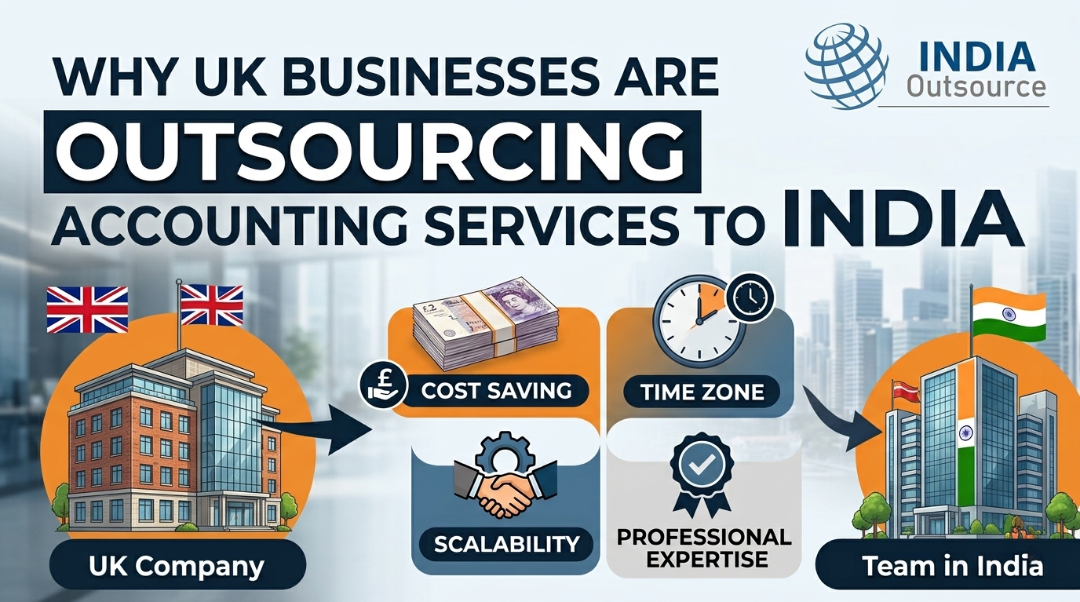
Why UK Businesses Are Outsourcing Accounting Services to India: Benefits, Costs, Process, Risks & Future Trends

Accounting is always an important part of a business, but the role of finance has evolved at a fast pace.

From cutting operating expenses to hiring skilled staff, keeping accurate financial records, adapting to increasingly complex laws and regulations, using cloud accounting technology and generating timely financial information to aid decision making, the pressure UK businesses are facing is immense. Meanwhile, accounting firms are facing a talent shortage and are placing increased demands on their clients.

This mix is sparking more and more small businesses and accountancy firms in the UK to re-think the provision of routine and specialist accounting work.

Outsourcing accounting to India is one solution that is becoming increasingly popular.

India has evolved into one of the world’s leading destinations for professional-services and outsourcing, boasting a large pool of accounting and finance professionals, English proficiency, a robust technology eco-system and experience working with international organizations.

Importantly, it’s no longer just a strategy for lowering labor expenses. Today, outsourcing accounting work is as much a business of access to talent, scalability, technology, productivity, business continuity and enabling in-house staff to focus on more value added tasks in the UK.

The ICAEW research, which marks the first step in the creation of an accountancy sector outsourcing/offshoring benchmark, reveals just how embedded outsourcing and offshoring has become in the accountancy profession. Half of the some of the smaller companies surveyed had outsourced or offshored at least one service line, typically accountancy, tax, audit and payroll. India was mentioned as one of the successful countries owing to the availability of qualified professionals and the scaling capability of the service centres.

Then, what is the reason for businesses from the UK to outsource accounting services to India?

Let’s explore the major reasons.

What Is Accounting Outsourcing to India?

Accounting outsourcing involves outsourcing a set of accounting, bookkeeping, finance, tax-support, payroll or similar processes to an external specialist provider.

If the provider is based in India, this outsourcing is generally termed as offshore accounting outsourcing.

A business in the UK doesn’t necessarily move all of their finance functions abroad. Rather, it can off-shoren particular processes but preserve strategic monetary regulate in the UK.

For example, a UK company could keep its finance director, accountant or senior management team in the United Kingdom, while an Indian outsourcing team manages:

  • Bookkeeping
  • Accounts payable
  • Accounts receivable
  • Bank reconciliation
  • Credit control support
  • Payroll processing
  • VAT preparation
  • Management accounts
  • Financial reporting
  • Year-end accounts preparation
  • Tax return preparation support
  • Audit preparation and documentation
  • Data entry and transaction processing
  • Invoice processing
  • Expense management
  • Financial data reconciliation
  • Cash-flow reporting
  • Month-end procedures
  • Accounting software administration

According to HMRC bookkeeping is the recording of vital primary business records such as money received and paid, sales ledgers and purchase ledgers. These records can then be used to create accounts and tax calculations.

This lends itself to bookkeeping and other accounting activities to be particularly appropriate for structured outsourcing arrangements.

10 Major Reasons UK Businesses Are Outsourcing Accounting Services to India

1. Lower Accounting and Operational Costs

Cost efficiency is one of the most apparent motivations for outsourcing accounting tasks to India.

Having a full complement of finance staff is significantly more than salary. Businesses might also have to take into account:

  • Recruitment costs
  • Employer National Insurance
  • Pension contributions
  • Employee benefits
  • Office space
  • Equipment
  • Software
  • Training
  • Recruitment agency fees
  • Staff turnover
  • Sick leave
  • Holiday cover
  • Professional development
  • Management overhead

Some of these fixed costs can be shifted to become a more flexible service cost through outsourcing.

India’s geography and the professional demographics of the workforce gives outsourcing providers an edge in providing accounting support service at reduced overall operating expense when compared with employing comparable extra resources at the UK.

But cost reducing is not the only motive for outsourcing.

The better the business case when there are cost savings plus capacity, technology, specialist knowledge and workflow efficiencies.

The real financial advantage

The objective should not be:

How do you find the cheapest accountant?

It should be:

What steps can be taken to ensure reliable accounting capacity at an economic cost, and yet achieve quality and control?

This is the key point to consider in choosing an outsourcing provider.

2. Access to a Large Pool of Skilled Accounting Professionals

Talent availability is one of the other significant factors that come to make India an appealing outsourcing destination.

Hiring and retaining top talent in the accounting profession is an ongoing challenge in the UK. ICAEW research actually indicates that talent-related concerns are a large problem in the mid-tier accountancy firms, as recruitment and retention of qualified staff is one of the main concerns.

India can provide a significant number of financial and accounting experts, such as those with experience in:

  • Bookkeeping
  • Financial accounting
  • Management accounting
  • Tax support
  • Audit support
  • Payroll
  • Accounts preparation
  • Financial analysis
  • Cloud accounting
  • Finance operations

This can help a UK business to recruit people to fit their requirements without being limited to the local recruitment market.

This is especially beneficial for growing Business.

A company could be able to hire an accounting specialist offshore from the UK relatively quickly by using a known outsourcing provider instead of taking months to find a new specialist.

3. Strong Familiarity With UK Accounting Practices

Many people think that a team of accountants in India is not suitable to be part of a UK business due to the presence of the team in India.

The truth is that many outsourcing providers have a specific training of their teams to enable them to operate within the UK’s accounting frameworks, tax process, software and business practices.

Depending on the provider and engagement, teams may have experience with:

  • UK GAAP
  • FRS 102
  • FRS 105
  • VAT
  • HMRC processes
  • Making Tax Digital
  • UK payroll
  • Companies House-related processes
  • UK year-end accounts
  • UK bookkeeping procedures
  • UK accounting software

ICAEW’s research highlights that effective offshore arrangements can include offshore staff integration with UK staff and processes and the training of offshore teams in UK GAAP.

This does not imply that people have to be good at geography in order to be good at accounting.

It’s the ability to prove their UK expertise that’s the key here.

4. Scalability Without Constant Recruitment

Business requirements are not everlasting.

A company might require:

  • One bookkeeping resource today
  • There were two finance professionals next year
  • Additional support during year-end
  • Increased payroll capacity through acquiring employees
  • Temporary assistance during a busy tax period
  • A focused staff with a very rapid growth.

It is cost and time intensive to hire person on a permanent basis for each change.

Outsourcing provides a potentially more flexible model.

Business can opt for various options like:

Dedicated resource

The accountant or accounting team is assigned to a single client.

Shared service model

Several clients share the provider’s resources.

Project-based outsourcing

Specific work is contracted out for a specific amount of time or specific project.

Fully managed accounting

The provider carries out an agreed accounting task from the processing of transactions to the production of reporting.

The scalability factor is one of the reasons why outsourcing can be particularly appealing to startups, SMEs and expanding accounts firms.

5. Ability to Focus on Core Business Activities

There is a vital need for finance administration, but not all financial activities need to be the responsibility of senior management in the UK.

Business owners and directors tend to waste a lot of time on:

  • Invoice processing
  • Bank reconciliation
  • Expense records
  • Bookkeeping queries
  • Data entry
  • Payment processing
  • Payroll administration
  • Month-end preparation

All these activities take time that could be better spent on:

  • Business development
  • Customer relationships
  • Sales
  • Strategic planning
  • Product development
  • Market expansion
  • Leadership
  • Investment decisions

Outsourcing helps businesses to distinguish transactional accounting from strategic financial management.

The goal here isn’t to replace the finance function.

It is to give internal professionals more time to be more productive in work activities where they have added value to the business.

6. Better Access to Accounting Technology

Today, outsourcing accounting is tightly linked to the cloud and automation.

A good outsourcing partner can potentially collaborate with platforms like:

  • Xero
  • QuickBooks
  • Sage
  • IRIS
  • TaxCalc
  • Microsoft Excel
  • Cloud payroll platforms
  • Document management systems
  • Workflow automation tools
  • Reporting and business intelligence platforms

Technologies can make it possible for UK companies and teams in the offshore to work together without having to be in the exact same workplace.

Authorised users can also access financial information and workflows from various locations from Cloud Accounting.

In this new way of working, outsourcing is not merely:

UK company → emails spreadsheet → India team → spreadsheet returned.

An operation can, instead, look like a mature operation:

Cloud accounting platform → automated workflow → offshore processing → quality review → UK management approval → real-time reporting.

The latter is a much more complicated model.

7. Faster Turnaround and Greater Capacity

When a UK team becomes overloaded, so do accounting deadlines.

The end of month, quarter, year, VAT deadlines, Payroll deadlines and tax periods can be very stressful.

An offshore team can add to the processing capacity without the need for the UK business to substantially increase its permanent staff.

Teams can function with:

  • Defined service-level agreements
  • Standard operating procedures
  • Task management systems
  • Automated reminders
  • Quality-control checks
  • Escalation procedures
  • Dedicated account managers

But some companies get an advantage due to the time zone difference as well.

Anything done by an Indian team outside office hours may be reviewed when UK team starts work the following morning.

This can be a helpful follow-the-sun workflow, as long as there’s proper communication, deadlines, and the provider’s team structure.

8. Improved Business Continuity

Resilience is another benefit of outsourcing.

An employee can put a small internal finance team at risk when he or she:

  • Resigns
  • Takes annual leave
  • Becomes ill
  • Goes on parental leave
  • Retires
  • Changes roles
  • Becomes unavailable during a critical deadline

An appropriately managed outsourcing provider will have several trained employees and documented procedures.

This lessens the reliance on an individual person.

But, there is no guarantee that outsourcing equates to resilience in the business. They should enquire from providers about:

  • Backup staffing
  • Disaster recovery
  • Business continuity plans
  • Data backups
  • Access controls
  • Staff replacement procedures
  • Disaster recovery testing
  • Service-level commitments

The aim is to establish a process that documents key financial processes, rather than relying on one person to know them.

9. Support During UK Accounting Staff Shortages

As a company grows, they start to need accounting staff and the challenge of hiring them becomes a strategic problem in many companies in the UK.

Some esearch reveals that talent issues can have direct impact on outsourcing and offshoring. Of the mid-tier companies surveyed, half had already outsourced and/or offshored at least one service line. This makes an important difference:

This makes an important difference:

Outsourcing doesn’t always mean that UK accountants are being replaced.

It can mean augmenting the existing UK team.

For example:

A practice in the UK can have five accountants but require seven during peak periods.

The firm might be able to get an offshore accounting team to prepare and process the defined work, and UK accountants to work on the client facing and review tasks.

This can help the UK team to manage a greater number of clients while reducing the number of staff at a similar rate.

10. Greater Focus on High-Value Accounting and Advisory Services

Money may not be the ultimate motivator for outsourcing.

It could be developing capacity for more expensive services.

An accountancy practice which mainly does bookkeeping and routine accounts work has limited capacity to:

  • Business advisory
  • Management reporting
  • Tax planning
  • Forecasting
  • Cash-flow advisory
  • Strategic finance
  • Virtual CFO services
  • Client consultations
  • Business growth planning

Outsourcing appropriate processing work can give UK accountants the opportunity to focus their time on advisory services.

That opens up a possibility to shift the business model from:

“We sell accounting hours.”

to:

“We sell financial expertise and business insight.”

Especially as everyday office tasks are increasingly automated.

What Accounting Services Can UK Businesses Outsource to India?

Not all processes have to be done in-house.

Typical tasks which are outsourced to an accountant are:

Bookkeeping

  • Daily transaction recording
  • Bank reconciliation
  • Sales ledger
  • Purchase ledger
  • General ledger maintenance
  • Expense processing
  • Journal entries

Accounts Payable

  • Supplier invoice processing
  • Invoice verification
  • Purchase order matching
  • Payment preparation
  • Supplier statement reconciliation

Accounts Receivable

  • Customer invoicing
  • Payment allocation
  • Debtor reporting
  • Credit-control support
  • Receivables reconciliation

Payroll

  • Payroll processing
  • Payroll data preparation
  • Employee records
  • Payroll reconciliations
  • Payroll reporting

VAT and Tax Support

  • VAT data preparation
  • VAT return support
  • Tax schedules
  • Tax computation support
  • Supporting documentation

Management Accounts

  • Monthly management accounts
  • Profit and loss statements
  • Balance sheet preparation
  • Cash-flow reports
  • Budget-versus-actual reporting

Year-End Accounts

  • Working-paper preparation
  • Reconciliations
  • Supporting schedules
  • Draft accounts preparation
  • Audit documentation

Responsibility for the work should always be clearly defined and agreed in contract and re-evaluated against the UK regulatory and professional requirements.

How Much Can UK Businesses Save by Outsourcing Accounting to India?

It will depend on the business largely.

There is no company-wide percentage that will be saved by all businesses.

Actual economics depend on:

  • Number of transactions
  • Complexity of accounting
  • Number of employees
  • Required qualifications
  • Service scope
  • Software
  • Quality-control requirements
  • Provider location
  • Dedicated versus shared resources
  • Working hours
  • Internal management requirements
  • Data-security requirements
  • Contract structure

The responsible outsourcing analysis should therefore not only take the price of outsourcing in India and the price of the employee in the UK into consideration, but should include the total cost of ownership.

Total cost of ownership should include:

In-house model

Salary + benefits + employer costs + recruitment + software + office + training + management + employee turnover

versus

Outsourced model

Provider fee + onboarding + software/access costs + management/review time + transition costs + compliance/security requirements

It is a much more realistic estimate of potential savings when the difference between the two is calculated.

Is Outsourcing Accounting to India Safe?

One of the most crucial questions to ask UK businesses is about security.

Accounting staff have access to confidential data such as:

  • Bank details
  • Customer information
  • Supplier information
  • Payroll information
  • Financial statements
  • Tax records
  • Business performance data
  • Employee information

So, security should be considered a selection value, not an afterthought.

When evaluating an outsourcing provider, businesses should evaluate them on their:

  • Data-protection policies
  • Access controls
  • Encryption
  • Employee confidentiality agreements
  • Security certifications
  • Backup systems
  • Disaster recovery
  • Incident-response procedures
  • Data-processing agreements
  • Subcontractor arrangements
  • Staff training

If the business uses data from the UK, the business should also take into account the UK data protection requirements that apply and the legal basis and safeguards for international data transfers.

A provider that states that they are “secure” is not sufficient. Ask for evidence.

What About UK Compliance When Accounting Is Outsourced?

The legal obligations of the business don’t necessarily go with the outsourcing job.

This is one of the most important points for UK businesses.

A company should clearly understand:

What is being outsourced?

Who performs the work?

Who reviews it?

Who approves it?

Who remains legally responsible?

Outsourcing arrangements are covered by HMRC guidance which highlights the need for the HMRC to see if a third party is competent, qualified and controlled when outsourced functions impact tax accounting.

Thus, it is important that UK companies have adequate control, even if the accounting process is outsourced to overseas locations.

A good outsourcing model typically has the following characteristics:

  1. Defined responsibilities
  2. Written procedures
  3. Clear approval authority
  4. Quality-control reviews
  5. Access controls
  6. Performance monitoring
  7. Regular communication
  8. Contractual protections
  9. Data-protection arrangements
  10. Escalation procedures

Challenges of Outsourcing Accounting Services to India

Outsourcing has significant benefits, but it is not risk-free.

Businesses should understand the potential challenges before making a decision.

Communication Issues

Communication, differences in work or expectations can cause issues.

Solution:

Use:

  • Written SOPs
  • Clear deadlines
  • Defined escalation procedures
  • Regular meetings
  • Task-management systems
  • Dedicated account managers

Quality-Control Problems

It is the wrong approach of outsourcing to produce errors, not to prevent them.

Solution:

Introduce a multi-level review process.

For example:

Processor → Senior reviewer → UK accountant/manager → Client approval

The level of review should be appropriate to the complexity and risk of the work.

Data Security Risks

Financial data is highly sensitive.

Solution:

Check security certifications, access controls, encryption, confidentiality agreements, data-processing arrangements and disaster-recovery procedures before signing a contract.

Lack of UK-Specific Knowledge

All the accounting experts in India do not know the accounting standards in the UK.

Solution:

Ensure provider has UK experience and specifically request:

  • UK GAAP
  • FRS 102
  • FRS 105
  • VAT
  • HMRC
  • Making Tax Digital
  • UK payroll
  • Companies House
  • UK accounting software

Hidden Costs

If a seemingly inexpensive provider turns out to be expensive, it may be because of extra fees for such things as:

  • Training
  • Software
  • Urgent work
  • Rework
  • Management
  • Extra reports
  • Additional resources

Solution:

Ask a detailed pricing structure before signing.

How to Choose the Right Accounting Outsourcing Company in India

Choosing the best outsourcing partner is vital rather than picking the cheapest option.

Use the following evaluation criteria.

1. UK Accounting Experience

Ask:

  • How many UK clients do you serve?
  • Which UK accounting standards do you support?
  • What types of UK businesses do you work with?
  • Do your employees have UK accounting experience?

2. Qualifications and Training

Ask about:

  • Accounting qualifications
  • Staff experience
  • UK-specific training
  • Continuing professional development
  • Senior-level supervision

3. Technology

Check whether the provider can work with your existing technology stack.

For example:

  • Xero
  • QuickBooks
  • Sage
  • IRIS
  • Microsoft 365
  • Payroll platforms
  • Practice-management systems

4. Data Security

Ask for evidence rather than promises.

Consider:

  • ISO certifications
  • GDPR processes
  • Access controls
  • Encryption
  • Backup
  • Disaster recovery
  • Security audits

5. Quality-Control Procedures

Ask:

Who reviews the work before it gets to us?

It is important that a provider can be transparent about its review process.

6. Scalability

Inquire about the provider’s ability to expand its capacity as your business expands.

Any outsourcing partner you choose should be able to easily adjust their workload while keeping you from having to redesign the whole engagement.

7. Communication

Determine:

  • Who your account manager is
  • How frequently you meet
  • What communication platform is used
  • How urgent issues are escalated
  • How performance is reported

A Practical Step-by-Step Process for Outsourcing Accounting to India

1: Identify What to Outsource

Begin with repetitive and process oriented jobs.

For example:

Bookkeeping → Reconciliations → Accounts preparation → Management reporting

Do not outsource everything immediately.

2: Document Your Existing Process

Create SOPs covering:

  • Who performs each task
  • What software is used
  • What information is required
  • Deadlines
  • Review procedures
  • Approval requirements
  • Exceptions

3: Select Potential Providers

Compare providers based on:

  • UK experience
  • Expertise
  • Cost
  • Security
  • Technology
  • Scalability
  • Communication
  • Reviews and references

4: Conduct Due Diligence

Request:

  • Company information
  • References
  • Security documentation
  • Sample reports
  • Staff qualifications
  • Service-level agreements
  • Business-continuity information

5: Start With a Pilot

Do not move all of the accounting work at once—start with a clear process.

For example:

Monthly bookkeeping for selected entities

Measure:

  • Accuracy
  • Turnaround
  • Communication
  • Cost
  • Review time
  • Error rates

6: Build Quality Controls

Establish:

  • KPIs
  • Review procedures
  • Deadlines
  • Escalation routes
  • Monthly performance reports

7: Gradually Expand

Once the provider demonstrates consistent performance, additional functions can be outsourced.

UK Accounting Outsourcing vs Hiring In-House

Factor In-House Accounting Team Outsourced Accounting to India
Recruitment Required Provider handles recruitment
Cost structure Mostly fixed Potentially more flexible
Scalability Slower Usually easier to scale
Talent pool UK-focused Access to broader international talent
Management Direct Managed through provider
Technology Business-funded Often provider-supported
Business continuity Depends on internal staff Can benefit from shared resources
Strategic focus Can be limited by routine work Can free UK team for higher-value work
UK expertise Direct Must be verified
Control High direct control Requires governance framework
Data security Internal responsibility Shared contractual/operational responsibility

The right choice depends on the company’s size, complexity, risk profile and strategic objectives.

Why India Rather Than Other Outsourcing Destinations?

India’s appeal is not based on one factor.

It has several benefits:

Large talent pool

India has a large workforce of finance, accounting, tech and business service professionals.

English-language capability

Accounting communication with UK clients requires a good command of English.

Established outsourcing ecosystem

India has decades of experience in providing international business-process and professional services.

Technology expertise

The country’s out-sourcing industry has grown up hand-in-hand with the cloud, automation and digital transformation.

UK familiarity

There are many Indian providers which have established their own accounting units and practices in the United Kingdom.

Scalability

The larger service providers may be able to increase resources that are easier than the smaller out sourcing markets.

The Role of AI and Automation in UK-India Accounting Outsourcing

The next generation of accounting outsourcing will not be based solely on human labour.

AI and automation are transforming the business of accounting.

Automation can increasingly assist with:

  • Invoice extraction
  • Transaction categorisation
  • Bank reconciliation
  • Data matching
  • Anomaly detection
  • Report generation
  • Workflow management
  • Document processing

It’s not that accountants are no longer needed.

Rather, the division of work is evolving.

Traditional model

Human → data entry → reconciliation → report

Emerging model

Automation → processing → exception detection → accountant review → business insight

This merely provides an opportunity for businesses in the UK to merge:

UK strategic oversight + Indian accounting expertise + cloud technology + automation.

The research indicates that the role of the accountant is increasingly one of judgement, interpretation and ethical oversight in the face of changes in technology with respect to the duties involved in routine work.

Is Accounting Outsourcing to India Right for Every UK Business?

No.

Not all the time outsourcing is the best option for all organisations.

It might not be as well suited in the following cases:

  • Accounting processes are extremely specialised
  • The business requires constant physical interaction
  • Data restrictions create specific operational limitations
  • Internal processes are undocumented
  • Management cannot dedicate time to oversight
  • The provider does not have relevant experience in the UK

Likewise, businesses need to be careful regarding handing out sensitive or strategic jobs without proper governance.

Selective outsourcing is typically the best option.

Delegate processes to external experts when they can provide value but where internal expertise is important ensure strategic control.

Conclusion: Outsourcing Is Becoming a Strategic Finance Decision

For businesses in the UK the question is not so much:

“Should we outsource accounting?”

The more important question is:

“Which accounting activities should remain in-house, which should be automated, and which should be delivered by a specialist offshore team?”

India’s vast pool of skilled professionals, robust infrastructure for outsourcing, technological capabilities, and experience in handling international enterprises makes it an important outsourcing destination for accountants.

The advantages that UK businesses can gain from are nothing new.

A well-designed outsourcing partnership can provide:

  • Access to skilled accounting talent
  • Flexible capacity
  • Cost efficiency
  • Faster processing
  • Business continuity
  • Technology support
  • UK accounting expertise
  • Scalable finance operations
  • Reduced administrative burden
  • More time for strategic activities

However, successful outsourcing requires more than choosing a low-cost provider.

The winning model is based on quality, security, communication, UK expertise, technology, governance and measurable performance.

When those elements are properly designed, outsourcing accounting services to India can become more than a cost-saving exercise—it can become a powerful component of a modern, scalable and technology-enabled finance function.

Ready to Make Your Accounting Function More Efficient?

Contact Us Today

FAQs | Outsourcing Accounting Services to India

1. Why do UK businesses outsource accounting services to India?

The main reasons why businesses outsource accounting to the UK to India are to gain access to skilled accounting professionals, manage operating costs, expand the capacity, enhance scalability, avail technology support, and give time to the internal team for higher value tasks.

2. Is outsourcing accounting to India cheaper than hiring in the UK?

It may be, but saving is dependent on the service scope, provider, staffing model, complexity and internal management requirements. When comparing salaries, companies must take into account the cost of ownership.

3. Can Indian accountants handle UK accounting standards?

Yes, there are lots of specialist outsourcing companies that instruct teams to operate by UK accounting requirements and processes. But when choosing a provider for business, it is important to check the provider’s actual experience in the United Kingdom, and not take it for granted that all the Indian accounting professionals will have experience in the UK.

4. Can bookkeeping be outsourced to India?

Yes. One of the most usual outsourced accounting processes is bookkeeping. It can allow for transaction processing, sales and purchase ledgers, bank recon and other financial record maintenance. HMRC defines bookkeeping as keeping the main accounts of the business and records that are essential for calculating taxes and accounts.

5. Is offshore accounting secure?

It may be secure if the provider has the necessary technical, contractual and organisational controls in place. There are few things businesses need to do, such as perform due diligence with regard to data protection, access controls, data encryption, security certifications, employee confidentiality, backups, and disaster recovery.

6. Will outsourcing eliminate the need for UK accountants?

Not necessarily. Outsourcing is often employed as an aid for UK accountants, and not as a replacement. There’s room to have an offshore team process the day-to-day stuff, while UK folk focus on review, client relationships, judgement and advisory services.

7. What accounting software can be used with an Indian outsourcing team?

This will vary based on the provider, but most of the teams working with cloud accounting and practice-management systems like Xero, QuickBooks, Sage or other accounting systems.

8. How quickly can a UK business start outsourcing accounting work?

This will vary depending on the complexity of the business and the provider. A small bookkeeping task can typically be converted quicker than a big multi-entity financial operation. It is generally better to implement a structured induction and pilot programme before transferring on a full scale.


Professional Management Accounts Services

How Professional Management Accounts Services Can Save Your Business Time

Running a business requires much more than selling products or delivering services. Business owners and managers must constantly monitor cash flow, control expenses, review financial performance, prepare reports, manage budgets, meet deadlines, and make important strategic decisions. When all of these responsibilities are handled internally without the right systems or expertise, financial management can quickly consume valuable hours that could otherwise be spent growing the business. Professional Management Accounts Services.

This is where professional management accounts services can make a significant difference.

Businesses can also get a more in-depth look at their finances from professional management accounts, which deliver accurate, timely and meaningful financial information, much more than bookkeeping. Management accounts provide business owners with regular information on the business’ performance, such as revenue, expenses, profitability, cash flow, budgets and financial trends – rather than waiting until the end of the financial year to find out.

But, more importantly, outsourcing or professionally handling your accounts can certainly help lighten the workload of business owners and internal teams. The delegation of skilled accounting expertise to report financial information and analyze it will allow businesses to save time, enhance financial visibility, minimize errors and dedicate more time to what matters most: growth.

From a small business to a growing company, professional practice, a startup to an established organisation, professional management accounts services can offer you back valuable time and turn financial data into a practical tool for decision making.

What Are Professional Management Accounts Services?

Management accounts are financial statements that are prepared with the specific purpose of assisting the business owner, director or managers to understand the financial performance of their organisation.

Management accounts are created to meet the needs of the business in relation to its day-to-day activities, unlike statutory accounts which are prepared to satisfy legal, regulatory and tax reporting requirements.

The services provided by professional management accountants generally include, but are not limited to, preparing, reviewing, analyzing and interpreting financial information periodically. Report may be written monthly, quarterly or as agreed with the business and their needs.

A professional management accounts package can consist of:

  • Profit and loss statements
  • Balance sheets
  • Cash flow reports
  • Budget versus actual analysis
  • Management reporting
  • Revenue analysis
  • Expense analysis
  • Gross and net profit analysis
  • Key performance indicators (KPIs)
  • Departmental or project profitability
  • Cash-flow forecasting
  • Financial trend analysis
  • Variance analysis
  • Debtor and creditor reporting
  • Budget preparation
  • Financial forecasting
  • Commentary and recommendations from accountants

The greatest benefit is that these reports are more than just a page of numbers. A professional accountant can help to interpret what the numbers mean, why they are different and what the business should be doing next.

Why Time Is One of the Most Valuable Business Resources

To most entrepreneurs, time is more valuable than money.

Potential avenues for recovering money include higher sales, higher price, higher margins, or investment. But time gone is time gone.

But the business owner’s time to devote to financial management can be a surprising part of his/her work week.

Take all aspects of keeping financial information accurate into account:

  • Collecting invoices
  • Checking expenses
  • Reconciling bank transactions
  • Reviewing payments
  • Monitoring outstanding invoices
  • Preparing reports
  • Updating spreadsheets
  • Checking financial figures
  • Comparing actual results against budgets
  • Preparing forecasts
  • Investigating discrepancies
  • Communicating with accountants
  • Preparing information for tax or compliance purposes
  • Analysing profitability
  • Reviewing cash flow

If these activities are done by hand or without the professional assistance, they can be a costly time-consuming task.

Professional management accounts services can alleviate a lot of this by establishing structured financial processes and providing clear, consistent information to the decision makers.

10 Ways Professional Management Accounts Services Save Your Business Time

1. Reduce Time Spent Preparing Financial Reports

Creating accurate financial statements can take a lot of time, especially if financial data is located in accounting software, spreadsheets, bank statements, invoices, receipts and more.

An accounting professional service, that specializes in management accounting, can take care of this process with proper reporting procedures, and can generate management reports regularly.

Business owners can no longer spend hours compiling the figures and can get organised reports to review.

This will save a lot of time in preparing financial information and help to understand and act on financial information.

The result:

Less administration + faster reporting + more time for business management.

2. Automate and Streamline Repetitive Accounting Tasks

There are many repetitive financial activities.

Businesses may find themselves having to do these things over and over again, for instance:

  • Reconcile transactions
  • Categorise expenses
  • Record income
  • Review invoices
  • Update financial records
  • Prepare recurring reports
  • Compare monthly figures
  • Monitor accounts receivable
  • Track expenses

These activities can be streamlined with the introduction of more effective workflows and accounting systems by professional accountants.

The aim is not just to speed up the accounting process. The goal is to develop a process that is consistent, efficient and less reliant on manual input.

With fewer repetitive tasks, business owners and employees are able to focus on other more valuable activities.

4. Give Business Owners Immediate Access to Financial Insights

A major drawback of the traditional financial management process is that the issues are sometimes only realized when it is too late.

For instance, margins could be in decline for months, before a company’s management becomes aware of the issue.

Financial performance can be reviewed regularly much more often with the regular management accounts.

A monthly management accounts report might reveal:

  • Sales are increasing but profit margins are declining.
  • Operating expenses are rising faster than revenue.
  • A particular product is becoming less profitable.
  • Customer payments are taking longer than expected.
  • Cash flow may become tight in the coming months.
  • One department is significantly exceeding its budget.
  • A particular project is generating lower returns than expected.

The earlier these problems can be identified, the sooner management can respond to them, and thus avoid future problems.

Decision makers get structured information that identifies key trends, rather than having to spend hours trying to figure out what’s happening financially.

4. Reduce the Time Spent on Spreadsheet Management

While spreadsheets can be helpful business tools, too many business tasks rely on manually-maintained spreadsheets.

A business may have separate spreadsheets for:

  • Sales
  • Expenses
  • Budgets
  • Payroll information
  • Cash flow
  • Forecasting
  • Project profitability
  • Customer balances
  • Supplier payments
  • Monthly reporting

Multiple spreadsheets can result in redundant work and inaccuracies.

Professional management accounts services can help develop a more systematic reporting structure, which can minimize any unnecessary spread sheet work.

Management can spend more time reading and understanding information and making decisions rather than taking hours to copy, paste, format and reconcile figures.

5. Improve Cash Flow Management

One of the most critical business management aspects is cash flow.

Even if a business is successful, it can find itself in trouble if there is not enough cash on hand to cover the payments that are due.

Managing accounts requires the regular attention of the professional management accounts services, which can give you regular insight into:

  • Cash coming into the business
  • Cash leaving the business
  • Outstanding customer invoices
  • Supplier commitments
  • Upcoming expenses
  • Expected revenue
  • Short-term cash requirements
  • Potential cash-flow gaps

Cash-flow forecasting can also assist companies identify times when they might need to acquire extra working capital.

This enables management to plan ahead instead of rushing to make up their cash shortfall.

Clearly seeing the cash-flow enables less time to be spent on tackling financial fires.

6. Make Budgeting and Forecasting More Efficient

Making a realistic business budget involves more than just making a best guess of the business’s sales and expenses.

A review of historical financial information is essential, assumptions should be taken into account, plans should be converted into financial projections.

Businesses can use a practical budget and forecast, which can be provided by business professionals like professional accountants, with the financial information they have.

Management accounts can then be used to make comparisons:

Budgeted performance vs. actual performance.

For example:

Area Budget Actual Variance
Revenue £100,000 £108,000 +£8,000
Staff Costs £30,000 £34,000 -£4,000
Marketing £10,000 £8,000 +£2,000
Operating Costs £20,000 £22,000 -£2,000
Net Profit £40,000 £44,000 +£4,000

The numbers can only be presented by a professional accountant, but with greater value added to management understanding of the differences between the numbers.

This helps to save management time because financial analysis is structured instead of reactive.

7. Identify Financial Problems Before They Become Expensive

Saving time doesn’t have to be related to doing something quicker.

In some instances, a time saving can be saving hours or days from a potential problem.

Warning signs include those that can be spotted by a professional management account:

  • Increasing overheads
  • Declining gross margins
  • Falling sales
  • Rising debtors
  • Excessive stock levels
  • Poor-performing projects
  • Unexpected expenditure
  • Budget overruns
  • Weak cash conversion
  • Unprofitable customers or services

The early identification provides management with a chance to react.

For instance, any business that finds out about a margin problem early can consider changing prices or contracts with suppliers before it turns into a big problem affecting profitability.

8. Free Up Internal Employees for Higher-Value Work

Financial administration is not just a time waster to an owner’s time.

Staff can also spend a considerable amount of time collecting financial data, creating reports, checking data and working on spreadsheets.

This workload can be lessened with professional management accounts services.

Manual preparation of reports can take up hours of employees’ time, which can be better used to engage in business activities, such as:

  • Customer service
  • Sales
  • Marketing
  • Operations
  • Product development
  • Business development
  • Project delivery
  • Strategic planning

This can improve overall productivity without necessarily requiring additional staff.

9. Make Meetings More Productive

Business meetings can be unproductive if people spend the majority of the time at the meeting trying to determine basic financial facts.

Questions such as:

  • How much did we sell last month?
  • Why did expenses increase?
  • Are we meeting our budget?
  • Which department is performing best?
  • What is our current cash position?
  • Why has profit fallen?
  • Which customers owe us money?

The answer to this question should preferably be given prior to the start of strategic meetings.

The participants can meet with the same financial picture when using professional management accounts.

This enables to focus on discussions regarding:

What happened? → Why did it happen? → What should we do next?

That change can considerably enhance the effectiveness of management meetings.

10. Give Business Owners More Time to Focus on Growth

The best part about having professional management accounts services is not just the fact that they save you a few hours per month.

It’s allowing business owners to be more productive in the business instead of working in the business.

Owners can divert their time and efforts from the constant wrangling with money to channel them into:

  • Winning new customers
  • Improving products and services
  • Developing employees
  • Expanding into new markets
  • Building partnerships
  • Improving customer experience
  • Increasing profitability
  • Developing long-term strategies

These decisions are supported by good financial information and lessened by professional accounting support.

Management Accounts vs. Traditional Bookkeeping

Knowing the difference between management accounts and bookkeeping is crucial.

Bookkeeping

Bookkeeping is the main work of keeping record and maintaining financial transactions.

This can include:

  • Recording sales
  • Recording purchases
  • Posting expenses
  • Reconciling bank accounts
  • Maintaining financial records

Management Accounts

Management accounts go beyond financial information.

  • They will assist in answering questions like:
  • Is the business profitable?
  • Which areas are generating the most profit?
  • Are costs increasing?
  • Are we meeting our budget?
  • What is driving changes in performance?
  • Is cash flow healthy?
  • What could happen over the next few months?
  • Where should management take action?

In simple terms:

Bookkeeping tells of what occurred.

Management accounts give the manager an explanation and an indication of what management can do.

What Should Be Included in Professional Management Accounts?

An effective management accounts package must be customized to the business, and not be a collection of reports.

It can contain the following according to the organisation.

Profit and Loss Statement

A profit and loss report gives a summary of income, expenses and profitability for a period of time.

It can assist management in determining if the business is on the right course for financial success.

Balance Sheet

Balance Sheet: It gives information regarding the company’s assets, liabilities and equity.

It can be used by management to analyse the financial situation of the business.

Cash Flow Reporting

Information on cash flow aids businesses in grasping how liquid they are and whether they have the funds to make the necessary financial commitments.

Variance Analysis

Variance analysis is the comparison between actual and budgeted (or forecast) performance.

This can then lead to significant differences being studied.

KPI Reporting

Key performance indicators can help to give a narrower focus on business performance.

KPIs may vary depending on the industry, but can include:

  • Gross margin
  • Net profit margin
  • Revenue growth
  • Customer acquisition cost
  • Average transaction value
  • Debtor days
  • Stock turnover
  • Labour costs
  • Sales conversion rate

Management Commentary

Numbers are a lot more helpful when you can get some expert interpretation.

Management commentary can provide an explanation for significant change, financial trends, risks and things for management to focus on.

How Management Accounts Support Better Business Decisions

Ideally, decisions should be made on solid information and not assumptions.

Imagine a company is thinking about adding 5 more staffers.

The choice isn’t just made because the company might have an opening for them.

Management may need to consider:

  • Current revenue
  • Gross margins
  • Payroll costs
  • Expected additional revenue
  • Cash-flow impact
  • Break-even point
  • Future demand
  • Available working capital

Financial information from Management Accounts can be used to examine these questions.

Likewise, in the case of a business that is looking to expand further, buy machinery for the new site, offer new services or boost marketing budgets, it can utilize professional financial reporting to gauge the effect.

The Role of Management Accountants in Business Growth

A good management accountant can play a crucial role in a company’s decision making process.

They can assist management in understanding the financial implications of business decisions, and do more than just prepare financial statements.

Their role may involve:

  • Analysing financial performance
  • Preparing management reports
  • Creating budgets
  • Monitoring KPIs
  • Developing forecasts
  • Reviewing profitability
  • Identifying cost-saving opportunities
  • Supporting investment decisions
  • Analysing business trends
  • Improving financial processes

This helps to develop a more proactive financial management.

Rather than having to consult an accountant after the end of the year, business owners can use the financial data during the year to help them perform better.

How Outsourcing Management Accounts Can Save Even More Time

Having a management accountant on staff can not always be practical for smaller, growing businesses.

Outsourcing management accounts services can bring in seasoned financial knowledge, without investing in a large finance department or financial team.

An outsourced service may provide:

  • Regular management reports
  • Professional financial analysis
  • Budgeting support
  • Forecasting
  • Cash-flow reporting
  • Financial planning
  • KPI monitoring
  • Accounting process improvements

This can be especially helpful for small businesses that are rapidly expanding, but aren’t yet ready to hire a large finance department.

The Hidden Cost of Poor Financial Management

A lot of businesses see accounting as a cost of running the business.

But a lack of financial good judgment can result in very significant hidden costs.

Financial information may be inaccurate or delayed leading to:

  • Poor business decisions
  • Missed opportunities
  • Cash-flow problems
  • Overspending
  • Weak pricing decisions
  • Unnecessary expenses
  • Delayed action
  • Lost productivity
  • Increased financial risk

It’s not just a matter of the hours spent keeping finances.

The extra expense can be the consequences of making decisions without accurate information.

Businesses can minimise this risk by using professional management accounts services to supply timely and pertinent financial details.

How Much Time Can Professional Management Accounts Services Save?

The time saved varies according to the following:

  • Business size
  • Number of transactions
  • Complexity of operations
  • Number of employees
  • Number of locations
  • Existing accounting systems
  • Quality of financial records
  • Reporting requirements
  • Internal finance resources

For a small business, a few hours could be saved per month if they outsource the reporting and analysis, and for a larger business with more complex operations, they could save several hours a month.

The key thing to remember is that the time savings is just one aspect of the return on investment.

The true value lies in the combination of:

Time savings + better financial visibility + fewer errors + faster decisions + improved financial control.

When Should Your Business Consider Professional Management Accounts?

If you can benefit from professional management accounts services, then you should:

  • Your business is growing rapidly.
  • You aren’t sure how profitable your business is going to be each month.
  • Financial reporting is too time-consuming.
  • You have table-driven needs and can’t work without spreadsheets.
  • You have difficulty keeping track of cash flow.
  • You frequently discover financial problems too late.
  • You don’t know what products or services you are going to sell will be most profitable.
  • Your in-house team is spending more time managing finances.
  • You are preparing for expansion.
  • Better budgeting and forecasting is required.
  • You want to have more consistent KPI reporting.
  • You will require expert assistance in making financial decisions.

The sooner a business establishes good management reporting habits, the more manageable it will be to keep the business financially in check as it expands.

Choosing the Right Management Accounts Service

Not all accounting services will provide the same level of support.

If you’re looking for a professional management accounts provider, take into account the following.

Industry Experience

Find a tax professional who is familiar with the financial issues and metrics that are important to your business.

Reporting Frequency

Inquire if reports are created monthly, quarterly or based on your business needs.

Technology and Integration

A modern accounting service should have a relaxed approach to using relevant accounting software and digital accounting systems.

Level of Analysis

Be sure not to just check if the provider has the capability of making reports.

Check if they will assist you to understand numbers.

Communication

Your accountant should be available when you need assistance clarifying or providing financial advice.

Customisation

The management reports should reflect your business priorities, not generic reports.

Forecasting and Planning

The ideal strong provider should be able to provide information about forward-looking financial plans, not just historical information.

Common Mistakes Businesses Make With Management Accounts

Companies can even fail to reap the full benefits of management accounts even when they are preparing such accounts.

Mistake 1: Producing Reports Too Late

Reports received months after the actual time period may not be of much value as a decision-making tool.

Mistake 2: Focusing Only on Profit

Cash flow, working capital, debtors, margins, and other KPIs need to be taken care of too, apart from profit.

Mistake 3: Creating Too Many Reports

Don’t assume that more information is good information.

Management reports ought to be based on indicators which affect choices.

Mistake 4: Ignoring Variances

A budget comparison will only benefit companies if there are substantial differences to be investigated.

Mistake 5: Looking Back but Not Forward

While historical reporting is important, forecasting can aid management planning for future opportunities and risks.

Mistake 6: Treating Accounting as Pure Administration

Professional financial management must be a means to strategy, not just compliance.

Professional Management Accounts Services: A Strategic Investment

There is one of the most common misconceptions about accounting services, that they are centred on the recording of transactions and preparing compliance documents.

Modern Management Accounting can be a lot more strategic.

It is now possible to have questions answered by professional management accounts such as:

What are the profitable business activities?

What is the amount of money being wasted?

Which expenses are on the rise?

Who or what are the most profitable customers or services?

Is the cash flow positive?

Can we afford to expand?

Are we on track to achieve our goals?

What are the financial risks that management should be concerned about?

These are questions regarding the growth of business and not merely accounting.

That is why management accounts by a professional accountant should be considered as an investment and not just an expense.

Conclusion: Save Time, Improve Control, Grow With Confidence

Time is a valuable resource, and one of the most valuable things a business can have.

Spending too much time preparing spreadsheets, checking financial information, investigating discrepancies, and compiling reports takes time out of the day to find out what is happening that owners and managers could be using more time to engage in activities that promote growth.

To address this issue, professional management accounts services integrate sound financial reporting with expert analysis and streamlined processes.

They can help businesses:

  • Reduce financial administration
  • Save management time
  • Improve financial visibility
  • Monitor profitability
  • Strengthen cash-flow management
  • Improve budgeting
  • Identify problems earlier
  • Make faster decisions
  • Increase internal productivity
  • Plan for future growth

It’s not about creating more financial reports.

The aim is to get the relevant financial data to the right people at the right time to enable more effective decision making with minimal administrative burden.

Need assistance with managing financial data instead of using it to grow your business? Professional management accounts services may be just what you’re looking for.

Ready to Save Time and Take Better Control of Your Business Finances?

Contact a professional management accounts provider today

FAQs About Professional Management Accounts Services

1. What are management accounts services?

Management accounts services cover the generation and analysis of regular financial statements to support business owners and managers in tracking performance, profitability, cash-flow, budgets and important financial metrics.

2. How can management accounts save business time?

They save business owners and employees time in preparing spreadsheets, compiling reports, analysing financial data and uncovering financial discrepancies. Much of this can be done by professional accountants, and presented in a clear format.

3. How often should management accounts be prepared?

Monthly management accounts are useful for many businesses as there is a constant update of financial performance available monthly. But it will vary according to the size, complexity and requirement of the business.

4. Can small businesses benefit from professional management accounts services?

Yes. Because the owners of small businesses may have limited time and finances for the business, small businesses can benefit greatly. Running a large internal accounting department is not essential to getting valuable financial information, as professional management accountants can do the job.

5. Can professional management accounts services help with cash flow?

Yes. Monthly reporting can be used to track cash flow, outstanding bills, expenditures, and planned financial needs. Forecasting cash-flow can also help to point out possible shortages that may be a problem before it is an urgent problem.

6. Can professional management accounts services improve profitability?

They can assist to ensure profitability by detecting the cost increases, margin changes, underperforming products or services and other financial trends that management is looking for. Reports do not make money, they provide decision makers with the information they need to make better financial decisions.

7. Should I outsource professional management accounts services?

Outsourcing may be beneficial when a company requires financial skills and knowledge that it does not require or cannot afford to pay for, such as a full-time management accountant. The selection is based on the size, complexity, budget and financial reporting needs of a company.

8. What should I look for in a professional management accounts services provider?

Seek experience in relevant field, reporting, communications, accounting technology, tailored reports, financial analysis, forecasting support, and a business goal understanding.


Bookkeeping Service

How to Choose the Right Bookkeeping Service for Your Business

Choosing the right bookkeeping service for your business is more important than simply finding someone who can record income and expenses. With proper bookkeeping, you’ll have a good idea of your financial well-being, get ready for tax day, make better business decisions, and spend more time growing your business than dealing with spreadsheets and receipts.

But with so many bookkeeping services, virtual bookkeepers, accounting firms, and outsourced bookkeeping companies out there, how will you know which one is perfect for your business?

The lowest priced isn’t necessarily the best. What works seamlessly for a freelancer can be a total disaster for a thriving eCommerce business, construction company, professional practice or multi-location business.

A bookkeeping service that is right for you would depend on various factors such as the size of your business, industry, accounting software, nature of transactions, reporting needs, budget, and future plans.

In this guide, you’ll learn how to choose a bookkeeping service, what bookkeeping services to expect, how much bookkeeping usually costs, and what questions to ask prior to hiring a bookkeeper, common pitfalls when it comes to bookkeeping, and if you should consider hiring a bookkeeper.

With a thoughtful selection, a professional bookkeeping service can be more than merely a monthly cost, it can be a valuable financial asset to your business.

What Is a Bookkeeping Service?

Bookkeeping is a profession providing business financial information management and record keeping.

The bookkeeping system should maintain record of business income and expenses.

  • Recording business income and expenses
  • Categorizing financial transactions
  • Reconciling bank and credit card accounts
  • Managing accounts payable
  • Managing accounts receivable
  • Tracking invoices and payments
  • Preparing financial statements
  • Maintaining the general ledger
  • Recording payroll-related transactions
  • Monitoring cash flow
  • Managing sales tax records
  • Cleaning up historical bookkeeping errors
  • Supporting tax preparation
  • Preparing monthly or quarterly financial reports
  • Integrating accounting software and financial tools

The bookkeeping companies have various packages that can be availed for basic transaction recording, or for a complete outsourced bookkeeping package that also includes financial reports and bookkeeping support.

Knowing exactly what a provider can provide is one of the initial steps to picking the best bookkeeping solution for your company.

Why Choosing the Right Bookkeeping Service Matters

Bookkeeping has a big impact on your business, in almost every aspect.

If financial records are incomplete, incorrect or missing, you might find it hard to answer the following basic questions:

  • How much money is the business actually making?
  • Which products or services generate the most profit?
  • How much cash is available?
  • Which customers still owe money?
  • What expenses are increasing?
  • Are operating costs under control?
  • How much should be reserved for taxes?
  • Can the business afford to hire another employee?
  • Is it time to expand?
  • Which areas of the company are underperforming?

The important thing about reliable bookkeeping is that you have a set of financial information that you can use to make informed decisions.

1. Better financial visibility

Accurate books provide you with knowledge of your income, your spending, your profits and losses, your liabilities and your cash flow.

2. Easier tax preparation

Good financial records will help to make tax filing easier and less likely to overlook transactions or deductions.

3. More time for business growth

Outsourcing bookkeeping can remove repetitive administrative work from your schedule.

4. Improved cash-flow management

Existing books can help you discover excellent invoices, regular spending and any anticipated financial commitments.

5. Better business decisions

Financial reports provide information on which to base pricing, hiring, investments, marketing costs, and expansion strategies.

6. Greater financial accuracy

Manual data entry, lack of reconciliation, and incorrect classification can be minimized with professional bookkeeping processes.

10 Steps to Choose the Right Bookkeeping Service for Your Business

There are no one-size-fits-all bookkeeping services for all businesses. Engage in systematic evaluation of providers using the following steps:

1. Determine Your Bookkeeping Needs

Make sure you know what you need assistance with prior to contacting bookkeeping companies.

Take a look at how you’re currently doing your bookkeeping.

Ask yourself:

  • Who currently handles the books?
  • How often are transactions recorded?
  • Are your accounts reconciled regularly?
  • Are your books up to date?
  • Do you need monthly financial statements?
  • Do you need accounts payable support?
  • Do you need accounts receivable management?
  • Do you need payroll bookkeeping?
  • Are your books prepared for tax filing?
  • Do you need historical bookkeeping cleanup?
  • Are you planning to grow or expand?
  • Do you need industry-specific reporting?

For instance, an individual consultant who’s handling 50 transactions each month could require a rather easy bookkeeping package.

If you have a growing business with employees, inventory, several bank accounts, credit cards, loans, and hundreds of transactions a month, you will need a much more robust solution.

The more you know about your needs, the simpler the comparison process will be when it comes to bookkeeping companies.

2. Look for Experience in Your Industry

The knowledge gained from industry may be very useful.

There are several bookkeeping challenges that different businesses face.

For example:

Retail businesses

Retail companies might need assistance with:

  • Inventory
  • Sales tax
  • Point-of-sale systems
  • Returns and refunds
  • Cost of goods sold
  • Multiple payment processors

Construction companies

Construction companies can experience:

  • Job costing
  • Project profitability
  • Contractor payments
  • Progress billing
  • Retainage
  • Multiple projects

Professional services

Professional-service industries such as consultants, agencies, lawyers, designers, and others may require:

  • Time tracking
  • Client billing
  • Accounts receivable
  • Project profitability
  • Contractor management

eCommerce businesses

Online businesses could need to integrate with:

  • eCommerce platforms
  • Payment processors
  • Inventory systems
  • Bank accounts
  • Accounting software
  • Sales-tax systems

Restaurants

To track is an important function for restaurants:

  • Food costs
  • Labor costs
  • Inventory
  • Sales
  • Tips
  • Payroll
  • Vendor payments

Inquire with potential bookkeeping companies if they have experience with companies like yours.

While having industry knowledge is not a good thing, it can make it easier to learn and better financial reporting.

3. Check Their Accounting Software Expertise

Your bookkeeping service should be familiar with the accounting software that your business uses.

Common accounting platforms include:

  • QuickBooks
  • Xero
  • FreshBooks
  • Zoho Books
  • Sage
  • Wave
  • Industry-specific accounting systems

If you are currently able to use accounting software, ask:

Have you worked on this platform before and will you be working within our current account?

You should also ask whether the provider can integrate your accounting system with other business tools.

Potential integrations include:

  • Payroll software
  • Banking platforms
  • Expense management tools
  • Payment processors
  • CRM systems
  • Inventory platforms
  • eCommerce platforms
  • Point-of-sale systems
  • Invoicing applications

The knowledge of software can enhance the efficiency of bookkeeping and eliminate unnecessary manual work.

4. Decide Between Local, Virtual, and Outsourced Bookkeeping

In the modern world, there are a number of options for bookkeeping models that businesses can select from.

Local Bookkeeper

A local bookkeeper works within your geographic area and may meet with you in person.

Advantages

  • Face-to-face communication
  • Local business knowledge
  • Easier in-person meetings
  • Potentially stronger local relationships

Disadvantages

  • Geographic limitations
  • Potentially higher costs
  • Smaller talent pool

Virtual Bookkeeper

A virtual bookkeeper works remotely and communicates through email, video meetings, messaging platforms, and cloud-based accounting software.

Advantages

  • Flexible communication
  • Access to a wider talent pool
  • Convenient remote collaboration
  • Often scalable

Disadvantages

  • Less face-to-face interaction
  • Communication processes need to be clearly defined
  • Quality varies between providers

Outsourced Bookkeeping Company

A “bookkeeping company” that performs the bookkeeping service from the outside instead of having an employee in the company.

Advantages

  • Access to a team rather than one individual
  • Easier scalability
  • Potentially broader expertise
  • Less employee-management responsibility
  • Reduced overhead compared with some in-house arrangements

Disadvantages

  • Quality can vary
  • Communication may involve multiple team members
  • Some companies may use standardized processes that don’t fit every business

It’s dependent on the needs, budget, size, and preferred working relationship of your company.

5. Evaluate the Services Included

Don’t compare bookkeeping service providers by their monthly rates.

Two companies can be offering dramatically different service, but have similar prices.

When signing a contract, clarify all its terms.

A bookkeeping package might include:

  • Monthly transaction categorization
  • Bank reconciliation
  • Credit card reconciliation
  • Financial statements
  • General ledger maintenance
  • Accounts payable
  • Accounts receivable
  • Invoicing
  • Expense tracking
  • Payroll bookkeeping
  • Sales tax support
  • Financial reporting
  • Bookkeeping cleanup

Also inquire about any additional fees.

A provider may quote a cheap per month bookkeeping fee but ask you to pay extra for these services:

  • Catch-up bookkeeping
  • Historical cleanup
  • Additional bank accounts
  • Additional entities
  • Payroll support
  • Tax preparation
  • Year-end closing
  • Special reports
  • High transaction volume

Knowing the entire pricing will help you understand what you are getting into and prevent surprises.

6. Ask About Pricing and Billing Structure

Bookkeeping cost can differ significantly based on your business’s complexity.

Providers may charge:

  • A fixed monthly fee
  • An hourly rate
  • A tiered monthly package
  • A per-transaction fee
  • A customized retainer
  • A combination of fixed and variable fees

Your bookkeeping costs may depend on factors such as:

  • Number of monthly transactions
  • Number of bank accounts
  • Number of credit cards
  • Number of business entities
  • Payroll complexity
  • Inventory
  • Accounts payable volume
  • Accounts receivable volume
  • Required reporting
  • Bookkeeping frequency
  • Historical cleanup requirements

Don’t go for the lowest priced bookkeeper.

Rather, consider value for money.

For a little more money, you can get more useful financial analysis, better controls, communication and reporting.

It is not the purpose to get the cheapest deal.

The objective is to discover a bookkeeping remedy that will offer dependable monetary control at an acceptable price. ‘

  1. Verify Qualifications and Experience

Not all those who provide bookkeeping services are similarly trained and experienced.

When checking out a provider, inquire about:

  • Professional experience
  • Education or accounting training
  • Certifications
  • Software certifications
  • Industry experience
  • Continuing education
  • Client experience
  • Professional references

Another thing that you should consider is the difference between a bookkeeper, an accountant and a CPA.

A bookkeeper usually specializes on the organization and recording of the financial transactions.

A more sophisticated financial analysis and accountant assistance, reporting, and tax help may be provided by an accountant.

A CPA is a licensed accounting professional who passes an exam that has specific requirements in the jurisdiction where s/he practices.

You can hire a bookkeeper on a day-to-day basis if you need financial records kept on a regular basis and consult an accountant or tax specialist for more complex accounting and tax issues.

8. Ask How They Protect Your Financial Data

Bookkeeping carries very critical information about business.

Your provider may have access to:

  • Bank information
  • Credit card transactions
  • Payroll data
  • Vendor information
  • Customer information
  • Financial statements
  • Tax-related documents
  • Business revenue information

Security should therefore be a major part of your evaluation.

Ask prospective providers:

  • How is financial data stored?
  • How is information transmitted?
  • Who has access to my books?
  • Do you use secure cloud platforms?
  • Do you use multi-factor authentication?
  • How are passwords managed?
  • What happens when an employee leaves?
  • Do you maintain backups?
  • How do you handle security incidents?

A reliable bookkeeping service must see to the security of the data they deal with and have in place procedures for managing and controlling access to confidential data.

9. Evaluate Communication and Responsiveness

Technical bookkeeping skills are essential, but so is communication.

Think you find a hole in your budget or expenses that you can’t explain, and then you wait several days for a response.

Prior to getting a bookkeeping service, make sure to discuss:

  • Who will be your primary contact?
  • How quickly do they respond?
  • What communication channels do they use?
  • How often will you receive updates?
  • Will you have regular financial review meetings?
  • Who handles urgent questions?
  • Will the same person manage your account?

A successful bookkeeping relationship is well-structured and routine.

Set communication guidelines before the relationship starts.

10. Request References or Reviews

Before making a final decision, look for evidence that the provider has successfully served businesses like yours.

Consider:

  • Client testimonials
  • Online reviews
  • Professional references
  • Case studies
  • Industry experience
  • Length of time in business
  • Examples of reporting they provide

When requesting references ask clients questions regarding:

  • Accuracy
  • Communication
  • Reliability
  • Responsiveness
  • Pricing transparency
  • Technical expertise
  • Problem-solving
  • Overall experience

Be careful not to just take their word for it. Use them as a component of your overall assessment.

What Services Should a Good Bookkeeping Company Provide?

The most suitable bookkeeping service will depend on your company, but a well-rounded service will include some of the following services:

Bank Reconciliation

Bank reconciliation is a process that involves comparing the bank statements with your accounting records to account for any discrepancies and verify the transactions.

Properly reconciling is a key element in keeping good financial records.

Expense Tracking

Regularly and appropriately classify business costs in your bookkeeping.

This will enable you to gain a better understanding of where funds are going and make financial reporting easier.

Accounts Receivable

You can use accounts receivable services to keep track of:

  • Customer invoices
  • Outstanding balances
  • Payment status
  • Aging reports
  • Collections workflows

Accounts Payable

Accounts payable management enables businesses to keep tabs on their bills and vendor commitments.

Depending on the service, this may include:

  • Recording bills
  • Categorizing expenses
  • Scheduling payments
  • Monitoring outstanding obligations

Financial Statements

A bookkeeping firm can create one of the following reports:

  • Profit and loss statement
  • Balance sheet
  • Cash-flow statement
  • Accounts receivable aging
  • Accounts payable aging
  • Expense reports

These reports are useful to learn the financial performance and position of your company.

Bookkeeping Cleanup

If your books are several months or even years late, you might require a bookkeeping clean up service prior to starting monthly bookkeeping.

Cleanup may involve:

  • Correcting transaction classifications
  • Reconciling accounts
  • Identifying duplicate transactions
  • Fixing opening balances
  • Reviewing historical entries
  • Resolving discrepancies

Inquire if the cleanup is part of the monthly rental or added to the bill.

How Much Does a Bookkeeping Service Cost?

Bookkeeping services come in a wide range of prices.

However, a small business with straightforward accounts and finances might have a much lower cost than a company with high transaction volume and more complicated accounts, or one that has inventory, payroll, multiple entities, etc.

Considerations for bookkeeping expenses are:

Transaction volume

As the number of transactions rises, so does the amount of bookkeeping task.

Number of accounts

Additional reconciliation may be necessary for business that has multiple bank and credit card accounts.

Business complexity

This can be complicated by inventory, multiple locations, multiple entities and international transactions.

Payroll

Bookkeeping tasks related to payroll can be an added burden.

Reporting requirements

There may be added expenses involved with custom financial and management reporting beyond the basic monthly bookkeeping.

Cleanup

Bookkeeping can be costly if you are doing a lot of cleanup work, and if your books are behind or have errors, it may be a lot more expensive than regular bookkeeping.

Frequency

There are companies that need bookkeeping done on a monthly basis and others that might need it once a week, even daily.

Instead of asking only:

“How much does bookkeeping cost?”

Ask:

What does your monthly bookkeeping fee cover and what might other fees be?

That will provide you with a much more valuable comparison.

Questions to Ask Before Hiring a Bookkeeping Service

Before signing an agreement, ask potential providers these questions.

Experience

  1. How long have you provided bookkeeping services?
  2. Are you involved in working with companies in my line of work?
  3. What is the number of clients you have now?
  4. Can you provide references?

Services

  1. What bookkeeping services are offered?
  2. Do you reconcile bank and credit cards?
  3. Do you prepare monthly financial statements?
  4. Do you assign the accounts payable and receivable?
  5. Are you able to do some cleaning up of my old books?
  6. Do you support payroll bookkeeping?

Technology

  1. Which accounting software do you specialize in?
  2. Can you work with my existing accounting system?
  3. Can you integrate my banking and payment systems?

Communication

  1. Who will be the manager of my account?
  2. How quickly do you reply to questions?
  3. How do we review reports of my finances?

Pricing

  1. What is the monthly fee?
  2. Is there an onboarding fee?
  3. Is historical cleanup included?
  4. What services cost extra?
  5. Can the monthly fee increase as transaction volume grows?

Security

  1. How do you protect financial information?
  2. Who has access to my financial records?
  3. Do you use multi-factor authentication?
  4. What happens to my data if we end the relationship?

The responses will give you an insight into the professionalism, transparency, and appropriateness of a provider for your company.

Red Flags to Watch for When Hiring a Bookkeeper

While searching for the right bookkeeping service, be cautious if a provider:

Promises unrealistic results

Avoid dealing with anyone who guarantees a guaranteed tax savings, guaranteed financial results, or guaranteed business growth.

Gives vague pricing

If the provider doesn’t know what your monthly fee includes, you could have to pay more money than you expect in the future.

Has poor communication

A lack of timely feedback and miscommunication can pose significant issues.

Doesn’t ask questions about your business

The best bookkeeper will want to know your business model, transactions, systems, and financial requirements.

Lacks security procedures

Any financial information should never be treated lightly.

Refuses to explain their processes

You need to have an understanding of how your books will be maintained, reviewed and delivered.

Has no clear onboarding process

A professional service should have a defined workflow for information capture, cross referencing, access and initiating work.

Should You Hire a Bookkeeper or Do It Yourself?

Numerous small business owners do their own bookkeeping to begin with.

When it makes sense to do your own bookkeeping:

  • Your business is very small
  • Transaction volume is low
  • Your finances are straightforward
  • You understand basic bookkeeping principles
  • You have enough time to maintain accurate records

As your business expands, however, DIY bookkeeping can start to be a problem.

Professional bookkeeping could be useful if:

  • Your transaction volume is increasing
  • Your books are falling behind
  • You don’t understand your financial reports
  • You have multiple accounts
  • You have employees
  • You’re spending too much time on bookkeeping
  • Your business is growing rapidly
  • You need better financial reporting
  • You’re preparing for financing or investment
  • You’re making important expansion decisions

The software or tools is not necessarily one of the biggest expenses in DIY bookkeeping.

It’s the opportunity cost of your time.

The significance of outsourcing bookkeeping is huge when a reasonable amount of time can be devoted to gaining clients, improving processes, designing products, or overseeing employees

When Should You Outsource Bookkeeping?

Companies do not have a magic figure regarding the outsourcing of bookkeeping.

What you need to consider is the level of complexity and workload you have.

Outsourcing bookkeeping can be beneficial when bookkeeping starts to hinder normal operations.

For example, if you work nights reconciling accounts, pursuing invoices, fixing errors in spreadsheets, or struggling with understanding financial reports, then professional bookkeeping may be a good consideration for you.

If your business requires financial information that you are unable to provide due to lack of time or expertise, outsourcing can be an option.

How to Compare Bookkeeping Services

When comparing providers, create a simple evaluation scorecard.

Factor Questions to Consider
Experience Do they understand my industry?
Services Do they provide everything I need?
Software Are they proficient with my accounting platform?
Pricing Is pricing transparent?
Communication Are they responsive?
Security How is my financial data protected?
Reporting Will I receive useful financial reports?
Scalability Can they support future growth?
References Do existing clients recommend them?
Fit Do their processes match my business?

Don’t choose a bookkeeping service based on one factor.

Look at the complete picture.

Why Scalability Matters When Choosing a Bookkeeper

Your bookkeeping requirements today probably won’t be the same 6 months or 2 years from now.

Your business may eventually:

  • Hire employees
  • Add locations
  • Launch new products
  • Enter new markets
  • Increase sales volume
  • Add new payment processors
  • Acquire another business
  • Create another legal entity
  • Need more sophisticated financial reporting

A bookkeeping service should be capable of expanding with you.

Ask:

What would you do if your number of transactions doubled?

And:

Would you be able to accommodate more sites or entities in the future?

The responses will reveal if you are selecting a short or long term partner.

The Importance of Accurate Monthly Bookkeeping

Bookkeeping isn’t only about maintaining a tidy record.

It provides you with a periodic financial overview.

If your books are accurate on a monthly basis, you can track:

  • Revenue
  • Gross profit
  • Operating expenses
  • Net profit
  • Cash position
  • Accounts receivable
  • Accounts payable
  • Business liabilities
  • Financial trends

You can find trends year round, rather than waiting until tax time.

This will make your finances more valuable to make decisions.

Bookkeeping vs. Accounting: What’s the Difference?

While accounting and bookkeeping share similarities, they are distinguishable concepts.

The main task of bookkeeping consists of capturing and organizing financial transactions.

Accountants carry out tasks such as analyzing financial data, producing more advanced reports, evaluating financial results, and advising clients with respect to financial and tax affairs.

A business may use both.

For example:

Bookkeeper → maintains accurate financial records

Accountant → analyzes financial information and handles higher-level accounting needs

Tax professional/CPA → handles applicable tax planning and preparation

How the responsibility is divided depends on the business and the provider.

When choosing a bookkeeping service, you should know what is offered—and what is not.

How to Make the Bookkeeping Relationship Successful

Choosing the best bookkeeper is just the first step.

You also require an efficient process.

Keep business and personal finances separate

Use dedicated business accounts if possible.

Provide documents promptly

Your bookkeeper will be unable to keep good records when they don’t have the information.

Establish deadlines

Set deadlines for documents, reports and reconciliations.

Review reports regularly

Don’t take on financial statements, don’t read them and forget about them.

Examine them to know what is going on in your business.

Ask questions

When you’re not familiar with a financial report, seek clarification.

The very best bookkeeping relationship should make you more financially educated.

Conclusion: How to Choose the Right Bookkeeping Service

Selecting the ideal bookkeeping service should go beyond the idea of merely having someone enter numbers in the accounting system.

Finding a solid financial partner who can keep your books accurate, provide helpful information, communicate effectively, keep your financial information safe, and help your business achieve its goals is needed.

In order to find the right bookkeeping firm for your business, you should figure out the nature of your business, the number of employees you have, the transactional volumes you deal with, the kind of technologies you use, the reporting requirements, the financial budget available, and your business goals over a long period of time.

Thus, you should take your time for the selection of providers, compare their services, ask questions, figure out what is included in the price, check their reviews, and make sure that the company you choose has enough experience to help you.

Above all, avoid service providers that are the cheapest because they cannot provide the best services.

Select the provider that will make you feel confident that all financial information is accurate, readily accessible, safe and helpful with making decisions which will make your business better.

Ready to Take Control of Your Business Finances?

Contact Us Today

FAQs

1. How do I choose the right bookkeeping service for my business?

When selecting a bookkeeping service, important factors to consider are your industry, size of business, volume of transactions, accounting software used, requirements for reports, range of budgeting options, and growth strategy moving forward. Check out various companies based on the services offered, pricing structure and consistency, level of experience in the field, reviews by other customers, communication, and data security.

2. How much does a bookkeeping service cost?

Depending on your volume of transactions, the number of accounts maintained, your payroll needs, inventory, the complexity of your business, your reporting needs, and the amount of cleanup you need, bookkeeping costs can differ. Providers can have a flat fee, hourly fee, tiered package, per transaction fee or custom retainer. Be sure to ask what is covered in the monthly charge and what services are charged extra.

3. What services should a professional bookkeeping company provide?

A professional bookkeeping service provider will help you with recording transactions, reconciliation of bank and credit card accounts, bookkeeping for accounts receivable and accounts payable, invoice tracking, categorization of expenses, payroll bookkeeping, financial statements, cash-flow reporting, sales tax services and general ledger maintenance.

4. Is it better to hire a local or virtual bookkeeper?

There is no single method that always works better depending on the needs of your business and your style of work. Local bookkeeping services are preferable if you need regular meetings and personal communication. A virtual bookkeeping company offers more flexibility and access to more professionals. Both options work as long as the communication process is organized well, the security is ensured and the obligations are divided between the parties.

5. Should I outsource my bookkeeping?

Bookkeeping outsourcing can be the right solution for those who have too many other issues apart from bookkeeping, need to manage transaction volumes growing rapidly, have late documents or they need more trustworthy financial reports. It allows companies to devote more time to customers and operational processes.

6. What should I look for in a bookkeeping service?

Make sure to find someone with relevant domain experience, knowledge of certain software, clear pricing, services offered, communication level, data security measures, timely reports, and good references from satisfied clients.

7. Does a bookkeeper need to be certified?

Even though most bookkeeping services do not need to be certified for their services to be valid, it is helpful to have knowledge and skills as well as certifications and referrals available. Look for examples of getting experience in firms similar to yours or certifications when you assess a provider.

8. What is the difference between a bookkeeper, accountant, and CPA?

A bookkeeper is responsible for recording, arranging, and balancing a business’s financial transactions. An accountant usually performs an advanced level of financial reporting and analysis, and gives accounting advice. A CPA is a certified accountant who complies with certain requirements in the state where he/she works. Moreover, depending on a particular situation there may be need to employ one or several of the mentioned accounting specialists.

9. Can a bookkeeping service work with QuickBooks or other accounting software?

Many bookkeeping companies work with such accounting systems as QuickBooks, Xero, FreshBooks, Zoho Books, Sage or Wave. Before choosing accounting provider verify whether this company is experienced in this accounting package and can connect it to the banking system, payroll system, points of sales system, inventory system, and accounting payment processor.

10. What questions should I ask a bookkeeping service before hiring them?

Ask about accounting experience, accounting knowledge and skills, services offered, accounting software used, pricing policy, terms of communication and handling with clients, turnaround times, data protection, references, and the way of conducting accounting services. It is also important to get to know who will be responsible for handling you.