



Accounts Finalisation vs. Bookkeeping: What Every Business Owner Must Know
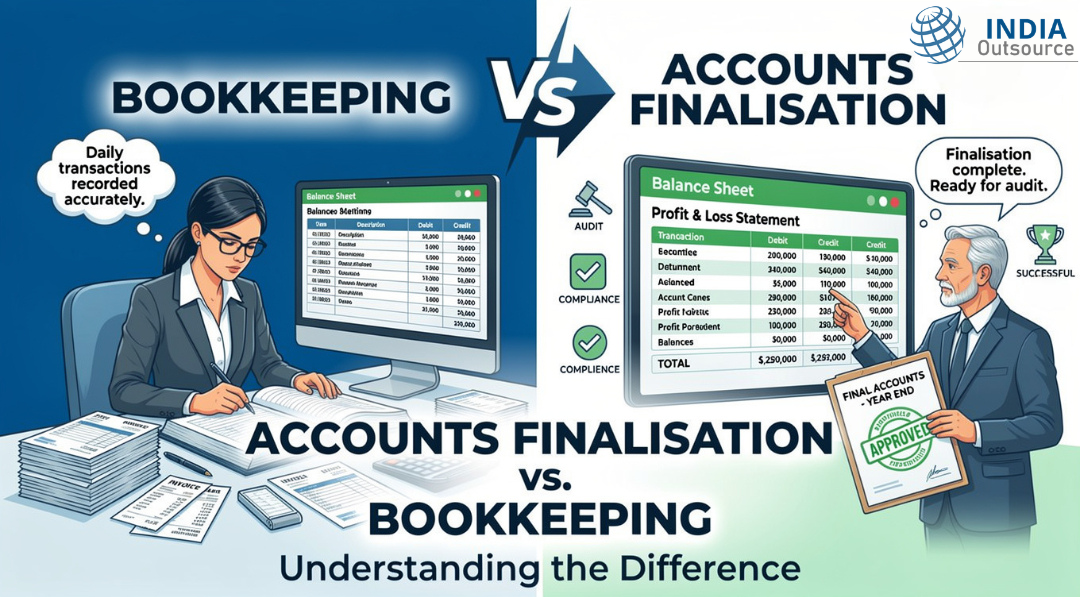
Bookkeeping and Accounts Finalisation may seem to be interchangeable when it comes to dealing with business finances; however, they actually refer to two different areas of finance. Bookkeeping refers to the ongoing process of recording all of your company’s financial transactions each day – as they occur.
Accounts Finalisation refers to the preparation and closing of financial statements in order to accurately represent your company’s financial position (Health). For business owners, entrepreneurs, start-ups, and finance professionals, knowing the differences between bookkeeping and Accounts Finalisation is very important to provide a solid foundation for running your business.
Both of these functions are critical to maintaining proper records and records for businesses, ensuring that you are in compliance with state and federal regulations, making prudent financial decisions and growing your business by attracting investors and providing a timeline that leads to a financially secure future.
In this Guide, we will explain what bookkeeping and Accounts Finalisation are, the differences between bookkeeping and Accrued Expenses, what they do together and why they are both important to your business success.
What is Bookkeeping?
Bookkeeping involves daily, systematic recording, organizing and keeping of a company’s financial records. It is the starting point of accounting process and provides the accuracy of the financial activities.
Key Functions of Bookkeeping
Bookkeepers will keep an eye on several monetary transactions such as:
- Sales and revenue entries
- Purchase transactions
- Expense tracking
- Cash receipts and payments
- Payroll records
- Accounts payable
- Accounts receivable
- Bank reconciliations
- Inventory records
The main purpose of bookkeeping is to keep accurate financial records that are kept up to date for use in financial reporting and analysis.
Importance of Bookkeeping
Good bookkeeping skills enable businesses to:
- Monitor cash flow
- Track income and expenses
- Maintain financial accuracy
- Simplify tax preparation
- Improve budgeting and forecasting
- Ensure regulatory compliance
- Detect financial discrepancies early
Without proper bookkeeping, companies can have difficulties grasping their monetary standing and making decisions.
What is Accounts Finalisation?
Accounts finalisation is the process of preparing the final statements of accounts, making adjustments and reviews at the end of each accounting period. It converts raw bookkeeping information to meaningful financial reporting that represents the organization’s true financial performance and position.
The process typically monthly, quarterly or yearly and is the end of the accounting cycle.
Key Activities in Accounts Finalisation
Accounts finalisation includes:
- Reviewing accounting records
- Adjusting journal entries
- Recording accruals and prepayments
- Depreciation calculations
- Inventory valuation
- Reconciliation of accounts
- Correction of accounting errors
- Preparation of financial statements
The following are common outputs for the final delivery:
- Profit and Loss Statement
Shows the company’s income, expenses, and profitability during a specific period.
- Balance Sheet
Gives a snapshot of a company’s assets, liabilities and equity.
- Cash Flow Statement
Monitors the flow of funds in the company.
- Notes to Financial Statements
Provides supplemental explanations/disclosures for compliance.
Bookkeeping vs. Accounts Finalisation: Key Differences
Although closely connected, bookkeeping and accounts finalisation serve different purposes.
| Aspect | Bookkeeping | Accounts Finalisation |
| Purpose | Record daily transactions | Prepare final financial reports |
| Timing | Continuous process | Period-end process |
| Focus | Data entry and record keeping | Financial reporting and analysis |
| Complexity | Relatively straightforward | More analytical and technical |
| Responsibility | Bookkeeper | Accountant or Finance Professional |
| Output | Financial records | Financial statements |
| Frequency | Daily | Monthly, Quarterly, Annually |
| Decision Making | Provides raw data | Provides actionable insights |
| Compliance | Supports compliance | Ensures regulatory compliance |
| Financial Review | Minimal | Extensive review and adjustments |
How Bookkeeping and Accounts Finalisation Work Together
Bookkeeping and accounts finalisation should not be competitive, it’s complementary!
Bookkeeping is like laying the groundwork for a building; also accounts finalisation builds the building.
Step 1: Recording Transactions
Bookkeepers keep records of all the financial transactions during the accounting period.
Step 2: Maintaining Ledgers
All transactions are classified and recorded in the appropriate accounts.
Step 3: Trial Balance Preparation
Bookkeeping records are used to create a trial balance.
Step 4: Adjustments
Accountants make necessary adjustments for accruals, depreciation, provisions, and corrections.
Step 5: Financial Statement Preparation
Adjusted balances are used in the preparation of final accounts.
Step 6: Financial Analysis
Finalised accounts are used for strategic decision making.
If a business does not have accurate bookkeeping, accounts finalisation can become challenging and prone to errors.
Why Accurate Bookkeeping is Critical for Successful Accounts Finalisation
Poor bookkeeping results in the following:
- Incorrect financial statements
- Tax filing errors
- Compliance issues
- Cash flow mismanagement
- Audit complications
- Financial penalties
Accurate bookkeeping ensures:
- Reliable financial data
- Faster closing processes
- Reduced accounting errors
- Better business insights
- Improved investor confidence
Good bookkeeping is likely to result in smoother and efficient accounts finalisation.
The Accounts Finalisation Process Explained
Let’s take a look at the standard accounts finalisation workflow.
Review of Financial Records
All bookkeeping entries are checked for completeness and accuracy.
Reconciliation of Accounts
Accounts will be checked against supporting documents including:
- Bank statements
- Vendor statements
- Customer records
- Tax records
Adjusting Entries
Adjustments may include:
- Accrued expenses
- Prepaid expenses
- Depreciation
- Amortization
- Bad debt provisions
Inventory Verification
An inventory check is done against accounting records.
Preparation of Final Accounts
The accountant prepares:
- Profit and Loss Statement
- Balance Sheet
- Cash Flow Statement
Management Review
Financial reports are reviewed and approved by management.
Benefits of Professional Bookkeeping Services
There are many reasons why many businesses outsource their bookkeeping to someone who already has the experience in the line of work.
Key benefits include:
Improved Accuracy
Experts minimise mistakes and keep accurate records.
Time Savings
Business owners can concentrate on expansion and not administration work.
Better Financial Visibility
Financial data is updated in real time, aiding in decision making.
Tax Readiness
The records help simplify tax filing and tax audits.
Regulatory Compliance
Professional bookkeeping assists in fulfilling legal requirements.
Benefits of Professional Accounts Finalisation Services
There are many benefits to professional accounts finalisation.
Reliable Financial Statements
Strategic planning is made easier with accurate reports.
Compliance Assurance
Compliance with accounting principles and tax laws.
Audit Preparedness
Audits and inspections will be easier to prepare if the accounts are well prepared.
Enhanced Investor Confidence
Clear financial reporting builds trust among stakeholders.
Business Growth Support
Financial insights enable the identification of opportunities and risks.
Common Mistakes Businesses Make
There are numerous companies that face issues because of the improper financial practice.
Mixing Personal and Business Expenses
This causes confusion and will impact on reporting.
Delaying Transaction Recording
Errors are likely to increase with late entries.
Ignoring Reconciliations
Unreconciled accounts may conceal discrepancies.
Incomplete Documentation
It makes it harder to deal with missing invoices and receipts.
Skipping Adjustments
Not accruing or depreciating can mislead the financial statements.
Technology’s Role in Bookkeeping and Accounts Finalisation
Modern accounting software has transformed financial management.
Popular solutions offer:
- Automated transaction recording
- Bank integrations
- Real-time reporting
- Cloud-based access
- Financial dashboards
- Automated reconciliations
Such technologies enhance bookkeeping efficiency and accounts finalisation accuracy.
When Should Businesses Finalise Accounts?
This can be different based on the business requirements and regulations.
Most businesses finalize accounts:
- Monthly for management reporting
- Requires Quarterly for Performance Review.
- To be reported monthly for management purposes.
Finalisation should be carried out on a regular basis to keep management informed and proactive.
Choosing the Right Financial Partner
No matter if you are a startup, SME, or a big organization, partnering with proficient accounting experts can help you manage your finances better.
Look for providers that offer:
- Bookkeeping services
- Accounts finalisation
- Tax compliance
- Payroll management
- Financial reporting
- Audit support
An all-encompassing financial partner guarantees smooth bookkeeping and final accounts preparation.
Conclusion
The difference between Accounts Finalisation vs Bookkeeping is key to supporting the health of your company’s finances and facilitating business growth. Bookkeeping provides the basis for your financial recordkeeping. Good bookkeeping captures every transaction accurately, while accounts finalisation uses this data to create meaningful financial statements, which support decision making, compliance and growth.
Both processes are essential. Accurate bookkeeping supports easier accounts finalisation, generating reliable financial statements, enabling better management of cash flow and achieving improved business performance.
By placing equal priority on both activities, companies can achieve a competitive advantage by leveraging greater financial transparency, better compliance, and more informed strategic planning.
Ready to Streamline Your Financial Management?
Contact our accounting specialists today
FAQs
1. What is the difference between bookkeeping and accounts finalisation?
Bookkeeping entails the maintaining of the records of daily financial transactions: sales, purchases, and expenses. Account finalisation means checking those records and compiling the financial summaries: profit and loss accounts and balance sheets.
2. Why is bookkeeping important before accounts finalisation?
Bookkeeping provides the financial information needed to complete accounts. By keeping proper books, you can produce financial reports that are accurate, credible, and free of major errors.
3. What documents are prepared during accounts finalisation?
Account finalisation typically includes preparing the profit and loss statement, cash flow statement, balance sheet, trial balance, and attached financial disclosures.
4. Can a business perform accounts finalisation without bookkeeping?
No. Accurate bookkeeping records are necessary for accounts finalisation. If the books are not properly maintained, they will be difficult to use to prepare accurate financial statements.
5. How often should accounts be finalised?
Typically, Businesses will finalize accounts based on their management needs; either monthly, quarterly or annually; factoring in tax requirements, and regulatory obligations.
6. Who is responsible for bookkeeping and accounts finalisation?
Primarily, a bookkeeper or accounting personnel performs bookkeeping duties and an accountant, financial manager, or accounting professional performs account finalisation duties.
7. What are the benefits of professional bookkeeping services?
Professional bookkeeping provides increased accuracy, tracks cash flow, decreases errors, simplifies tax preparation, and increases financial visibility which facilitates making better decisions.
8. What are the benefits of accounts finalisation?
Through finalizing accounts a company can understand its financial performance, comply with local laws and regulations, prepare for an audit, prepare themselves to attract potential investors and ultimately help them make good strategic business decisions.
9. Is accounts finalisation part of accounting?
Yes. Accounts Finalisation is an integral part of the accounting process that involves reviewing, adjusting and reconciling financial statements in accordance with the rules and regulations in order to prepare official financial statements.
10. How do bookkeeping and accounts finalisation contribute to business growth?
The process of bookkeeping assists in maintaining accurate financial records; while finalizing accounts provides insight through generated financial report(s). These components of bookkeeping, accounts finalization, input to budgeting, planning, compliance and ultimately supporting growth.